
By Colleen Goko


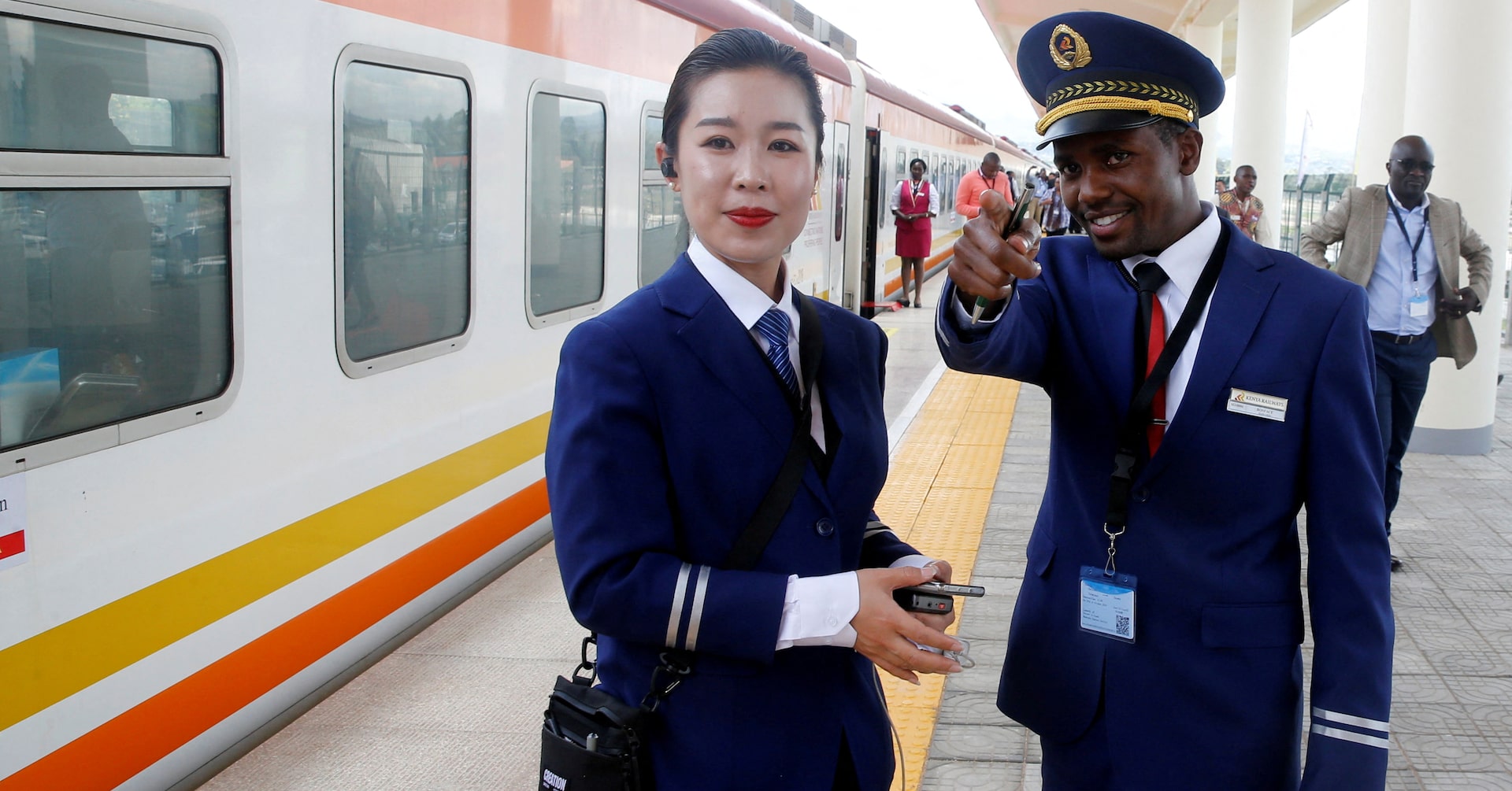
Item 1 of 4 Kenya Railways attendants talk next to a train along the Standard Gauge Railway (SGR) line constructed by the China Road and Bridge Corporation (CRBC) and financed by Chinese government in Ongata Rongai, Kenya October 16, 2019. REUTERS/Thomas Mukoya/File Photo
[1/4] Kenya Railways attendants talk next to a train along the Standard Gauge Railway (SGR) line constructed by the China Road and Bridge Corporation (CRBC) and financed by Chinese government in Ongata Rongai, Kenya October 16, 2019. REUTERS/Thomas Mukoya/File Photo Purchase Licensing Rights , opens new tab
JOHANNESBURG, Oct 10 (Reuters) – Developing nations are now paying more to service debt owed to China than they receive in new loans, a shift that risks deepening economic strain and slowing climate investment, a report released on Friday by Boston University’s Global Development Policy Center found.
The study, titled Reviving Chinese Development Finance in the Global South, revealed that net debt transfers—calculated as new loan disbursements minus principal and interest repayments—turned negative in 2022 and 2023, with developing nations repaying $3.9 billion more annually than they borrowed.
China, the world’s largest bilateral creditor, has historically played a key role in financing infrastructure projects across the Global South, committing over $472 billion through its policy banks—the China Development Bank and Export-Import Bank—between 2008 and 2024.
These funds supported more than 900 projects worth $316 billion in transport, energy, information technology, and water infrastructure, which “significantly contributed to public asset building, economic growth and poverty alleviation in the Global South,” authors Rebecca Ray, Kevin Gallagher, Zheng Zhai, Marina Zucker-Marques, and Yan Liang wrote in the study.
A revival by Beijing to overseas development finance could avoid derailing growth and climate investment across poorer nations.
“Countries across the Global South are in urgent need of a stepwise increase in financing to invest in low-carbon, socially inclusive and resilient economic growth,” the authors said.
The paper proposed five steps which would be mutually beneficial for China and the Global South: refinancing loans in distress, issuing RMB-denominated bonds, expanding green lending, supporting cooperative foreign investment and boosting South–South trade.
“Restarting growth-enhancing development finance in the Global South will help spur demand for Chinese exports,” they said.
Some of this is already happening. In June, China said it was making progress on removing all tariffs on the African states with which it has diplomatic ties.
Afreximbank launched its debut yuan denominated panda bond in April. In South Africa, the China-Africa Development Fund is preparing to bid for independent energy transition projects in Africa’s most industrialized economy.
And in Kenya, Finance Minister John Mbadi said this week that three Chinese railway construction loans have been converted from dollars to yuan to save on interest costs.
Discover more from The Who Dat Daily
Subscribe to get the latest posts sent to your email.



OUTLAW CHEMICAL FREE SOAPS AND NATURAL BODY PRODUCTS!


Tulane College Sports
Tulane vs. South Alabama Preview: Green Wave Seek Week 2 Rebound

New Orleans Saints News
Saints Free $10.3M! Ruiz & Godchaux Restructures Explained | PODCAST

Sports News & More
Why Jared Goff Is Underrated and Dangerous

Sports News & More
Here’s the Saints vs Lions Week 1: Keys to Victory & Score Predictions!

New Orleans Saints News
Saints Add 12 Players to Practice Squad as New Orleans Continues Roster Moves

New Orleans Saints News
Saints Trade for Zamir White as RB Injuries Mount

New Orleans Pelicans News
Pelicans Sign Bennedict Mathurin to 2-Year, $16M Deal

New Orleans Saints News
Saints Looking for WR Help: Four Receivers Work Out Before Lions Opener