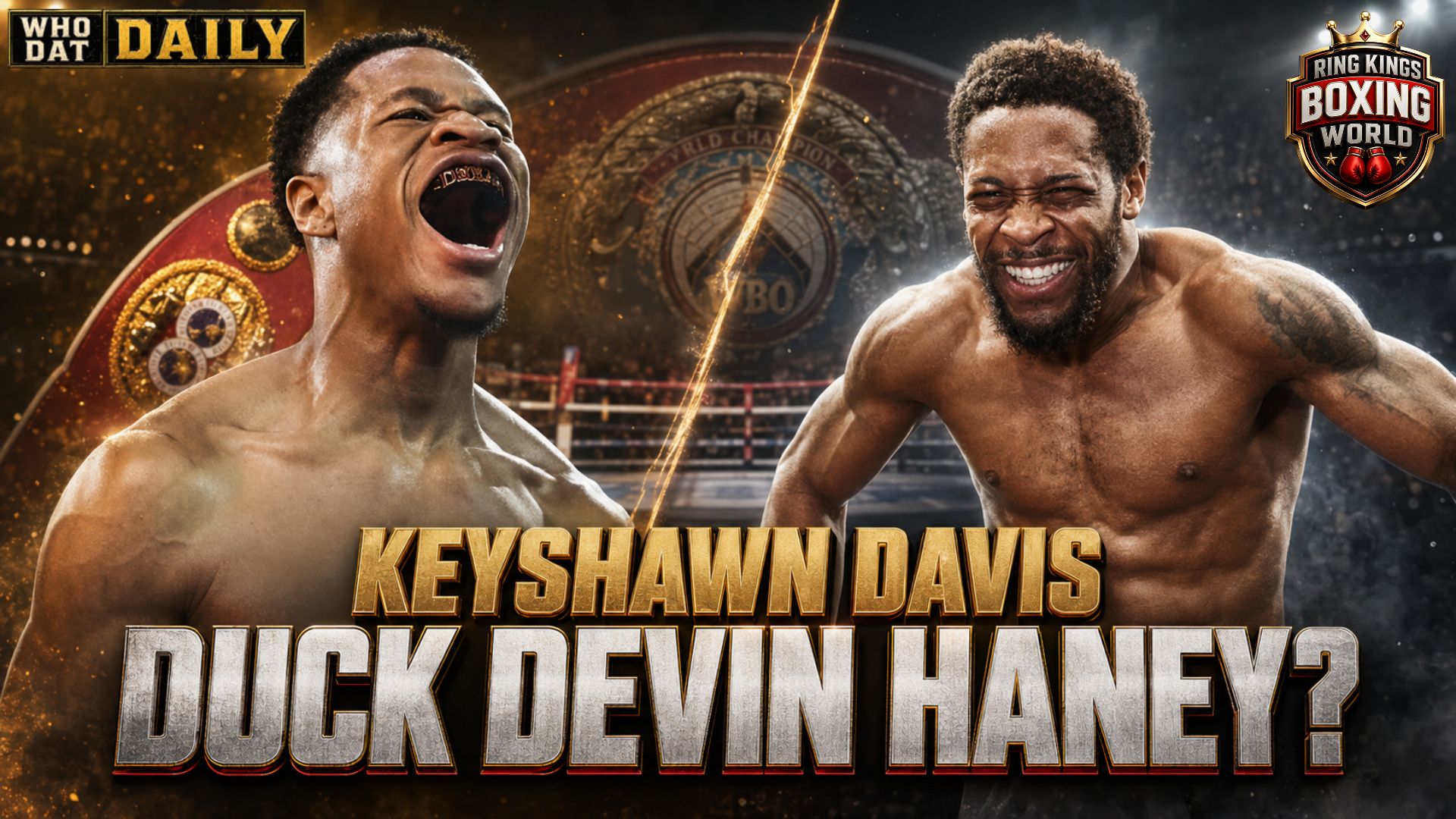

By Gee Bino | The Who Dat Daily
Keyshawn Davis spent months positioning himself as one of the young fighters willing to challenge boxing’s established names. When the WBO ordered him to face welterweight champion Devin Haney, the sport appeared ready to reward that ambition with a major title fight.
Then the purse bid arrived—and Davis walked away.
The WBO announced Friday that Davis had withdrawn from the ordered championship bout after rejecting the mandatory challenger’s 25 percent share. Top Rank won the promotional rights with an $8.55 million bid, which would have paid Haney approximately $6.41 million and Davis roughly $2.14 million. The fight had been targeted for October 3.
That decision immediately produced the question boxing fans were always going to ask: Did Keyshawn Davis duck Devin Haney?
The honest answer requires some nuance. Davis may view his withdrawal as a business decision, but after calling for the champion and receiving a seven-figure title opportunity, he has earned every bit of the criticism coming his way. Until his team provides a stronger explanation—or secures a comparable fight—the move looks like a duck.

The Opportunity Davis Turned Down
This was not a speculative matchup discussed only on social media. The WBO ordered the fight, the negotiation period expired, and the matter advanced to an official purse bid.
Top Rank, which represents Davis, submitted the winning offer of $8.55 million. Takeover Promotions reportedly entered the only competing bid at $2.35 million. Under the WBO’s standard 75-25 championship split, Haney was entitled to $6,412,500 while Davis would have received $2,137,500.
For Davis, that meant a guaranteed multimillion-dollar purse, a shot at an undefeated three-division champion and an opportunity to claim the WBO welterweight title. It also offered something money alone cannot purchase: the chance to change his standing in boxing overnight.
Davis declined.
The WBO said it will refer the matter to its Championship and Ratings committees for a ruling under the organization’s regulations. Davis could lose his mandatory position, while Haney may receive a new challenger.
Why the “Duck” Accusation Has Real Weight
Boxing fans often use the word “duck” too casually. A failed negotiation does not automatically prove fear. Promotional conflicts, broadcast rights, rematch clauses and purse demands can destroy legitimate fights.
However, this situation is harder to defend because most of those obstacles had already been cleared.
There was an official order. There was a winning bid. There was a proposed date. There was a guaranteed purse exceeding $2 million. Most importantly, Davis had openly pursued Haney and presented himself as willing to test the champion.
Once the opportunity became real, he rejected it.
That does not prove Davis was physically afraid of Haney. Professional fighters routinely accept risks that most people would never consider. Yet “ducking” in boxing usually describes the avoidance of an available competitive challenge—not literal fear. By that practical definition, Davis’s decision fits unless his camp can demonstrate that the financial or contractual conditions were genuinely unreasonable.
Was the 25 Percent Split Unfair?
Davis’s strongest defense is economic. He may believe his drawing power, amateur pedigree and promotional momentum made him worth more than 25 percent. Perhaps his team expected a purse closer to $3 million or wanted a negotiated structure that included additional upside.
That argument is understandable. It is not completely persuasive.
The 75-25 division was not a surprise inserted at the last moment. It reflected the WBO’s champion-versus-mandatory framework. Haney entered as the reigning titleholder and the more accomplished professional. He has won world championships at lightweight, junior welterweight and welterweight. Davis was the challenger moving into a new division.
Moreover, $2.14 million represented substantial guaranteed compensation for a fighter with 15 professional victories and no established pay-per-view résumé. A victory would have delivered the championship, greater negotiating leverage and access to much larger purses afterward.
Davis had every right to decide the reward did not justify the risk. Fans have the same right to conclude that he valued his market position more than the opportunity to prove his claims.

Film Room: Why Haney Presented a Difficult Puzzle
The matchup was compelling because it placed Davis’s explosive offense against Haney’s disciplined control.
Davis brings quick hands, sharp combination punching and dangerous counters. He can pressure behind a compact guard, attack the body and punish opponents who remain stationary. His athleticism would have allowed him to close distance faster than many of Haney’s previous opponents.
Haney, however, owns the advantages that become especially important at welterweight. He is the naturally established 147-pound champion, controls range with a long jab and understands how to manage rounds. His footwork, clinch awareness and ability to disrupt an opponent’s rhythm could have forced Davis to reset repeatedly.
Davis would not simply have needed to land the harder punches. He would have needed to cut off the ring, win the lead-hand battle and prevent Haney from turning the contest into a controlled tactical fight. It was a high-risk assignment, particularly for Davis’s first championship appearance at welterweight.
That competitive difficulty is exactly why withdrawing creates suspicion. Beating Haney would have validated Davis as an elite fighter. Losing could have slowed his momentum and weakened his negotiating power.
What Davis Must Do Next
The next move will determine whether this becomes a temporary controversy or a lasting stain on Davis’s reputation.
If Davis quickly secures another elite opponent for comparable money, his business explanation will gain credibility. A fight against a leading contender or another world champion would show that he rejected the split—not the danger.
If he returns against a lesser opponent for a smaller purse, the criticism will intensify. It would be difficult to justify abandoning a $2.14 million title shot only to accept less money and less competitive significance.
Davis and his team also need to explain their valuation. What purse would have been acceptable? Did the contract contain obligations beyond the WBO split? Was there backend participation? Did the proposed date or venue create a problem? Without specific answers, “business decision” becomes a convenient shield instead of a convincing explanation.
Big Q’s Take: The Optics Are Terrible
This is one of those moments when boxing’s business collides with its competitive spirit.
Keyshawn Davis is entitled to protect his financial interests. Still, you cannot repeatedly call for a champion, receive an ordered title fight, get offered more than $2 million and then expect the public to ignore your withdrawal.
The opportunity was real. The money was real. The belt was real.
Was Davis scared of Devin Haney? There is no evidence that anyone outside his camp can use to make that personal judgment. Did he avoid an available and dangerous fight because the guaranteed reward did not meet his price? Based on the information available, yes.
In boxing language, that is close enough for the “duck” label to stick.
Why It Matters
Boxing suffers whenever the sport’s most attractive matchups collapse after reaching the finish line. Haney needed a credible challenger. Davis needed the defining victory that could elevate him from rising star to championship attraction. The WBO created a path, and Top Rank supplied the money.
Now both fighters must pivot. Haney awaits the WBO’s next ruling, while Davis faces a reputational test that may be more difficult than any opponent he has encountered.
The only effective response will come inside the ring. Davis must pursue a fight dangerous enough—and valuable enough—to prove this withdrawal was about his price rather than his confidence.
Until then, the criticism is fair.
Gee Bino is a senior writer and columnist for The Who Dat Daily, covering the New Orleans Saints, Pelicans, LSU athletics, boxing, and the Gulf South sports landscape. He specializes in roster construction, player development, salary cap strategy, breaking news coverage, and combat-sports analysis.
Discover more from The Who Dat Daily
Subscribe to get the latest posts sent to your email.






New Orleans Saints
Kelvin Banks Jr. Injury: Saints Options & Ravens Takeaways


LSU Football News
LSU Drops to No. 10 in Week 4 AP Poll After Ole Miss Loss


New Orleans Saints News
Saints Looking for WR Help: Four Receivers Work Out Before Lions Opener

New Orleans Saints News
Saints vs. Lions Preview: Five Keys to a Week 1 Win in Detroit

New Orleans Saints News
Saints News: Thursday Practice Updates & Coordinator Pressers | Big Q