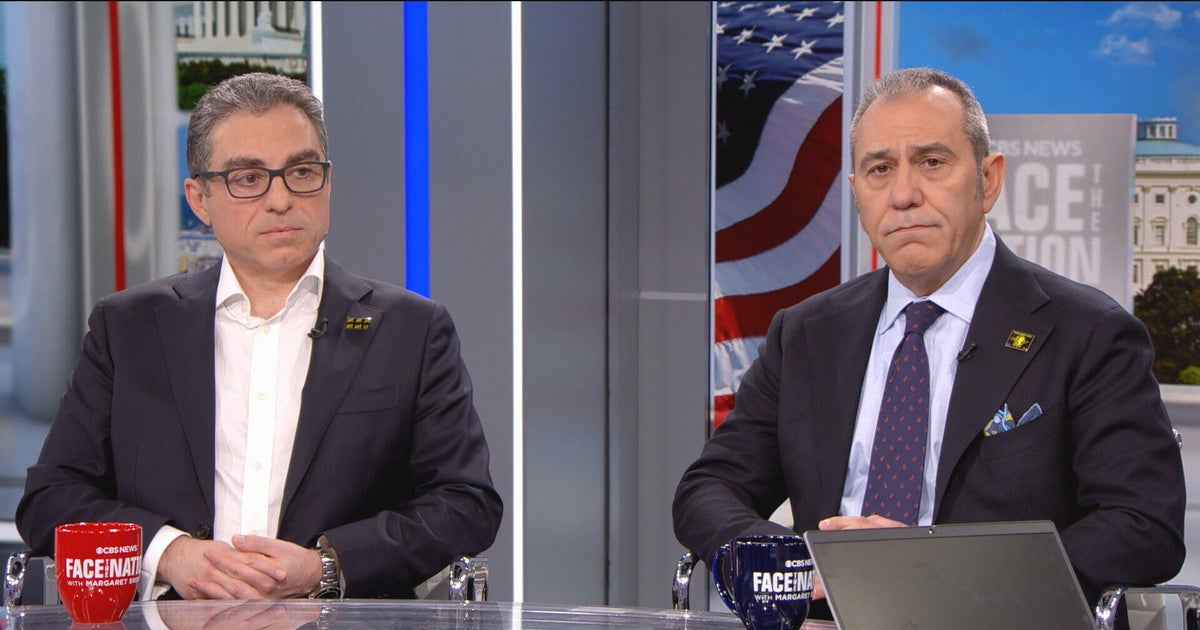
Former Iran detainee Siamak Namazi says he’s worried about the handful of Americans known to be held inside Iranian prisons as the U.S. war in Iran continues. “They are the easiest-to-grab punching bag right now in the hands of that rogue regime,” he said during a panel discussion with “Face the Nation with Margaret Brennan.” “I think this is a dangerous time,” said Namazi. He added, “For a hostage or wrongfully detained citizen abroad, their biggest fear is to be forgotten, and this is a very dangerous time for them, with all that’s going on in Washington’s mind.”Namazi was detained in Iran’s notorious Evin prison in 2015 after almost eight years of captivity, the longest-held American prisoner to be released from Iran. The State Department determined that he had been wrongfully detained.Emad Shargi, who was held in Iran for five years, recalled being in the Evin prison in October 2022, as massive anti-government protests seized the country. Mahsa Amini, 22, had been arrested for allegedly wearing a hijab incorrectly and died in police custody. Authorities said she had a heart attack, but her family said police beat her to death. Shargi said it’s a “very uncomfortable situation” inside the prison when there’s unrest outside. “Whenever there is an issue taking place in Iran, the walls of Evin are like an amplifier,” Shargi said. “So, when there’s a ripple outside in the society, there’s a tidal wave inside.” He recalled a fire inside the prison, and an influx of new prisoners related to the protests.Shargi and Namazi were among five U.S. citizens who were freed in 2023 in a high-stakes, complex diplomatic deal brokered between Iran and the Biden administration that included the transfer of $6 billion in unfrozen Iranian oil assets and the release of five Iranians facing charges in the U.S. At the time, a senior administration official said the deal “does not change our relationship with Iran in any way. Iran is an adversary and a state sponsor of terrorism.”Namazi said he was “confident” if President Trump and his administration knew “there are Americans sitting in Evin prison,” they would “put that on the agenda” amid the ongoing war. “I think it’s important that he hears that there are innocent Americans being held like we were — as political pawns,” said Namazi.Shargi agreed, saying that he couldn’t “imagine if President Trump knew their names and knew these cases, they wouldn’t be one of the priorities.””I personally think that there will be a time soon because all wars end with some form of diplomacy,” Shargi said. “So, I would implore President Trump to make sure that part of those negotiations that will be coming up is bringing our people home.” There are at least four Americans currently detained in Iran. Two of them — Reza Valizadeh and Kamran Hekmati — have been designated by the U.S. government as “wrongfully detained.” Both are believed to be held in Evin prison. Namazi and Shargi spoke on a panel with Shargi’s sister, Neda Sharghi, American hostage negotiator Roger Carstens and Margaret Brennan Thursday, as Defense Secretary Pete Hegseth said the “largest strike package yet” was coming in Iran. “Our American hostages, whether they’re in Iran or in Venezuela, is that they always become a hostage to other bigger, broader political issues,” Neda Sharghi said. She said Americans “need to convince our government to separate them from what’s going on and find a creative solution, like we did to get Emad and Siamak home.”Carstens, who served as the U.S. special envoy for hostage affairs in both the first Trump and the Biden administrations, told Brennan he doesn’t know whether the detained Americans were raised during the negotiations with Iran led by special envoy Steve Witkoff and the president’s son-in-law Jared Kushner. He said that when he was negotiating to bring Shargi and Namazi home, “we were very cognizant of the connection between the nuclear talks and that of the prisoner talks, because if the nuclear talks suddenly fail very horribly, the prisoner talks could be pulled down with it.” Carstens said the U.S. tried to keep the ties between the detainees and the nuclear talks less intertwined, “to maybe just have a dotted line between the two issues, but not link them too tightly together.””We were very practical about how close those issues got together, and we wanted the flexibility to separate them if we wanted to,” Carstens said. He acknowledged that for the regime, the nuclear issue and detainees are “much more married close together.” But Carstens said that might not be the case for the Americans: “If Witkoff and Kushner were trying to articulate an end to a nuclear issue, how close will they push it together? Practically, it may not be that close, depending on where they feel they are with the Iranians.”