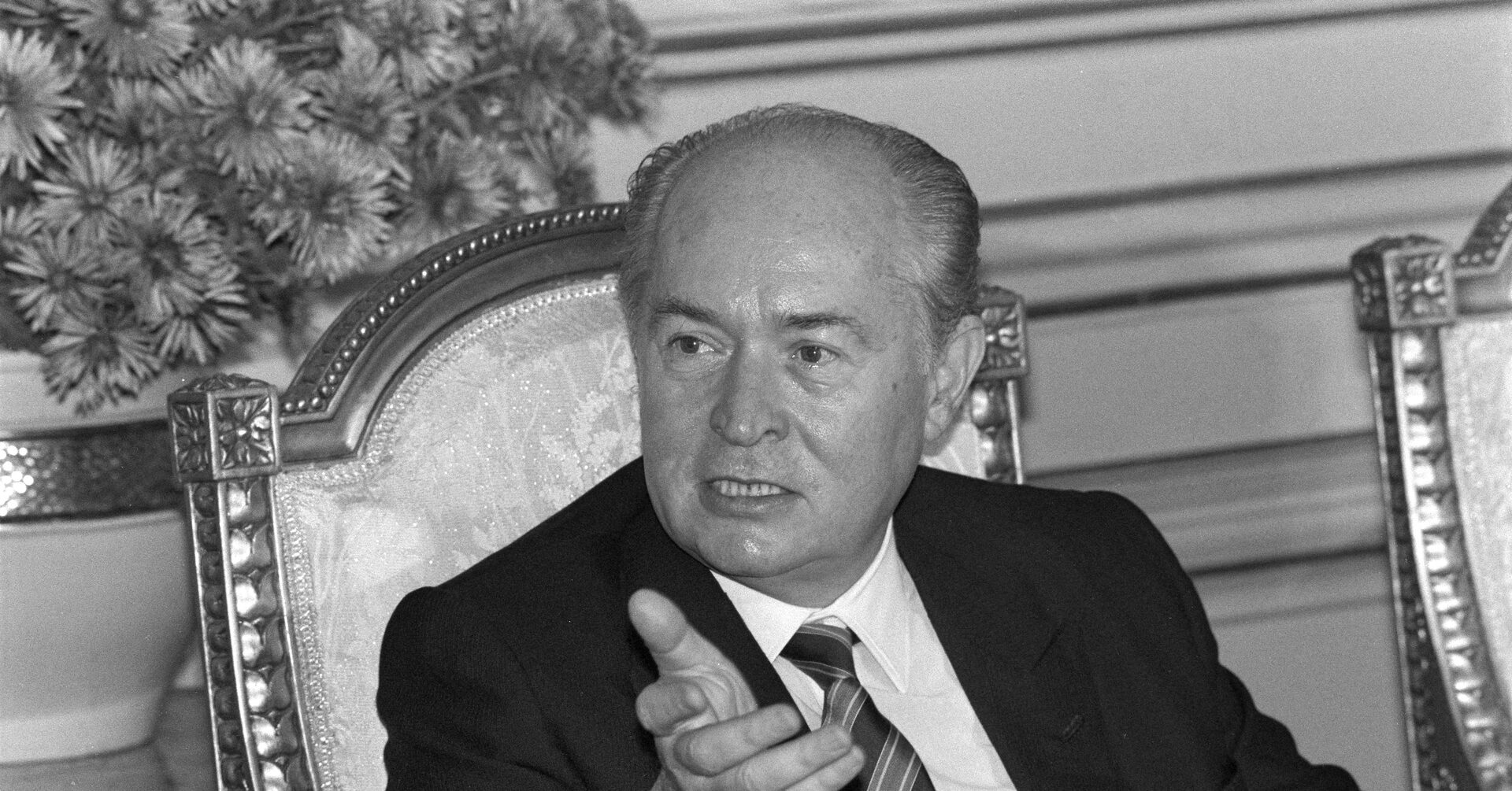


Cypriot President George Vassiliou speaks at a press conference about improving trade relations between Cyprus and Egypt in Cairo on November 22, 1989. REUTERS/Aladin Abdel-nabi 90001033/File Photo Purchase Licensing Rights , opens new tab
NICOSIA, Jan 14 (Reuters) – Former Cyprus President George Vassiliou, who died on Wednesday aged 94, once risked arrest in Cold War Hungary smuggling a banned political manifesto past the Iron Curtain.
In 1956, as Soviet tanks crushed a popular uprising in Budapest, he agreed to carry to the West the document, one of the anonymous “Hungaricus” pamphlets that gave the outside world its first uncensored accounts of the crackdown.
“I read it, agreed with what was written, and said I would gladly take it,” Vassiliou, who was president of Cyprus between 1988 and 1993, later recalled.
“And I was lucky because nobody noticed I took it.”
That early act of defiance helped shape the reformer who would later lead Cyprus toward Europe’s political mainstream and out of post-colonial uncertainty, helping to turn the former British island colony into a member of the European Union.
Vassiliou died in hospital aged 94, his wife Androulla said on X on Wednesday, adding, “He passed away peacefully in our arms.” The couple had been married for 59 years.
‘AN INTERESTING FELLOW’
Vassiliou was born in Cyprus in 1931 to parents who were both doctors and die-hard Communists who went wherever their cause would take them.
He initially enrolled in medical school in Geneva, and then Austria. But funds ran out when his father left a lucrative practice in Cyprus to join the communists in the Greek civil war that ran from 1946 to 1949.
Vassiliou moved to Budapest to be closer to his mother and younger sister, who were caught up in the tumult after that war, which stranded tens of thousands of partisans in Eastern Europe, barred from returning to Greece.
His father found himself in Albania, with the route through then-Yugoslavia shut after a fallout between Josip Tito, its prime minister at the time, and Soviet leader Joseph Stalin.
In Hungary, Vassiliou became an interpreter for Greek political refugees, got a part-time job in an aluminium factory and gave up on medicine, to his father’s chagrin. He enrolled instead at the capital’s Karl Marx University of Economics.
“I was a handsome young man who had lived in the West, a Cypriot (thus a British subject) who spoke French, German, English — an interesting fellow,” Vassiliou reminisced to Hungary’s Oral History Archive.
“The communists befriended me because I was a Greek refugee; the aristocrats because I was a British subject; the (women) because I was good-looking and well dressed.”
Vassiliou chose to study economics because he wanted to “be a planner to design the new world”.
IDEALISM CRUSHED
He moved among activists disillusioned with Stalinism and attended lectures by philosopher Gyorgy Lukacs, whose reading of Marxism departed from rigid Soviet philosophy.
Vassiliou was present during the 1956 Hungarian uprising, a nationwide revolt against Soviet-backed communist rule sparked by student protests and calls for political reform.
It was crushed within weeks when Soviet tanks entered Budapest, killing hundreds and forcing about 200,000 people to flee the country.
Vassiliou brought the confidential pamphlet to Paris at his friends’ request.
The risks were high.
Historians drawing on secret police files, court records and survivor testimony have shown that the underground networks behind such documents were met with harsh reprisals.
Hundreds of people involved in illegal printing and information smuggling were jailed, with many more arrested, interrogated, or subjected to long-term surveillance.
Vassiliou was held for two days when he returned to Hungary in 1959, and not allowed to leave the country for a year.
He later surmised that he escaped jail because he was a foreigner, or because authorities mistook him for the son of a high-ranking party official.
“The crushing of my youthful idealism by the tanks taught me that what was preached, and what was done, diverged,” Vassiliou said, reflecting on the events of 1956. “Since then I have never been a member of any party.”
A LIBERAL BACKED BY COMMUNISTS
A liberal who founded market research firm MEMRB in Cyprus in 1971 and grew it into one of the biggest in the Middle East, Vassiliou was a lone figure when he declared his bid for the presidency of the eastern Mediterranean island in 1987.
A year later, he won unexpected support from Cyprus’s influential communist AKEL party.
His credentials, as the son of Communists, helped. Yet it was known that Vassiliou did not subscribe to that ideology.
Two internal reports compiled by AKEL addressed to sister Communist parties in Greece and then-Czechoslovakia labelled him an “anticommunist, anti-Soviet and a revisionist”, Cyprus’s Alithia newspaper said in 1994, citing a former AKEL official.
In his memoir “Reflections on the Past and Future”, Vassiliou wrote that AKEL threw its weight behind him after its leadership found pictures of their preferred candidate wearing the garments of Freemasons.
That dealt a blow to the Communists, who viewed Freemasons as classists.
‘TOO MUCH SELF-CONFIDENCE’
In the 1988 election, Vassiliou inched to victory over conservative-backed Glafcos Clerides, although the latter would go on to defeat him in an election runoff in 1993.
In later life, Vassiliou would rue his arrogance: “I was sure I would be re-elected … it turned on me in the end because too much self-confidence isn’t always good,” he told Greece’s Kathimerini newspaper in 2017.
His election to the presidency shook up the stale world of Cypriot politics, ushering in more scrutiny and accountability.
He travelled widely to meet any prominent personality who would hear him out over Cyprus’s division between Greek and Turkish Cypriots.
A marketing man through and through, he became known for his brisk, two-handed handshake, which Cypriots nicknamed “kappakoti” (“to cup”) in their vernacular.
At home, he cut taxes to stamp out tax evasion and sent in police to demolish illegal shacks along the pristine coastline, along which he later built a palatial mansion, for use as a private residence.
‘ETERNAL OPTIMIST’
He also clashed with entrenched bias. In his failed bid for re-election in 1993, Vassiliou said he and his wife would be honoured to return to the office. Opponents said it was inappropriate to have mentioned her.
A politician in her own right, his wife Androulla Vassiliou was an EU Commissioner for health, then education and youth from 2008 to 2014. They had three children.
Under his watch, Cyprus was the first non-EU member state to apply and peg its currency, the Cyprus pound, to the precursor of the euro, the European Currency Unit (ECU), in 1992.
It was Vassiliou’s administration that applied for Cyprus’s membership in the EU in 1990, and he was chief negotiator for joining the bloc between 1998 and 2003. Cyprus eventually entered the EU in 2004, and adopted the euro in 2008.
As president, Vassiliou created the island’s first state university. Upon leaving the presidency, he launched the liberal United Democrats party, which fared poorly in elections, however.
Unlike other Greek Cypriot politicians, Vassiliou was steadfast in his support of a United Nations reunification blueprint for Cyprus in 2004. But that plan was rejected by fellow Greek Cypriots in a referendum.
A self-proclaimed “eternal optimist”, he died never having fulfilled his ambition of ending the division of Cyprus between its Greek and Turkish Cypriot populations, a simmering conflict that is a permanent drag on ties between NATO partners Greece and Turkey.
“The tragedy of Cyprus is between what is desired and what is possible,” he once said.
Our Standards: The Thomson Reuters Trust Principles. , opens new tab
Suggested Topics:
Read Next
ago World category
ago Europe category
ago Europe category
ago Europe category
Tehran has warned U.S. allies in the Middle East it will strike U.S. bases on their soil if Washington attacks Iran, a senior Iranian official told Reuters on Wednesday, following President Donald Trump’s threats to intervene in support of protesters.
Site Index
About Reuters
Stay Informed
Information you can trust
Reuters, the news and media division of Thomson Reuters, is the world’s largest multimedia news provider, reaching billions of people worldwide every day. Reuters provides business, financial, national and international news to professionals via desktop terminals, the world’s media organizations, industry events and directly to consumers.
OUTLAW CHEMICAL FREE SOAPS AND NATURAL BODY PRODUCTS!

PPR MERCH HERE NOW! CLICK THE AD TO SHOP!!!