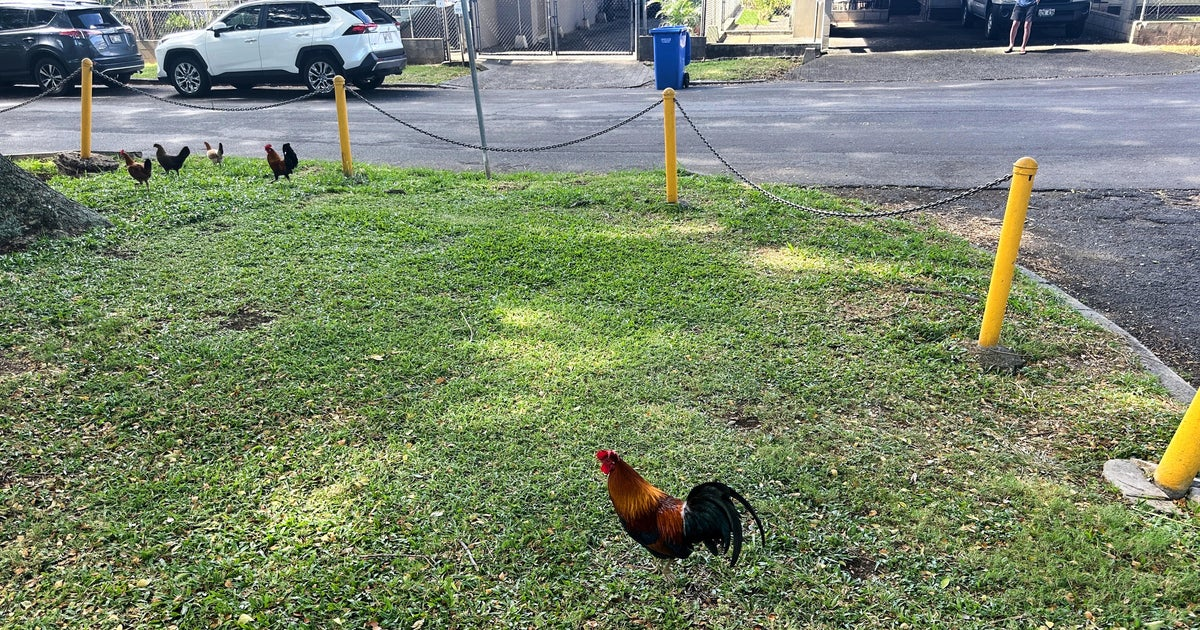
Honolulu — The crowing starts well before the sun rises over Mason Aiona’s home in Hawaii.But the 3 a.m. rooster alarm isn’t what bothers the retiree the most. It’s spending most of the day shooing away wild chickens that dig holes in his yard, listening to constant squawking and feather-flapping, and scolding people who feed the feral birds at a park steps from his house. “It’s a big problem,” he said of the roosters, hens and chicks waddling around on the narrow road between his Honolulu house and the city park. “And they’re multiplying.” Communities across the state have been dealing with pervasive fowl for years. Honolulu has spent thousands of dollars trapping them, to little avail. Now state lawmakers are considering possible solutions – including measures that would let residents kill feral chickens, deem them a “controllable pest” on public land in Honolulu, and fine people for feeding them or releasing them in parks.But one person’s nuisance is another’s cultural symbol, a dynamic that has also played out in Miami and some other cities with populations of wild chickens. Kealoha Pisciotta, a Hawaiian cultural practitioner and animal advocate, disagrees with killing feral chickens simply because they’re a nuisance. Some chickens today descended from those brought to the islands by early Polynesian voyagers, she said. “The moa is very significant,” she said, using the Hawaiian word for chicken. “They were on our voyaging, came with us.” The Hawaiian Humane Society opposes letting residents kill the chickens “as a means of population control unless all other strategies have been exhausted.” Rep. Scot Matayoshi, a Democrat representing the Honolulu suburb of Kaneohe, said he started crafting chicken control legislation after he heard from an elementary school teacher in his district that the birds were harassing the pupils.”The children were afraid of them, and they would kind of more aggressively go after the children for food,” Matayoshi said. Rep. Jackson Sayama said he introduced the chicken-killing bill because there are currently limited ways to get rid of them. The lethal method would be at the resident’s discretion. “If you want to go old-school, just break the chicken’s neck, that’s perfectly fine,” said the Democrat who represents part of Honolulu. “There’s many different ways you can do it.” Chicken eradication bills have failed over the years, Matayoshi said. Chicken birth control was an idea discussed when he was on a neighborhood board. “I think there are people who are taking it more seriously now,” he said. For more than 30 years, Aiona, 74, has lived in a valley near downtown Honolulu in a house his wife Leona grew up in. Wild chickens didn’t show up in their neighborhood until about a decade ago, they said. The birds proliferated during the COVID-19 pandemic. He once saw a man take a chicken out of his car, leave it in the park and drive away, he said. When the chickens first appeared outside his home, he caught one with his bare hands and put it in a plastic trash can, then drove it to a park near the airport. “I took off the cover, tipped it over and the chicken ran right out,” he said. “I said … ‘Don’t come back again.'” But he quickly realized the time-consuming effort was futile. He’s personally not interested in killing chickens, preferring for someone to scoop them up and take them to a rural farm. A city trapping program is too expensive, he said. The city contracts with a pest-control company that traps chickens. A weeklong service costs a private property owner $375, plus a $50 cage rental fee and disposal fee of $10 per chicken. More than 1,300 chickens were caught through the program last year, said Honolulu Department of Customer Services spokesperson Harold Nedd, who added the department also saw a 51% increase in complaints about feral chickens in 2025. Wild chickens aren’t likely to make a cheap dinner. The meat is tougher than poultry raised for harvesting, and the feral birds can be a vector of disease. One of Aiona’s neighbors shoos them with a leaf blower. “I have a blower, too, but mine is electric,” Aiona said. “It can only go so far with the cord.” Aiona has grown tired of spending his retirement telling park-goers to stop feeding the chickens. And while he doesn’t recommend that anyone eat them, he welcomes anyone who wants one to come get it.