
Gee Bino | The Who Dat Daily
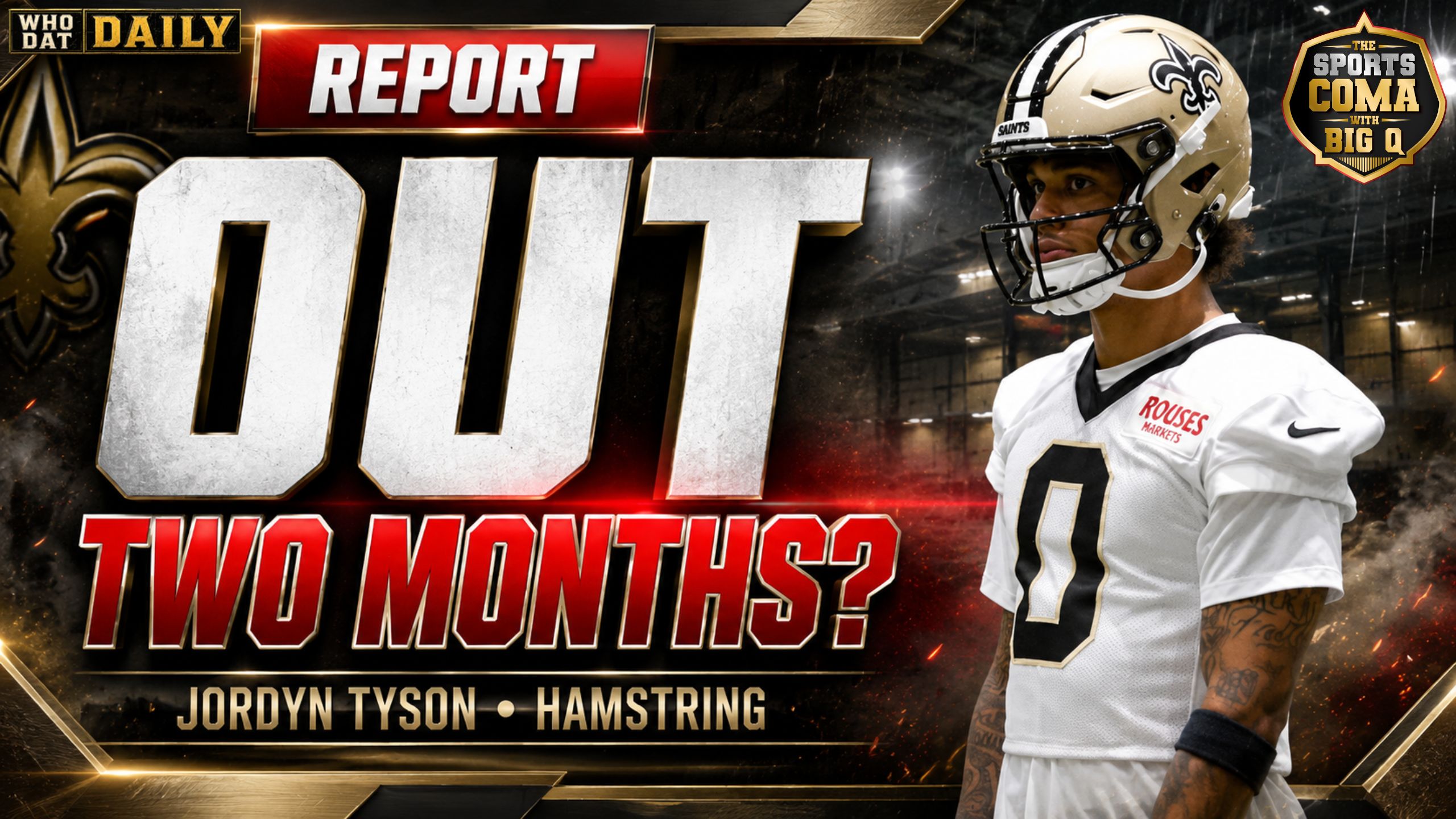
The Jordyn Tyson hamstring injury is reportedly much more significant than the New Orleans Saints initially hoped.
NFL Network reporters Ian Rapoport and Mike Garafolo reported Monday that Tyson could miss the next two months with the right hamstring injury he suffered during a joint practice against the Jacksonville Jaguars. The Saints have not publicly announced a firm return date, so the reported timeline should be treated as an estimate rather than a guaranteed recovery schedule.
Still, the news represents a major early setback for New Orleans. The Saints selected Tyson eighth overall in the 2026 NFL Draft and expected him to play an immediate role opposite Chris Olave. Instead, their prized rookie could miss the remainder of the preseason and a meaningful portion of the regular season.

What Happened to Jordyn Tyson?
Tyson suffered the injury during the Saints’ August 13 joint practice with Jacksonville. He caught a crossing route near the sideline, lost his footing and landed awkwardly while being contacted from behind.
Tyson remained on the ground briefly before trainers evaluated him. He eventually jogged off the field, which initially created hope that the injury was minor. Head coach Kellen Moore later described the play as an unfortunate football accident and said the issue was not a re-aggravation of Tyson’s previous hamstring injury.
Moore also declined to provide a firm timeline while the rookie underwent additional testing and sought medical opinions. The first public reports described the injury as not overly serious. However, a possible two-month absence changes the practical impact considerably.
Tyson will now need time for the injured tissue to heal before beginning a gradual return-to-play program. That process usually includes straight-line running, acceleration work, cutting, route running and eventually full-speed practice. The Saints have every reason to avoid rushing their first-round investment.
What a Two-Month Timeline Could Mean
Two months from the August 13 injury would place Tyson’s approximate return in the middle of October. That does not mean he will automatically play at that point.
The Saints open the regular season September 13 at Detroit. They then visit Baltimore before hosting Las Vegas, Atlanta and Minnesota. New Orleans travels to face the New York Giants in Week 6 on October 18 and plays Pittsburgh in Paris the following week. The official NFL schedule confirms that challenging opening stretch.
If the reported estimate holds, Tyson could miss the first five regular-season games and potentially more. Week 6 would represent only an approximate target window. His actual return will depend on how his hamstring responds when the Saints increase his workload.
That distinction matters. Medical clearance does not immediately equal game readiness, especially for a wide receiver who relies on explosive acceleration, sudden deceleration and sharp directional changes.
Why the Injury Is Especially Concerning
This injury is new, according to Moore, but Tyson’s broader medical history makes caution unavoidable.
Tyson dealt with hamstring trouble during his final season at Arizona State. He recorded 61 receptions for 711 yards and eight touchdowns despite missing three regular-season games. He also encountered another hamstring issue during the pre-draft process that prevented him from completing a normal NFL Combine and pro-day workout schedule.
The Saints knew that history when they drafted him. They still made Tyson the No. 8 overall selection because of his separation ability, body control and potential to develop into a premier NFL receiver. The team’s official website noted that New Orleans carefully managed his workload during offseason activities and gradually built him toward full participation in training camp.
The current setback does not prove Tyson will suffer chronic problems throughout his career. It does reinforce why the Saints must prioritize a complete recovery over an aggressive return date.
How the Saints Replace Tyson
Tyson’s absence places more responsibility on the rest of the receiving corps.
Olave remains the clear No. 1 option. His route running and ability to win at every level will anchor the passing game. However, the Saints drafted Tyson to reduce the amount of coverage tilted toward Olave. Without the rookie, opposing defenses can devote more attention to New Orleans’ established star.
Devaughn Vele should receive a larger role. His size and physical style give the Saints a different type of target. Bub Means also strengthened his case during the preseason opener, producing 77 receiving yards and consistently winning downfield.
Rookie Barion Brown flashed explosive ability with four catches for 53 yards against Jacksonville. His speed makes him one of the most intriguing candidates for expanded snaps. Fellow rookie Bryce Lance will also receive additional opportunities as the coaching staff evaluates the bottom half of the depth chart.
The Saints do not need one player to imitate Tyson. They need a committee to replace his routes, targets and big-play potential until he returns.

The Impact on Tyler Shough and the Offense
The injury also affects quarterback Tyler Shough.
Shough and Tyson developed encouraging chemistry during training camp. Tyson’s ability to separate quickly fit an offense designed to create defined throws and yards after the catch. Losing him removes one of the unit’s most talented young weapons just as the starting offense prepares for Detroit.
Offensive coordinator Doug Nussmeier may need to distribute more targets through the tight ends and running backs. Juwan Johnson, Noah Fant and rookie Oscar Delp can help attack the middle of the field. The Saints can also create mismatches with Alvin Kamara and Travis Etienne out of the backfield.
New Orleans still has enough weapons to function. However, the offense becomes less explosive and less flexible without Tyson available.
Why New Orleans Must Take the Long View
The Saints drafted Tyson to become a foundational player, not merely to help them survive September.
Hamstring injuries can become lingering problems when a player returns before restoring full strength and confidence. A setback would cost Tyson additional games and could disrupt his entire rookie season. That risk outweighs the benefit of forcing him back for one early matchup.
The organization should focus on Tyson’s full development. He needs practice time, chemistry with Shough and confidence in his lower body. Those goals are difficult to accomplish if his recovery becomes a weekly race against the injury report.
Big Q’s Take
The reported two-month absence is a serious blow, but it should not create panic.
Tyson remains one of the most talented young receivers in the NFL. Nothing about this injury changes his route-running ability, toughness or long-term ceiling. It does change the Saints’ immediate plan.
New Orleans must allow Tyson to heal completely while using the next several weeks to identify which young receivers deserve meaningful roles. Means and Brown now have major opportunities. Vele must provide stability. Shough and the coaching staff must adjust without forcing the offense through one replacement.
The Saints invested the eighth overall pick in Tyson because they believe he can help transform their passing game for years. Protecting that investment matters more than rushing him back for Week 1—or any other artificial deadline.
If Tyson returns healthy later in the fall and remains available afterward, patience will have been worth it.
Discover more from The Who Dat Daily
Subscribe to get the latest posts sent to your email.






NEW ORLEANS PELICANS
Pelicans Open Preseason Against Thunder in Tulsa: Five Things to Watch


New Orleans Saints
Saints Rule Out 3 vs. Falcons: Who Steps Up on MNF?

NEW ORLEANS PELICANS
Pelicans Training Camp: Building a Defensive Identity? | PPR

New Orleans Saints News
Saints vs. Ravens Week 2 Full Preview: Can New Orleans Shock Baltimore?

NEW ORLEANS PELICANS
Pelicans Open Training Camp With a New Voice, New Depth and No Time to Waste

LSU Football News
LSU Drops to No. 10 in Week 4 AP Poll After Ole Miss Loss