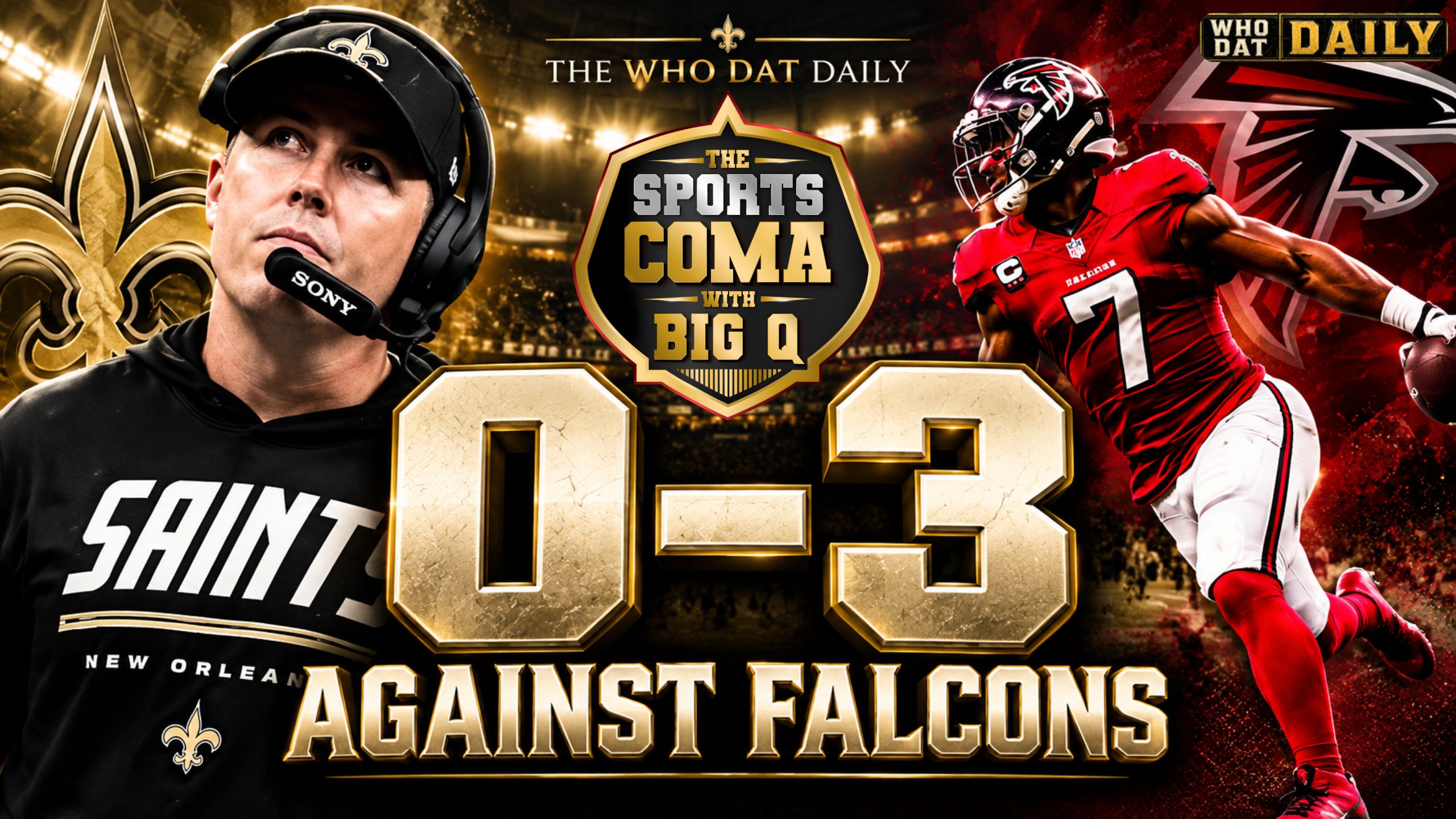

Kellen Moore is 0–3 against the Atlanta Falcons as Saints head coach, and Monday’s 45–24 home defeat has made the question facing New Orleans harder to avoid: When will the promise of improvement become a team its supporters can trust?
The Saints are 1–3. Moore is 7–14 through 21 regular-season games. Losing to Atlanta again would have hurt under any circumstances. Doing it during the celebration of the Superdome’s reopening, with the game slipping away early, gave this defeat an emotional weight that a routine explanation cannot remove.
That creates pressure to deliver results. It does not, by itself, establish that ownership has issued an ultimatum or that players have abandoned their coach. The football evidence is damaging enough without turning speculation into reporting.
Three Falcons losses, three missed opportunities
The Saints’ official 2025 season review documents Atlanta’s sweep of Moore’s first team. Monday added a third defeat.
| Game | Location | Saints result |
|---|---|---|
| November 23, 2025 | New Orleans | Lost 24–10 |
| January 4, 2026 — 2025 season finale | Atlanta | Lost 19–17 |
| October 5, 2026 | New Orleans | Lost 45–24 |
Across those meetings, Atlanta has outscored New Orleans 88–51, a combined 37-point margin. The Saints have averaged 17 points, and two defeats came in their own building.
The rivalry record matters because these are division games, but also because beating Atlanta is a basic expectation for this fan base. Moore does not need a speech explaining that history. He needs a team that performs as though it understands the assignment.
The first defeat exposed an inability to finish scoring opportunities. The second ended a late-season winning streak. The third raised questions about whether the Saints had carried enough of that progress into a new season.
Different circumstances. Same winner.
The negative numbers behind the frustration
The following figures separate Moore’s full tenure from the current season. The 2026 rankings come from the Saints’ official Week 5 statistical comparison, with additional totals from their team statistics.
| Measure | Figure | Period |
|---|---|---|
| Overall head-coaching record | 7–14; .333 winning percentage | 2025 through 2026 Week 4 |
| Record against Atlanta | 0–3; outscored 88–51 | First three meetings |
| Opening stretch of first season | 2–10 | First 12 games of 2025 |
| Current record | 1–3 | 2026 through Week 4 |
| Points allowed per game | 32.0; 32nd in NFL | 2026 through Week 4 |
| Rushing yards allowed per game | 147.8; 30th | 2026 through Week 4 |
| Total yards allowed per game | 360.3; 26th | 2026 through Week 4 |
| Rushing offense per game | 88.5 yards; 27th | 2026 through Week 4 |
| Turnover margin | Minus-5; tied for 27th | 2026 through Week 4 |
| Sacks taken by Tyler Shough | 12; 89 yards lost | 2026 through Week 4 |
There is a meaningful counterpoint: New Orleans ranks ninth in total offense at 367 yards per game and fourth in net passing at 278.5. This is not an offense without production. It is a team whose strengths have not consistently overcome its weaknesses.
Moore also finished his first season with four victories in the final five games. That showed improvement was possible. The burden now is to make it sustainable before another season becomes a recovery project.
Yardage provides evidence of offensive potential. Wins require that production to arrive alongside defensive stops, ball security and competent situational decisions.
Start with the opening possessions
Against Atlanta, New Orleans trailed 14–0 after the first quarter and 24–7 at halftime. Those are different problems from merely falling short on a final drive.
In the official postgame transcript, Moore said, “We obviously did a poor job just preparing our football team.”
The response should begin with a tighter opening plan: quick completions, manageable protection assignments and runs chosen for the available blockers. Motion can help Shough identify coverage, but only if the offense can execute the resulting checks cleanly.
Manufacturing an early completion for Chris Olave or Juwan Johnson is more useful than demanding a difficult explosive play before the line settles. Moore should make defenders prove they can handle the Saints’ basic concepts before introducing unnecessary complexity.
A first-drive touchdown would help. Repeatedly avoiding sacks, turnovers and third-and-long would tell us more about whether the preparation has improved.
The Saints cannot keep asking their quarterback to rescue the game before the offense has established any rhythm.
Give Shough a workable protection plan
Shough’s 12 sacks do not establish that every breakdown belongs to the offensive line. Protection calls, route timing and the quarterback’s decisions all matter.
The Saints’ unofficial depth chart lists Asim Richards at left tackle, Cesar Ruiz at right guard and Erik McCoy at center. Their communication will be central against Minnesota’s pressure threats.
The Vikings’ statistics show Dallas Turner with 5.5 sacks, Andrew Van Ginkel with three and Blake Cashman with 2.5. Richards and Taliese Fuaga need clear rules for edge help; McCoy and Ruiz need equally clear answers when pressure threatens inside.
Moore should pair selected downfield shots with extra protection and give Shough immediate outlets on quicker concepts. A back or tight end helping a tackle can buy time, but that protection must be matched with routes capable of producing an available target.
Simply keeping more blockers in is not a complete solution if the remaining receivers cannot separate.
The larger objective is to give Shough answers before the snap and a realistic place to go afterward. Asking the same protection to survive longer while hoping for a different result would leave the underlying problem untouched.
Make the running game useful
The answer to a weak running game is not simply more carries.
Moore needs a smaller set of dependable concepts, with complementary passes that punish defenders for crowding those runs. A failed first-down rush cannot automatically become a predictable passing sequence.
That requires evaluating the blocking as carefully as the ball carrier. Are combination blocks reaching the second level? Are defenders penetrating before the runner can make a decision? Is the formation giving the offense favorable numbers?
Those questions should determine the adjustments.
The Saints also need to avoid confusing balance with a fixed run-pass split. An early completion can create a manageable rushing situation. A quick throw can punish a loaded box. The objective is to stay ahead of the chains and keep the entire playbook available.
A functioning ground game would help Shough, but calling runs without addressing why they fail would only produce more difficult passing downs.
Repair the run defense before chasing splash plays
Cameron Jordan’s postgame explanation focused on gap discipline. That is where Moore and defensive coordinator Brandon Staley should begin: who owns each lane, who sets the edge and who provides the next tackle when the first defender misses.
There is little value in a more aggressive call if it creates another uncovered running lane. The Saints need coordinated pursuit, controlled leverage and reliable tackling before they can expect takeaways to change games.
Against Minnesota, Aaron Jones presents the next test. His 297 rushing yards on 72 carries give New Orleans a concrete challenge: keep him from controlling early downs without creating easy passing windows behind the linebackers.
Injury-related changes also require clear assignments. Wednesday’s estimated participation report listed Kaden Elliss and Anfernee Jennings as nonparticipants and Carl Granderson as limited. Those were not final game designations.
Whoever plays needs a plan suited to the available personnel. Moore’s responsibility as head coach includes making sure the defensive response is more substantial than another request to execute better.

Regaining trust requires visible changes
Shough acknowledged the crowd’s frustration after Atlanta, saying, “I’d boo too.” He also described the team as close and its leadership as willing to accept responsibility.
Those comments support a distinction: fans are angry, but an abandoned locker room has not been established.
Moore should protect that internal belief by making accountability specific and consistent. If a player repeatedly misses an assignment, the staff should correct the teaching, simplify the responsibility or reconsider the role. If a play repeatedly fails, coaches should apply the same scrutiny to their own decisions.
Players need to see that adjustments help them succeed. Supporters need evidence that another week of preparation produces different football.
That evidence is visible. An offense gets lined up promptly. Blockers recognize pressure. Defenders maintain their assignments. A possession ends with points instead of a preventable mistake.
Fans do not need every strategic detail explained publicly. They need fewer reasons to believe the same problems will decide the next game.
Minnesota offers a chance to begin changing the conversation
Sunday against Minnesota offers the first opportunity to respond. A win would matter. A sustained pattern of competent, competitive football is what will restore confidence.
Moore does not have to solve every weakness in one afternoon. He does need to show that the Saints can begin a game prepared, adjust when an opponent challenges them and avoid contributing to their own defeat.
The Atlanta record will remain part of his evaluation because division rivalries expose a team’s progress over time. Three meetings have produced three losses, and the latest was the most damaging on the scoreboard.
Moore cannot erase 0–3 against Atlanta this week.
He can begin showing why the next meeting should end differently.
Related coverage: Saints soul searching after the Falcons loss • Saints vs. Vikings preview
Discover more from The Who Dat Daily
Subscribe to get the latest posts sent to your email.






NEW ORLEANS PELICANS
Pelicans vs. Heat Preview: New Orleans Needs a Stronger Start After Thunder Comeback


New Orleans Saints
Saints vs. Vikings Preview: New Orleans Needs a Response on Drew Brees Day

NEW ORLEANS PELICANS
Pelicans Open Training Camp With a New Voice, New Depth and No Time to Waste

LSU Football News
LSU Drops to No. 10 in Week 4 AP Poll After Ole Miss Loss