

- LSU’s Biggest Enemy Was Its Own Missed Opportunities
- Sam Leavitt and Jackson Harris Provided a Fighting Chance
- Alabama Won the Battle That Mattered Most
- Keelon Russell Delivered When Alabama Needed Him
- The Fourth Quarter Exposed LSU’s Lack of Finish
- Lane Kiffin Must Accept the Responsibility
- What This Loss Means for LSU’s Playoff Hopes
- Final Thoughts: LSU Must Become More Than Dangerous
The Tigers had opportunities to turn a heavyweight SEC showdown into a defining victory. Instead, missed chances, protection breakdowns and a fourth-quarter collapse left LSU searching for answers.
BATON ROUGE, La. — Tiger Stadium was ready for a statement. The lights were bright, the stakes were enormous, and Lane Kiffin had the kind of opportunity that can transform a promising first season into something unforgettable.
Instead, Alabama delivered a harsh reminder that championship aspirations mean little without championship execution.
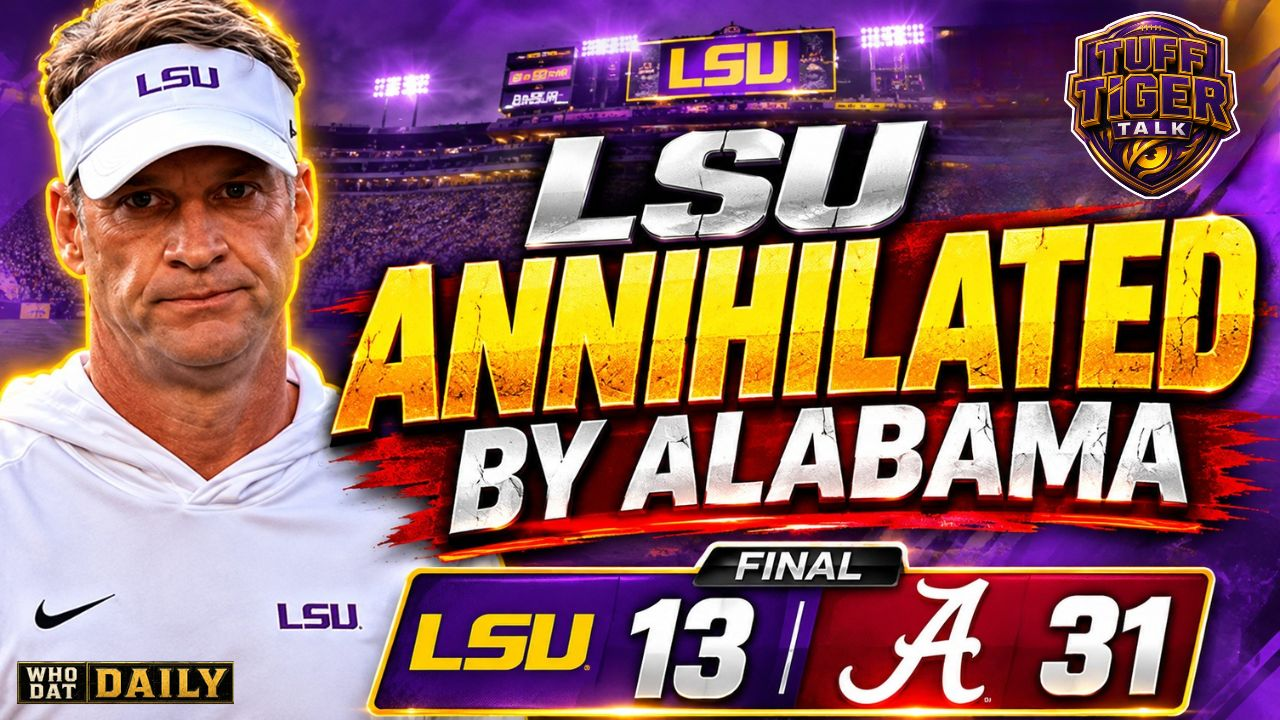
The fifth-ranked Crimson Tide defeated No. 14 LSU 31–13 Saturday night, turning a competitive SEC showdown into a frustrating defeat that leaves the Tigers with three losses and serious questions about their College Football Playoff future.
For LSU, this wasn’t simply a case of Alabama having better players or making more spectacular plays.
The Tigers repeatedly found themselves in positions to change the game.
They moved the football. They created opportunities. They demonstrated enough offensive ability to challenge Alabama’s defense.
But when the field shortened and the pressure increased, LSU couldn’t finish.
That failure became the defining story of the night.
LSU’s Biggest Enemy Was Its Own Missed Opportunities
Football games against elite opponents often turn on a handful of possessions.
Against Alabama, LSU wasted too many of them.
The Tigers turned the ball over on downs three times in Alabama territory, including twice inside the Crimson Tide’s 10-yard line. Another promising possession ended with an interception.
Those weren’t meaningless mistakes buried in the middle of a blowout.
They were opportunities to score, apply pressure and force Alabama to respond.
Instead, the Crimson Tide repeatedly escaped without surrendering points.
That’s the difference between moving the football and controlling a football game.
LSU demonstrated that it could reach dangerous areas of the field. Alabama demonstrated that it could survive those situations and punish the Tigers afterward.
For Kiffin, whose offensive reputation is built on creativity and attacking defensive weaknesses, those failures deserve serious examination.
Aggressiveness can win games.
But aggressiveness without execution can lose them just as quickly.
Sam Leavitt and Jackson Harris Provided a Fighting Chance
LSU quarterback Sam Leavitt had moments when he looked capable of challenging Alabama’s secondary.
His connection with wide receiver Jackson Harris was particularly impressive.
Harris finished with 11 receptions for 166 yards, giving the Tigers a legitimate receiving threat and repeatedly creating opportunities to move the chains.
His performance was one of the clearest positives of the evening.
Against a defense loaded with talent, Harris showed that LSU has a receiver capable of making plays in difficult situations.
But a productive passing attack cannot carry an offense by itself.
Leavitt faced increasing pressure as the game progressed, and Alabama’s defensive front made life particularly difficult in the fourth quarter.
The quarterback was sacked four times, including twice during the final period.
Those protection failures prevented LSU from building the offensive consistency necessary to complete a comeback.
Harris did his part.
The Tigers needed more help around him.
Alabama Won the Battle That Mattered Most
There is an uncomfortable truth about LSU’s offensive performance.
The Tigers have invested heavily in rebuilding their offensive line, yet Alabama’s defensive front controlled too many critical situations.
The Crimson Tide generated pressure, disrupted rushing lanes and forced LSU into difficult down-and-distance situations.
Running back Dilin Jones finished with 56 rushing yards on 17 carries, averaging approximately 3.3 yards per attempt.
Jones also contributed seven receptions for 36 yards, demonstrating his value as a receiving option.
But Alabama successfully limited his impact on the ground.
That mattered because LSU’s offense becomes far less dangerous when opponents can concentrate on defending the passing game.
A successful running attack creates manageable third downs, slows defensive pressure and opens opportunities for explosive passing plays.
Without that balance, LSU became increasingly predictable.
And against Alabama, predictability is dangerous.
Keelon Russell Delivered When Alabama Needed Him
While LSU struggled to finish possessions, Alabama quarterback Keelon Russell demonstrated the kind of efficiency that separates winning teams from frustrated ones.
Russell completed 17 of 24 passes for 206 yards and three touchdowns without an interception.
He was particularly effective after halftime, when Alabama began creating separation.
The Crimson Tide scored 14 fourth-quarter points, turning a competitive contest into a decisive victory.
Russell didn’t need an overwhelming rushing attack to succeed.
He made the necessary throws, capitalized on LSU’s defensive vulnerabilities and protected the football.
Alabama’s offense wasn’t flawless.
But when the Crimson Tide needed production, Russell delivered.
LSU couldn’t consistently match that execution.
The Fourth Quarter Exposed LSU’s Lack of Finish
The Tigers remained within striking distance deep into the game.
Trailing 17–13 in the fourth quarter, LSU still had an opportunity to change the outcome.
But the offense failed to convert a critical fourth-down opportunity after linebacker Luke Metz stopped Leavitt short of the first-down marker on third down.
Alabama capitalized on LSU’s inability to sustain the comeback.
The Crimson Tide eventually stretched the lead to 31–13.
What had been a competitive contest became another painful lesson in finishing.
For LSU, that fourth quarter should be particularly frustrating.
The Tigers weren’t facing an impossible deficit.
They needed disciplined possessions, reliable protection and a few decisive plays.
Instead, Alabama took control.
Championship-caliber teams understand how to turn close games into victories.
LSU is still learning how to avoid turning close games into defeats.


Lane Kiffin Must Accept the Responsibility
This was supposed to be one of the defining games of Kiffin’s first season at LSU.
The Tigers had home-field advantage, a talented offensive roster and a chance to strengthen their national standing against one of college football’s premier programs.
The opportunity was real.
So was the disappointment.
Kiffin deserves credit for helping LSU become competitive in major SEC matchups.
But competitiveness alone isn’t the standard in Baton Rouge.
The expectation is to beat elite opponents, challenge for conference championships and remain relevant in the national title conversation.
Against Alabama, LSU’s offensive strategy failed to produce enough points despite generating scoring opportunities.
That falls on the players who failed to execute.
It also falls on the coaching staff responsible for preparing them.
Kiffin must examine the offensive line, short-yardage decisions, red-zone execution and overall game management.
The Tigers cannot continue leaving points on the field and expect to defeat nationally ranked opponents.
At LSU, the standard demands more.
What This Loss Means for LSU’s Playoff Hopes
The Tigers entered Saturday with a 6–2 record and an opportunity to strengthen their postseason position.
Now LSU stands at 6–3.
With three losses, the road to the College Football Playoff becomes significantly more difficult.
The Tigers will need to finish the regular season strongly and hope other results improve their position.
But playoff projections shouldn’t become the only conversation.
LSU must first address the problems Alabama exposed.
Can the offensive line protect Leavitt against high-level defensive fronts?
Can the running game provide consistent production?
Can the offense finish possessions inside the opponent’s 20-yard line?
Can the defense prevent explosive plays when the game is on the line?
Those questions will determine whether LSU finishes the season with momentum or watches its championship aspirations disappear.
Final Thoughts: LSU Must Become More Than Dangerous
There is a difference between being talented enough to threaten a great team and disciplined enough to beat one.
LSU showed flashes of the former Saturday night.
Alabama demonstrated the latter.
The Tigers had opportunities to make this game memorable for the right reasons.
Instead, they walked away with another painful reminder that offensive yardage, impressive individual performances and home-field energy don’t automatically produce victories.
Jackson Harris gave LSU a tremendous effort.
Dilin Jones battled.
Sam Leavitt continued fighting despite increasing pressure.
But football remains a team sport, and Alabama executed better when the outcome was still in doubt.
Kiffin now faces a challenge that extends beyond one Saturday night.
He must prove that LSU can correct its weaknesses, finish critical possessions and compete with the SEC’s best when everything is on the line.
The Tigers don’t lack ambition.
They don’t lack talent.
What they lacked against Alabama was execution when it mattered most.
And until that changes, LSU will remain a team capable of threatening the nation’s best — but not consistently beating them.


Discover more from The Who Dat Daily
Subscribe to get the latest posts sent to your email.