
- A Fourth-Quarter Collapse That Changed Everything
- Jeremiah Fears Continues to Make His Case
- Zion Williamson’s Quiet Night Raises Questions
- Saddiq Bey and Karlo Matković Provide Support
- Minnesota’s Supporting Cast Made the Difference
- Trey Murphy III Returns, but the Bigger Picture Remains
- Four Straight Wins Were Progress — This Loss Is a Reminder
- What’s Next: A Road Test Against the Clippers
- Final Thoughts: Don’t Confuse Improvement With Arrival
New Orleans had momentum, a fourth-quarter lead and a chance to prove its resurgence was real. Minnesota had the stronger finish.

NEW ORLEANS — Four straight victories had changed the conversation around the New Orleans Pelicans. The confidence was returning, the offense was finding its rhythm, and a team that opened the season with four consecutive losses suddenly looked capable of making noise in the Western Conference.
Friday night was supposed to be the next step.
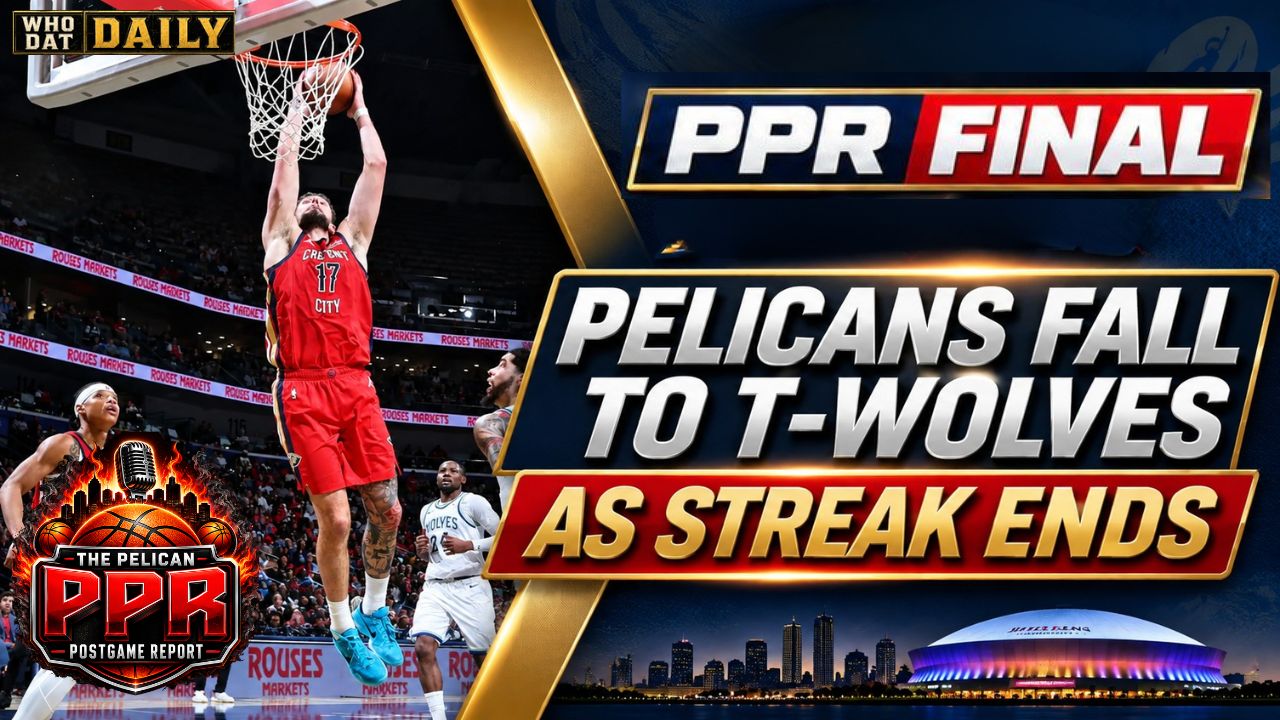
Instead, the Minnesota Timberwolves walked into the Smoothie King Center and handed New Orleans a sobering 115–109 defeat, snapping the Pelicans’ four-game winning streak and exposing the difference between playing competitive basketball and closing out a quality opponent.
The Pelicans weren’t overwhelmed. They weren’t outclassed from the opening tip. They fought, responded to adversity and entered the fourth quarter holding a two-point advantage.
But when the game demanded execution, Minnesota delivered.
New Orleans didn’t.
A Fourth-Quarter Collapse That Changed Everything
The Pelicans entered the final period leading 79–77 after overcoming an uneven first half.
For a team attempting to establish itself as a legitimate Western Conference competitor, this was precisely the type of situation it needed to master.
Protect the basketball. Get quality possessions. Defend without surrendering momentum-changing baskets. Make Minnesota work for everything.
Instead, the Timberwolves erupted for 38 fourth-quarter points.
Dejounte Murray briefly gave New Orleans an 89–87 lead with a three-pointer at the 7:55 mark. It should have been an opportunity for the Pelicans to seize control.
LaMelo Ball had other plans.
Ball scored five consecutive points, helping Minnesota launch a 10–2 run that turned a two-point deficit into a 97–91 advantage.
The Timberwolves never surrendered the lead again.
That’s the painful part of this defeat. New Orleans had done enough to put itself in winning position, only to lose its grip when the pressure increased.
A four-game winning streak can create excitement. But the final eight minutes against Minnesota showed that the Pelicans still have work to do before that excitement becomes trust.
Jeremiah Fears Continues to Make His Case
If there was an unmistakable positive for New Orleans, it was the continued emergence of Jeremiah Fears.
The young guard led the Pelicans with 24 points, providing offensive aggression and confidence against a Minnesota defense that doesn’t make scoring easy.
Fears has increasingly looked comfortable taking responsibility when the offense needs a spark.
His willingness to attack and create opportunities is becoming one of the more encouraging developments of the young season.
But there’s a larger issue here.
The Pelicans cannot consistently depend on a young guard to carry their offensive urgency while their established stars struggle to impose themselves.
Fears deserves credit for his performance. The veterans must provide the stability that allows his development to translate into victories.
Zion Williamson’s Quiet Night Raises Questions
Zion Williamson entered Friday averaging 21.5 points per game.
He finished with just 13.
That’s a season-low scoring performance, and it came in a game where New Orleans desperately needed his physical presence to dictate the action.
Zion doesn’t need to score 30 points every night for the Pelicans to win. But his ability to pressure defenses, attack the paint and force opponents into difficult decisions remains central to the team’s identity.
When he isn’t consistently influencing the game offensively, New Orleans becomes easier to defend.
The question isn’t whether Zion is talented enough.
We already know the answer.
The question is whether the Pelicans can establish a reliable offensive approach that keeps their most physically imposing player involved when opponents tighten their defensive coverage.
Against Minnesota, the answer wasn’t convincing.
Saddiq Bey and Karlo Matković Provide Support
Saddiq Bey contributed 17 points, continuing to demonstrate why his offensive versatility matters to this roster.
Karlo Matković added 18 points and helped New Orleans recover from an early Minnesota surge.
The Timberwolves opened aggressively, building a 13–5 advantage behind perimeter shooting.
But Matković knocked down three first-quarter three-pointers, helping fuel a 17–4 Pelicans run that brought New Orleans back into the contest.
That response mattered.
It showed the Pelicans have more offensive options than simply relying on Zion Williamson or Dejounte Murray to manufacture scoring opportunities.
The challenge is turning those contributions into a complete 48-minute performance.
Minnesota’s Supporting Cast Made the Difference
The Timberwolves didn’t need Anthony Edwards to control the decisive moments.
Ayo Dosunmu delivered a game-high 26 points, repeatedly giving Minnesota the offense it needed.
Jaden McDaniels contributed 23 points, while LaMelo Ball finished with 22 points and eight assists.
That combination proved difficult for New Orleans to contain.
Minnesota’s balance also exposed a familiar problem: the Pelicans can produce stretches of energetic defensive basketball without consistently sustaining that discipline across an entire game.
A good defensive possession means little if the next two allow easy scoring opportunities.
And when Minnesota increased its offensive pressure late, New Orleans couldn’t consistently answer.
The Timberwolves looked like a team comfortable playing through difficult moments.
The Pelicans looked like a team still learning how.
Trey Murphy III Returns, but the Bigger Picture Remains
Trey Murphy III returned to the lineup after missing Wednesday’s overtime victory over Utah with bilateral patellar tendinopathy.
His availability provided New Orleans with another important perimeter weapon.
Murphy’s shooting, spacing and athleticism remain essential to the Pelicans’ offensive potential, particularly when opponents collapse toward Williamson.
But one returning player cannot solve every problem.
New Orleans needs stronger late-game execution, more consistent defensive communication and a dependable offensive hierarchy when games tighten.
Those are team-wide responsibilities.

Four Straight Wins Were Progress — This Loss Is a Reminder
The Pelicans deserve recognition for recovering from an 0–4 start.
Winning four consecutive games against Sacramento, Atlanta, Memphis and Utah demonstrated resilience and helped restore confidence inside the locker room.
But Friday’s defeat revealed why the next stage of development will be more demanding.
Minnesota arrived with a winning record, an established defensive identity and the ability to execute under pressure.
New Orleans matched that opponent for much of the night.
Then the fourth quarter arrived.
That is where developing teams must learn to become dependable ones.
The Pelicans are now 4–5, and their NBA Cup campaign begins with an 0–1 record in West Group B.
There’s no reason to abandon the optimism generated by the winning streak. But there’s also no reason to pretend this loss doesn’t matter.
It does.
Because the Pelicans are no longer simply trying to prove they can win basketball games.
They’re trying to prove they can win the games that test their maturity.
What’s Next: A Road Test Against the Clippers
New Orleans travels to face the Los Angeles Clippers on Sunday, November 8.
The response will be important.
Head coach Jamahl Mosley must get his team back to the defensive urgency and collective offensive execution that fueled its recent success.
Zion Williamson needs to be more assertive. Dejounte Murray must help control late-game possessions. The supporting cast must continue contributing without allowing the team’s defensive standards to slip.
And Jeremiah Fears must keep developing without being asked to solve every offensive problem.
The Pelicans have shown they can recover from adversity.
Now they must demonstrate they can learn from it.
Final Thoughts: Don’t Confuse Improvement With Arrival
The most dangerous thing a developing team can do is mistake a winning streak for proof that its problems have disappeared.
New Orleans has made genuine progress.
The chemistry looks better. The offensive contributions are more balanced. The young players are gaining confidence.
But Friday’s 115–109 loss to Minnesota delivered an unmistakable message.
The Pelicans can compete with a quality Western Conference opponent.
The next challenge is proving they can finish one.
Four straight wins changed the conversation.
One disappointing fourth quarter reminded everyone that the work is far from finished.
The Pelicans don’t need to start over. They need to learn how to finish.
Discover more from The Who Dat Daily
Subscribe to get the latest posts sent to your email.