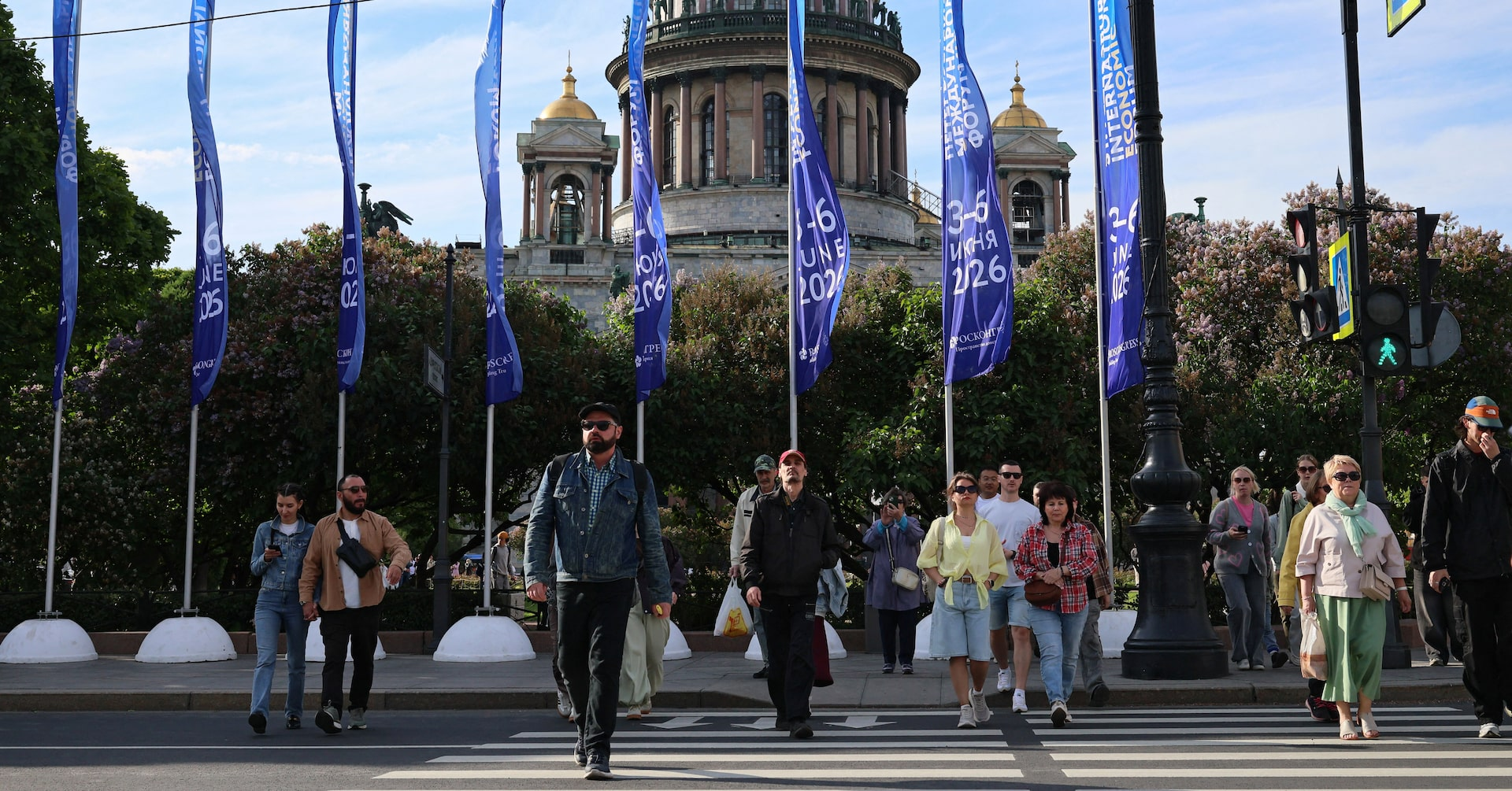


Item 1 of 3 People cross the street near flags with the logo of the St. Petersburg International Economic Forum (SPIEF) flying in front of the St. Isaac’s Cathedral on the eve of the forum’s opening in Saint Petersburg, Russia June 2, 2026. REUTERS/Anastasia Barashkova
[1/3] People cross the street near flags with the logo of the St. Petersburg International Economic Forum (SPIEF) flying in front of the St. Isaac’s Cathedral on the eve of the forum’s opening in Saint… Purchase Licensing Rights , opens new tab Read more
U.S. right-wing influencers and a U.S. official to join
ST PETERSBURG, Russia, June 2 (Reuters) – A right-wing U.S. influencer, a serving U.S. official and a German retail billionaire are due to attend President Vladimir Putin’s “Russian Davos” on Wednesday as the Kremlin grapples with stalled growth and a confrontation with the West over the Ukraine war.
Russia’s premier investment forum, the fifth since Russia sent troops into Ukraine in 2022, opens just hours after a deadly drone and missile attack on Kyiv which Russia said was in response to a deadly attack on a dormitory in Russian-controlled Luhansk.
Shunned by the West since the 2022 invasion, this year’s forum will include Rodney Mims Cook Jr., chairman of the U.S. Commission of Fine Arts, who oversees President Donald Trump’s White House ballroom extension, U.S. right-wing influencer Candace Owens and, possibly, Internet personality Andrew Tate.
The Kremlin said this would be the first such Russian investment conference with U.S. participation since 2017-2018.
The war looms large even if Ukraine is not mentioned once in the official programme.
“The question is: does this war end or do we stare into a much tougher future?” one Russian participant told Reuters on condition of anonymity due to the matter’s sensitivity.
Putin, Russia’s paramount leader as either president or prime minister since 1999, presided over a massive jump in prosperity in his first 15 years. The economy grew tenfold to about $2.3 trillion in 2013, the year before Russia annexed Crimea from Ukraine, according to International Monetary Fund data.
Since then, Russia’s economy has paid the price for the confrontation with the West over Ukraine: despite better-than-expected growth in 2023 and 2024, it is projected at around $2.9 trillion this year, a fraction of the combined economic might of the $45 trillion NATO alliance, according to Russian state data.
Russia’s commodity-dependent economy slowed sharply to about 1% growth last year from 4.9% in 2024, and shrank by 0.2% in the first quarter of 2026, which officials blamed on high interest rates, Western sanctions and a strong rouble. Growth is now forecast at a modest 0.4% this year.
WAR, SPIES AND OIL
Oleg Vyugin, a former deputy chairman of the central bank, told Reuters that Russia had a choice between a recession or reducing financing for what the Kremlin calls the Special Military Operation (SMO) in Ukraine.
“Russia is faced with a choice between reducing military financing, which will give the economy an incentive to grow by reducing the key interest rate more quickly, expanding lending to the civilian sector, partially lifting sanctions and restoring logistics chains, and continuing the SMO, which will constantly require increased spending and further tax increases, intensifying the economic slide into recession, and a decline in real incomes,” Vyugin said.
At the conference, whose theme is “Pragmatic Dialogue: the Path to a Stable Future”, attendees at the heavily guarded conference centre outside Putin’s hometown will rub shoulders with Russian billionaires and even some former intelligence officers over debates ranging from OPEC+ to the use of AI in information wars.
German retail billionaire Thomas Bruch, owner of Hyperglobus, is also listed as attending a discussion on investment from Germany, which was once the biggest single trading partner of Russia. The forum said 1,800 German companies continue to operate in Russia.
“Thomas Bruch is attending the Economic Forum in St Petersburg in his capacity as a shareholder in the Russian hypermarkets,” Globus Holding said. “The purpose of his attendance is to foster business contacts and engage in discussions with representatives from the business community and various institutions.”
Globus Holding noted that it focuses exclusively on its business in Germany and the Czech Republic, and that it has divested its entire stake in the Russian food markets.
Owens, an American conservative commentator, will speak at a session on “balancing parenthood in a large family with a successful career,” according to the official programme.
“I have been wanting to go to St Petersburg for a very, very long time just as a Christian in general just to see some of those cathedrals and churches,” Owens said ahead of her trip.
Some of the most prominent guests this year are from Saudi Arabia, including Energy Minister Prince Abdulaziz bin Salman, who is due to discuss the impact of the war in the Middle East on energy and the future of OPEC+ with Putin’s oil tsar Alexander Novak and OPEC Secretary General Haitham Al Ghais.
OUTLAW CHEMICAL FREE SOAPS AND NATURAL BODY PRODUCTS!

PPR MERCH HERE NOW! CLICK THE AD TO SHOP!!!


New Orleans Saints News
🚨Saints Underdogs In 12 Games?! Vegas Says

New Orleans Saints News
Mickey Loomis Speaks On Kamara’s Future