
By Bruno Kelly
MANAUS, Brazil, Oct 28 (Reuters) – Deep in Brazil’s Amazon, scientists have built a “time machine” pumping carbon dioxide into the rainforest canopy to simulate atmospheric conditions predicted for the future to gauge how the biome adapts – an open question to be discussed at the COP30 United Nations climate summit hosted by the country next month.
At the AmazonFACE project near Manaus, the largest city in the Amazon, six rings of steel towers loom above the jungle canopy, each surrounding groups of 50 to 70 mature trees.
After baseline testing, scientists will fumigate trees in three of the rings with carbon dioxide at levels simulating climate forecasts for coming decades, while the rest serve as control samples.
“We’re trying to create the atmosphere of the future,” said Carlos Quesada, a coordinator for the National Institute for Amazon Research (INPA), which is leading the experiment alongside Universidade Estadual de Campinas.
Preservation of tropical rainforests like the Amazon is vital to curbing the worst effects of climate change, according to scientists. At the climate conference set for November 10-21 in the city of Belem, where the Amazon Basin meets the Atlantic Ocean, policymakers are set to grapple with uncertainty about how the rainforest can adapt to a warming planet and changing atmosphere.


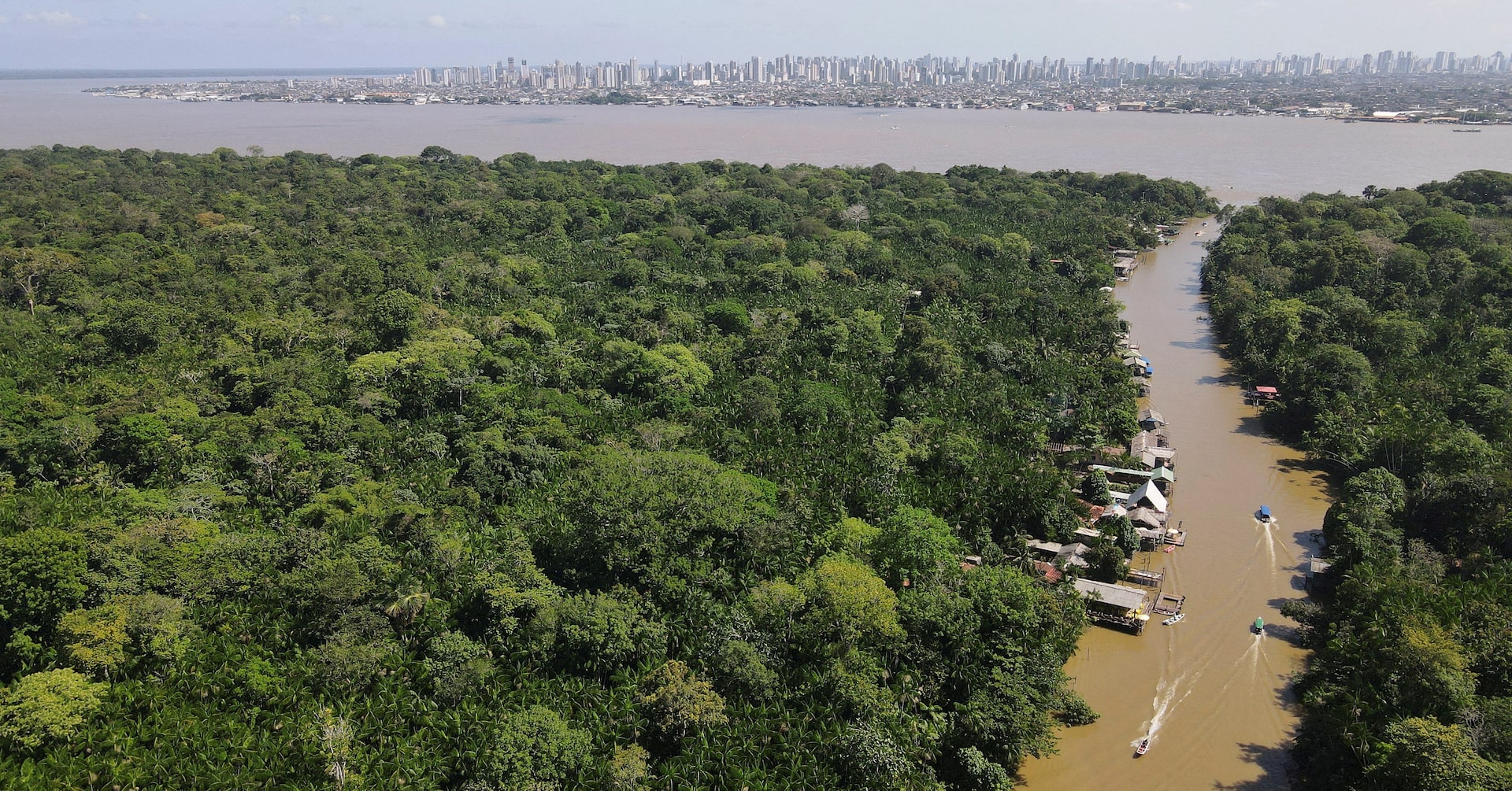
Item 1 of 2 A drone image shows the Amazon rainforest and the city of Belem in the back ahead of COP 30, at Ilha do Combu, in Belem, Para state, Brazil August 10, 2025. REUTERS/Anderson Coelho/File Photo
[1/2] A drone image shows the Amazon rainforest and the city of Belem in the back ahead of COP 30, at Ilha do Combu, in Belem, Para state, Brazil August 10, 2025. REUTERS/Anderson Coelho/File Photo Purchase Licensing Rights , opens new tab
FACE, short for Free-Air CO2 Enrichment, will let Quesada and his team of scientists study the effects of elevated carbon dioxide levels on the rainforest giants and surrounding plant life. The project is supported by Brazil’s federal government and the United Kingdom.
While FACE experiments have been performed around the world – including in the United States, where the Department of Energy tested temperate biomes – AmazonFACE represents a new frontier, forestry engineer Gustavo Carvalho said.
“This is the first experiment in a natural forest of this size in the tropics,” Carvalho said under the shade of the Amazon canopy.
With baseline testing underway, sensors record the forest’s response to changing conditions every 10 minutes, showing how the tree foliage absorbs carbon dioxide while releasing oxygen and water vapor in response to rain, storms and sunshine, Carvalho said.
Later experimentation will create artificial microclimates with higher carbon dioxide levels.
“If a model predicts a certain amount (of carbon dioxide in the atmosphere) in 2050 or 2060, then we’ll increase to that amount in these plots to try to understand how the forest responds,” Carvalho said. “We’ll have a small plot here in the forest that we can enter and know what will happen in the future.”
Discover more from The Who Dat Daily
Subscribe to get the latest posts sent to your email.



OUTLAW CHEMICAL FREE SOAPS AND NATURAL BODY PRODUCTS!


Tulane College Sports
Tulane vs. South Alabama Preview: Green Wave Seek Week 2 Rebound

New Orleans Saints News
Saints Free $10.3M! Ruiz & Godchaux Restructures Explained | PODCAST

Sports News & More
Why Jared Goff Is Underrated and Dangerous

Sports News & More
Here’s the Saints vs Lions Week 1: Keys to Victory & Score Predictions!

New Orleans Saints News
Saints Add 12 Players to Practice Squad as New Orleans Continues Roster Moves

New Orleans Saints News
Saints Trade for Zamir White as RB Injuries Mount

New Orleans Pelicans News
Pelicans Sign Bennedict Mathurin to 2-Year, $16M Deal

New Orleans Saints News
Saints Looking for WR Help: Four Receivers Work Out Before Lions Opener