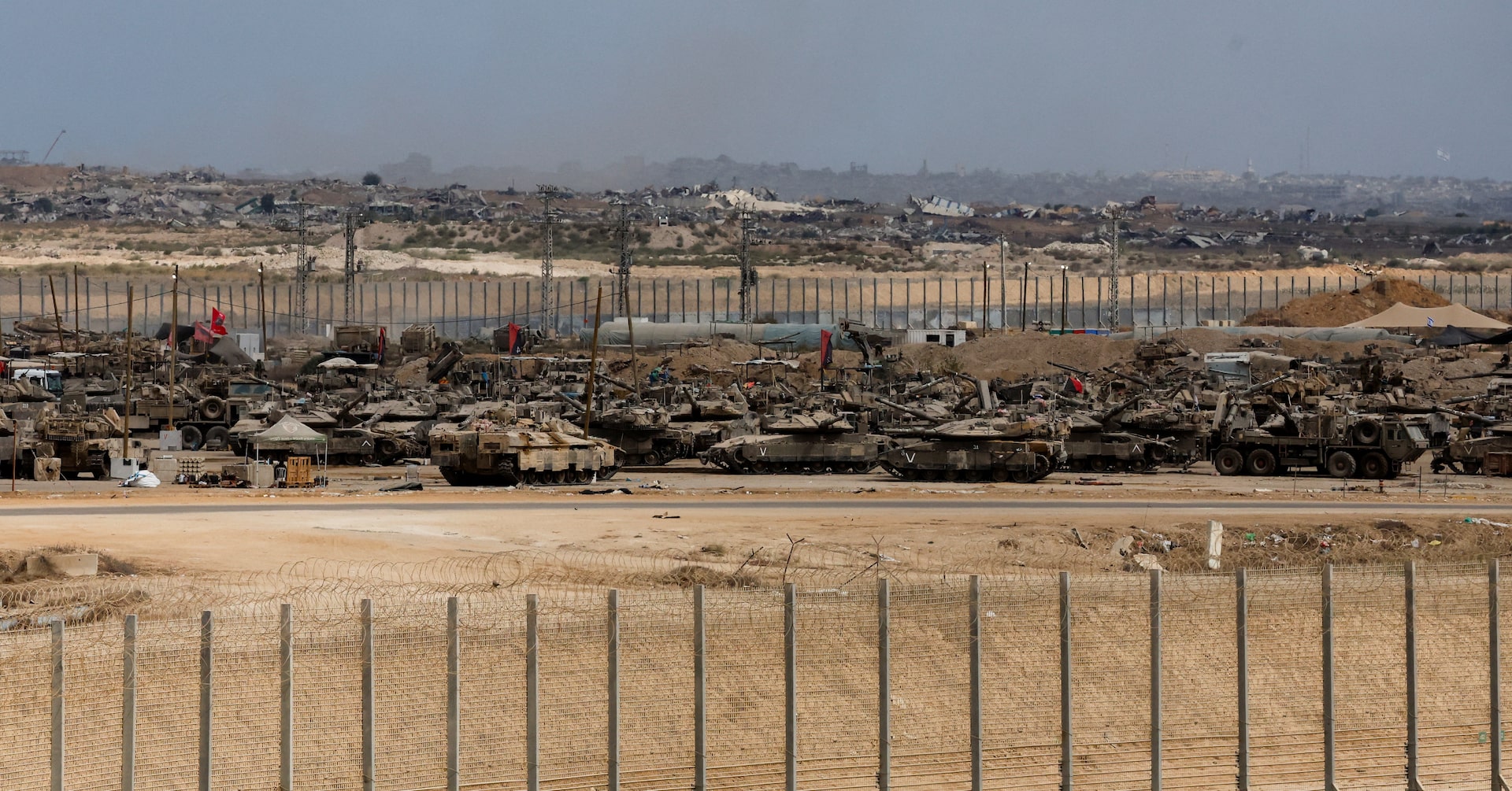


Item 1 of 2 Israeli tanks sit, after U.S. President Donald Trump announced that Israel and Hamas agreed on the first phase of a Gaza ceasefire, on the Israeli side of the border with Gaza, October 9, 2025. REUTERS/Ammar Awad
[1/2] Israeli tanks sit, after U.S. President Donald Trump announced that Israel and Hamas agreed on the first phase of a Gaza ceasefire, on the Israeli side of the border with Gaza, October 9, 2025. REUTERS/Ammar Awad Purchase Licensing Rights , opens new tab
WASHINGTON, Oct 9 (Reuters) – With the Gaza war entering its third year, U.S. President Donald Trump has achieved something no other world leader has been able to do: strong-arm Israel’s Prime Minister Benjamin Netanyahu into the first step of a broader peace deal while persuading other Middle Eastern countries to pressure Hamas.
But despite its potentially historic nature, Trump’s rushed deal signed in Egypt on Thursday leaves a host of unresolved issues that could still trip up implementation of the initial phase and impede progress toward the next, analysts say.
While crediting Trump with the most promising breakthrough yet to end the war, experts say the immediate challenge will be to iron out practical details for what has been agreed to on paper: silencing the guns, exchanging Israeli hostages for Palestinian prisoners and a partial Israeli withdrawal inside the devastated enclave.
After that, negotiators must tackle other parts of Trump’s 20-point plan over which the two sides remain bitterly at odds, including the disarmament of Hamas, which the militant group rejects, a formal end to the conflict and Gaza’s post-war governance.
None of this was dealt with in three days of indirect negotiations in Egyptian beach resort of Sharm el-Sheikh, where Trump had sent his son-in-law Jared Kushner and Middle East Envoy Steve Witkoff to help mediate. But a quick resolution appears unlikely.
“There is an enormous number of potential sticking points that are going to really determine whether this ceasefire ends up being the beginning of peace or just another twist in the cycle of violence,” said Jonathan Panikoff, a former deputy U.S. national intelligence officer on the Middle East.
Preventing the ceasefire deal from unraveling, as others have under Trump and his Democratic predecessor Joe Biden, will require a sustained, detailed effort by the president and his national security team, said Panikoff, now at the Atlantic Council think tank in Washington.
But with Trump’s foreign policy team stripped of some of its policy expertise due to job cuts and now hampered by the federal government shutdown, that won’t be easy.
For now, though, Trump – who has touted the deal as another reason why he deserves a Nobel Peace Prize – has through force of will seemingly gained momentum for Gaza peace beyond what many experts thought was possible.
Successful completion of the deal would mark a significant foreign policy achievement for the Republican president, who had campaigned on bringing peace to major world conflicts but has struggled to swiftly deliver, both in Gaza and on Russia’s war in Ukraine.
TRUMP’S STRATEGY
Just weeks ago, peace in Gaza seemed more distant than ever after Israel launched a strike on Hamas’ leadership in Qatar, a U.S. ally.
But Trump’s aides decided to turn his anger at Netanyahu into pressure on the Israeli leader to accept a framework for ending the war, which they presented to Muslim leaders on the sidelines of the U.N. General Assembly last month, according to people familiar with the matter.
Whereas Netanyahu readily defied Biden over Israel’s assault on Gaza in response to Hamas’ Oct. 7, 2023, cross-border attack, he found it harder to buck Trump, despite Israeli misgivings over the Gaza plan, including cracking open the door to eventual Palestinian statehood.
Trump had joined Israel in striking Iran’s nuclear sites in June and stood by Netanyahu amid increasing international isolation. Opinion polls have consistently shown Trump more popular with the Israeli public than their prime minister.
“Without the leverage, there was no deal. Bibi cannot say no to Trump,” said Dennis Ross, a former Middle East adviser to Republican and Democratic administrations, referring to Netanyahu by his nickname.
But the Israeli leader still faces big risks at home, including the chance that some far-right members of his governing coalition could quit his government over the concessions he has agreed.
In addition, Trump was able to marshal support from key Middle East states, especially Qatar and Turkey, to pressure Hamas to drop its opposition to certain issues, such as releasing Israeli hostages, dead and alive, at the start of the process rather than using them as bargaining chips further down the line.
Qatar, home to the largest U.S. military base in the Middle East, has warmed to Trump over upgraded security and business ties since he took office in January. During a White House visit in late September, Trump put Netanyahu on the phone with the Qatari prime minister to apologize for the strike in Doha.
Trump has also deepened his relationship with Turkish President Tayyip Erdogan, who is seeking advanced U.S. weaponry, and asked him to help push Hamas to accept the deal.
Known for his love of pomp and ceremony, Trump appeared ready to head to Israel this weekend around the time the hostages are due to come home. Netanyahu has invited him to address Israel’s parliament.
Even so, some of the details of the first phase of Trump’s plan remain unsettled, such as the final lists of Palestinian prisoners to be freed by Israel in exchange for the 20 living hostages and estimated 28 dead.
Also unresolved are longer-term questions about Gaza’s future. Those include whether Hamas would be allowed to have any part in governing Gaza, something Trump and Netanyahu have steadfastly rejected, as well as how to rebuild the territory from its ruins and who will pay for it.
The elusive quest for Middle East peace has been the bane of American presidents from Jimmy Carter to Biden. But some analysts see hope for at least a halt to the latest wave of destruction.
“There seems to be momentum behind it,” said Jonathan Alterman of the Center for Strategic and International Studies think tank in Washington.
“But it’s a mistake to think that this is all resolved. We will have some white-knuckle moments in the coming weeks.”
Discover more from The Who Dat Daily
Subscribe to get the latest posts sent to your email.



OUTLAW CHEMICAL FREE SOAPS AND NATURAL BODY PRODUCTS!


Tulane College Sports
Tulane vs. South Alabama Preview: Green Wave Seek Week 2 Rebound

New Orleans Saints News
Saints Free $10.3M! Ruiz & Godchaux Restructures Explained | PODCAST

Sports News & More
Why Jared Goff Is Underrated and Dangerous

Sports News & More
Here’s the Saints vs Lions Week 1: Keys to Victory & Score Predictions!

New Orleans Saints News
Saints Add 12 Players to Practice Squad as New Orleans Continues Roster Moves

New Orleans Saints News
Saints Trade for Zamir White as RB Injuries Mount

New Orleans Pelicans News
Pelicans Sign Bennedict Mathurin to 2-Year, $16M Deal

New Orleans Saints News
Saints Looking for WR Help: Four Receivers Work Out Before Lions Opener