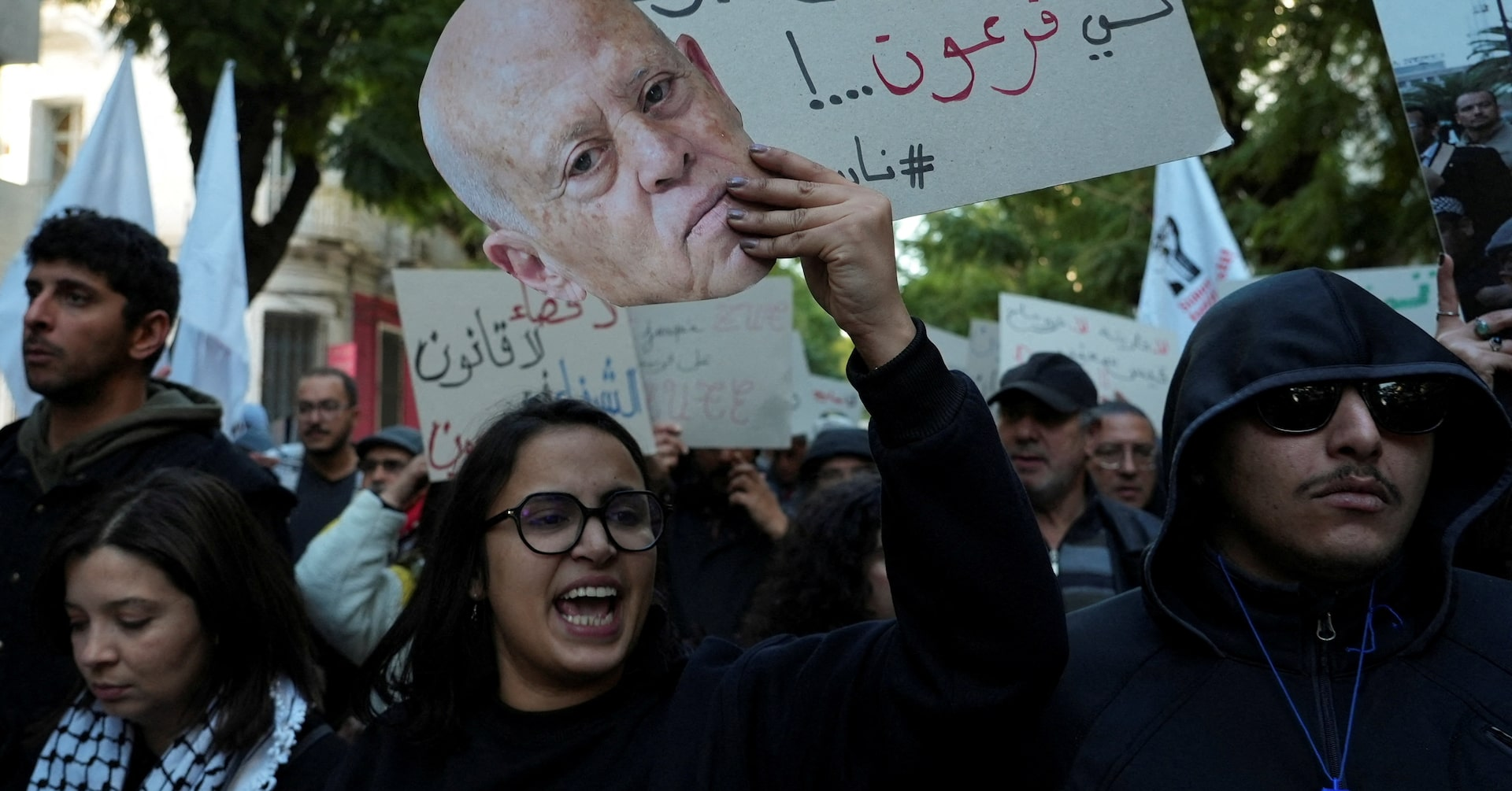


Item 1 of 2 Activists and political opponents protest against Tunisian President Kais Saied and calling for an end to one-man rule and the restoration of democracy, in Tunis, Tunisia January 10, 2026. REUTERS/Jihed Abidellaoui/File Photo
[1/2] Activists and political opponents protest against Tunisian President Kais Saied and calling for an end to one-man rule and the restoration of democracy, in Tunis, Tunisia January 10, 2026…. Purchase Licensing Rights , opens new tab Read more
June 9 (Reuters) – A Tunisian court sentenced prominent journalist Khaoula Boukrim to four years in prison in absentia, she said on Tuesday, in a ruling critics say highlights a growing crackdown on critical voices and free speech under President Kais Saied.
The ruling against Boukrim is the latest move against journalists following the jailing earlier this year of several media figures, including Zied Heni, Mourad Zghidi and Borhen Bsaies.
Boukrim, founder of the news website TUMEDIA who fled to Paris in December, was informed that two separate judgements had been issued against her under Decree-Law 54, a cybercrime law enacted in 2022 that includes strict penalties for online publication offences.
Rights groups say the law has increasingly been used to prosecute government critics and curb free speech, while authorities say it is needed to combat misinformation and online abuse.
“I was forced to leave to Paris when I learned that legal cases were being prepared against me because of my critical positions toward the president and those around him,” Boukrim told Reuters.
“The ruling is a continuation of the targeting of free journalism and critical voices,” she added.
The authorities were not immediately available for comment.
Rights groups warn of growing attempts to stifle remaining independent voices since Saied dissolved the elected parliament in 2021 and began ruling by decree.
Free speech initially flourished following the 2011 uprising that toppled autocrat Zine El Abidine Ben Ali and led to the “Arab Spring”.
Critics say Saied’s accumulation of power in 2021 and decrees he has issued since have dismantled democratic safeguards and enabled the authorities to pursue many journalists.
The leaders of Tunisia’s main opposition parties have been jailed in the last three years, along with dozens of politicians, activists and businessmen, on charges of conspiring against state security, money-laundering and corruption.
Saied says he will not be a dictator and that freedoms are guaranteed in Tunisia.
Our Standards: The Thomson Reuters Trust Principles. , opens new tab
Suggested Topics:
Read Next
ago Science category
ago Legal category
General Motors is releasing a software update that allows some U.S. electric-vehicle owners to pipe power back to the electric grid, another example of car companies pursuing business opportunities in the energy sector.
Site Index
About Reuters
Stay Informed
Information you can trust
Reuters, the news and media division of Thomson Reuters, is the world’s largest multimedia news provider, reaching billions of people worldwide every day. Reuters provides business, financial, national and international news to professionals via desktop terminals, the world’s media organizations, industry events and directly to consumers.
OUTLAW CHEMICAL FREE SOAPS AND NATURAL BODY PRODUCTS!

PPR MERCH HERE NOW! CLICK THE AD TO SHOP!!!


NEW ORLEANS PELICANS
Is a Jaylen Brown Blockbuster Trade Worth the Risk for New Orleans?

New Orleans Saints News
Saints NFC South Breakdown: Can New Orleans Contend?

NEW ORLEANS PELICANS
Pelicans Draft Sleepers: 5 Prospects to Watch at Pick 58