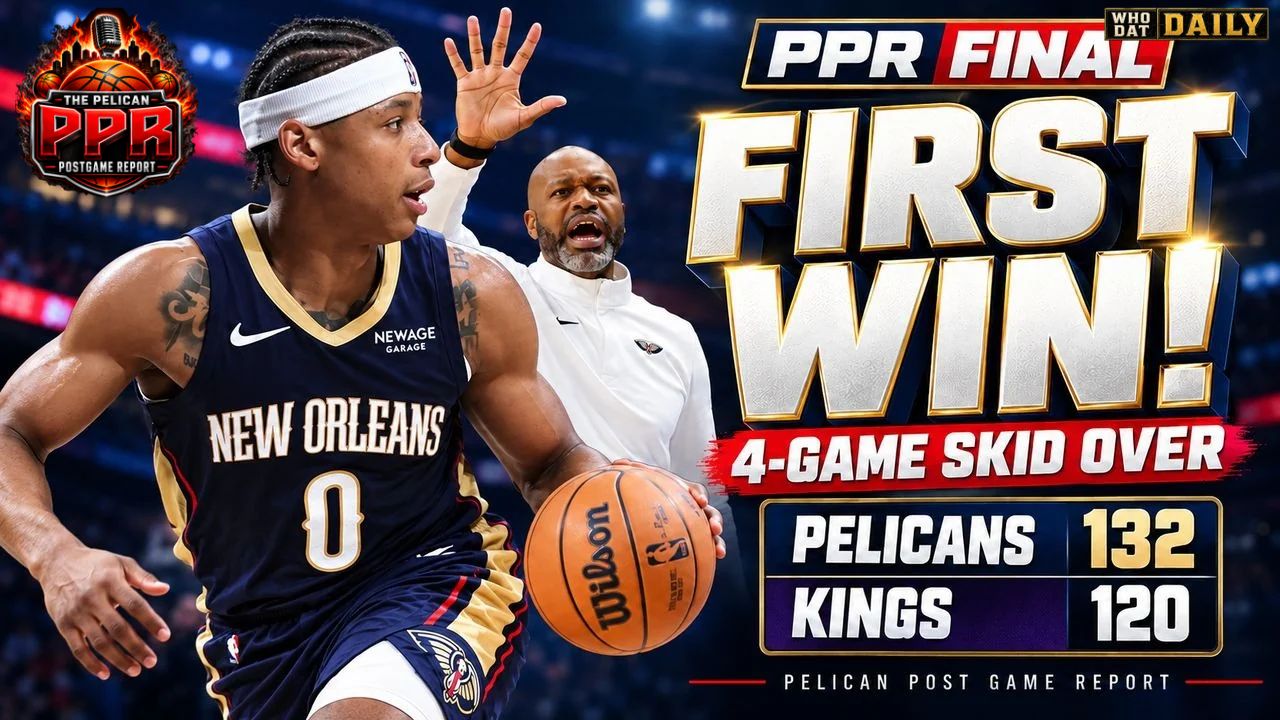

Pelicans 132, Kings 120 • Final
New Orleans ends its four-game skid with a breakout night from Jeremiah Fears, efficient work from Zion Williamson and a fourth-quarter response that finally holds up.

NEW ORLEANS — The Pelicans finally have a result their fans can celebrate without first explaining how close they came. New Orleans defeated Sacramento 132–120 Thursday at Smoothie King Center, ending an 0–4 start and giving Jamahl Mosley his first regular-season victory as the team’s head coach.
Jeremiah Fears supplied the organization. Zion Williamson supplied the efficiency. The reserves supplied a substantial scoring advantage. And when Sacramento made the fourth quarter uncomfortable, New Orleans supplied the answer that mattered most: another run of its own.
At 1–4, the Pelicans still have ground to recover. Beating a Kings team that dropped to 0–5 does not settle the larger questions about their season. It does give them a completed performance to build on, earned on the second night of a back-to-back after Wednesday’s 104–91 home loss to Denver.
The quick read
- Final: New Orleans 132, Sacramento 120.
- Standout: Fears finished with 22 points, a career-high 13 assists and eight rebounds.
- Interior efficiency: Williamson scored 22 on 10-for-12 shooting.
- Depth: The Pelicans won bench scoring 41–8.
- The closing response: A 10–0 fourth-quarter burst pushed a seven-point lead to 17.
Fears gave the offense direction
With Dejounte Murray and Jordan Poole unavailable, as noted in the Associated Press game report, Fears had more responsibility to carry. His answer was a near triple-double rather than a night built around scoring alone. He also recorded four blocks, adding a striking defensive contribution to his work as a creator.
The passing is the most encouraging part of that performance. A productive possession does not require the lead guard to finish it himself. Getting teammates involved spreads the burden, keeps more players connected to the offense and makes a good scoring night less dependent on one player rescuing difficult possessions.
That is the value New Orleans can try to carry forward. Fears gave Mosley evidence that he can handle meaningful creation duties when the rotation demands it. The next step is sustaining that decision-making as opponents adjust and the available backcourt changes.
Zion made his touches count
Williamson matched Fears’ scoring total while needing only 12 field-goal attempts. The AP reported that all 10 of his made baskets came in the paint. His night also included six rebounds and five steals.
That kind of efficiency matters beyond the individual line. New Orleans could get substantial production from its primary interior scorer while still finding opportunities for the rest of the lineup. It is a healthier offensive foundation than requiring a star to consume possession after possession simply to keep the team afloat.
The steals were useful, too. They helped create the kind of disruptive possessions that can give an offense an easier starting point. The challenge is making those bursts part of a more consistent defensive performance.
The rotation produced real support
Trey Murphy III scored 19, Herb Jones added 16 and starting center Karlo Matković contributed 12. Those totals are reflected in the game’s box score; they put all five New Orleans starters in double figures.
The bench advantage was just as consequential. Saddiq Bey and Bennedict Mathurin scored 10 each, Derik Queen added nine, Trendon Watford eight and Bryce McGowens four. That distributed contribution gave the Pelicans useful offense beyond the opening lineup.
Mosley can take something practical from that spread of production: several combinations helped put points on the board. One win cannot establish a permanent rotation, but it provides a starting point for identifying which groups deserve another look. The standard going forward should be whether those groups can also protect the ball and defend consistently.
New Orleans created separation in the third
The Pelicans carried a narrow 63–61 lead into halftime. Field Level Media’s recap described the third-quarter turning point: after Sacramento stayed within two early in the period, New Orleans put together a 21–4 surge, with Fears and Murphy connecting from deep and Williamson contributing inside.
That stretch changed the terms of the game. Instead of exchanging baskets with a team that remained one possession away, New Orleans built room to absorb a response. Creating that cushion was valuable; preserving it required another piece of work.
The fourth-quarter answer was the biggest difference
Sacramento cut the deficit to 113–106 on a Zach LaVine three with 7:11 remaining. For a team trying to stop a losing streak, that is an uncomfortable moment: a manageable lead, an opponent finding momentum and plenty of time left.
The play-by-play shows how the Pelicans answered. Williamson scored, Matković finished a dunk, Fears added two baskets and McGowens scored in transition. Ten consecutive points made it 123–106 with 4:45 remaining.
That response deserves more attention than the final margin alone. New Orleans still had to execute after Sacramento’s push. The Pelicans found enough offense to restore control, turning a potential late-game problem into a lead they could carry home.
After the earlier collapse against Denver, that was a particularly useful finish to put on the record. The value now lies in repeating it.

A win with clear areas to clean up
Sacramento committed 25 turnovers, and New Orleans recorded 18 steals. The statistical summary also credited the Pelicans with 40 points off turnovers. Those opportunities helped power the offense, but the game still exposed defensive work ahead.
Darius Acuff Jr. finished with 34 points and 14 assists, while De’Andre Hunter and Precious Achiuwa scored 24 apiece. Sacramento shot 52.3 percent from the field. New Orleans benefited from the Kings’ mistakes while still allowing productive possessions when Sacramento completed them.
The Pelicans have their own possession and free-throw issues to address. The team box score lists 20 turnovers and 22-for-32 foul shooting, alongside 58.8 percent shooting from the field.
That combination explains both the satisfaction and the work remaining. The offense was productive enough to win despite those empty trips. A tighter game may offer less room for them. Mosley can use the victory to reinforce what worked while keeping the same demands on execution.
What it means, and what comes next
The Pelicans needed the first victory to stop the losing streak from growing. They also needed evidence of a reliable response when an opponent threatened their lead. Thursday supplied both.
The next scheduled game is another home date, against Atlanta on Saturday, October 31. The useful question is whether New Orleans can carry over the shared offense, bench involvement and fourth-quarter composure while reducing its own mistakes.
For one night, Fears helped connect the pieces, Williamson converted his opportunities and the Pelicans finished the job. Now they have a win worth building from.
Keep the Pelicans conversation going
Follow Pelican Post Game Report for Big Q’s game breakdowns, interviews, previews and postgame coverage. PPR — For All Things Pelicans!Subscribe to Pelican Post Game Report
About Gee Bino: Gee Bino covers New Orleans sports for The Who Dat Daily, including the Pelicans, Saints, LSU and boxing.
Discover more from The Who Dat Daily
Subscribe to get the latest posts sent to your email.






New Orleans Saints
Saints Roster Exposed? Moore and Loomis Face Hard Questions

NEW ORLEANS PELICANS
Finally in the Win Column: Fears and Zion Power Pelicans Past Kings

NEW ORLEANS PELICANS
Pelicans Fall to 0-4 as Nuggets Slam Door on Rally

NEW ORLEANS PELICANS
Pelicans vs Nuggets: Mosley Must Fix the Rotation

New Orleans Saints
Saints Bye Week: Fix the Trenches or Lose 2026

Tulane College Sports
Six Takeaways, One Big Response: Tulane Stuns Memphis 31–17


Tulane College Sports
Uptown Stand: Tulane Faces Memphis With Its Conference Hopes Under Pressure