

- A Game That Got Away Almost Immediately
- Golden State’s Three-Point Shooting Was Devastating
- Missing Zion and Trey Murphy Hurt, but They Don’t Explain Everything
- Derik Queen Provides One of the Few Bright Spots
- The Rebounding Disparity Was Unacceptable
- Jamahl Mosley’s Defensive Identity Faces a Serious Test
- Three Straight Losses Have Erased the Momentum
- The Rotation Needs More Than Minor Adjustments
- What’s Next: Brooklyn Comes to New Orleans
- Final Thoughts: A 51-Point Loss Demands Accountability
New Orleans suffers its third consecutive defeat as Golden State dominates the perimeter, controls the glass and turns an undermanned Pelicans lineup into a 51-point blowout.
SAN FRANCISCO — There are losses that frustrate a basketball team. There are defeats that expose weaknesses. And then there are performances so thoroughly one-sided that they demand an organizational response.
The New Orleans Pelicans experienced the third category Monday night.
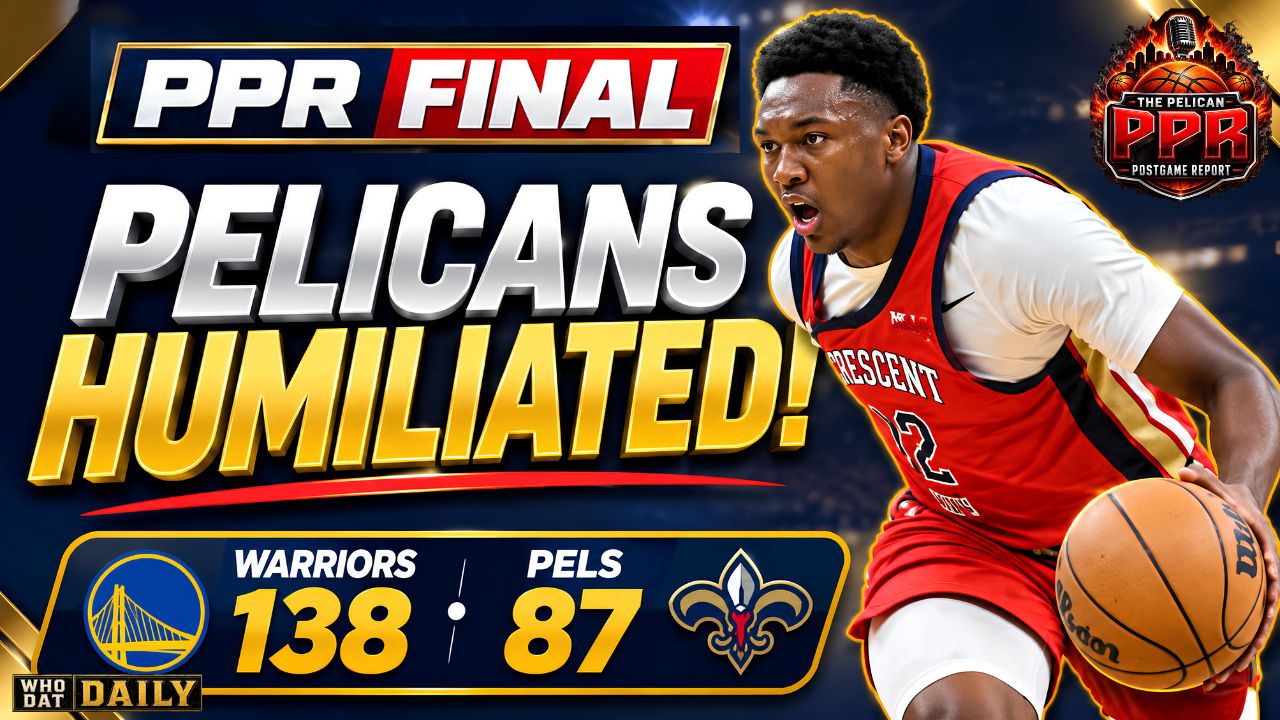
Golden State dismantled New Orleans 138–87 at Chase Center, delivering a humiliating 51-point defeat that left the Pelicans searching for answers just days after their four-game winning streak appeared to signal a turnaround.
For a team attempting to establish a new identity under head coach Jamahl Mosley, this was an alarming setback.
The Warriors didn’t simply win. They dictated the pace, controlled the glass, moved the basketball with precision and repeatedly exposed a New Orleans defense that struggled to communicate and recover.
By halftime, Golden State led 72–43.
By the end of the third quarter, the Warriors had scored 112 points.
The Pelicans never seriously threatened to make the game competitive.
A Game That Got Away Almost Immediately
Golden State established control in the opening quarter, building a 35–20 advantage while New Orleans struggled to generate quality offense.
The Pelicans made just seven of their first 23 field-goal attempts and missed 10 of 12 three-point attempts during the period.
That offensive inefficiency created an immediate problem.
Golden State could push the pace, attack a defense scrambling to recover and force New Orleans into increasingly difficult possessions.
The Warriors added 37 points in the second quarter and another 40 in the third.
Through three quarters, New Orleans had been outscored 112–65.
That 47-point deficit was more than a reflection of poor shooting.
It revealed a team unable to slow its opponent, establish physicality or generate the kind of sustained execution necessary to compete.
Golden State’s Three-Point Shooting Was Devastating
The Warriors made 21 of their 44 three-point attempts.
New Orleans converted only eight of 28.
That gave Golden State a 39-point advantage from beyond the arc alone.
Stephen Curry scored 25 points in just over 20 minutes, making four three-pointers.
Brandin Podziemski added 25 points and five three-pointers, while rookie Yaxel Lendeborg contributed 23 points, seven rebounds and four assists.
Three Warriors scored at least 23 points.
The Pelicans had no effective answer.
Golden State’s offensive movement repeatedly forced New Orleans defenders into difficult decisions. When the Pelicans collapsed toward the basket, shooters found open space. When defenders stayed home, the Warriors attacked through cuts and movement.
The result was an offense that appeared several steps ahead throughout the night.
Missing Zion and Trey Murphy Hurt, but They Don’t Explain Everything
New Orleans entered the game without two of its most important offensive weapons.
Zion Williamson was rested on the second night of a back-to-back after Sunday’s loss to the Clippers.
Trey Murphy III was unavailable because of knee issues.
Those absences unquestionably changed the Pelicans’ offensive ceiling.
Williamson’s ability to pressure the paint creates opportunities for teammates. Murphy’s perimeter shooting stretches defenses and forces opponents to respect the three-point line.
Without them, the Pelicans lacked two of their most dangerous scoring options.
But injuries and rest cannot become blanket explanations for a 51-point defeat.
A team can be undermanned and still compete defensively.
It can communicate, rebound, contest shots and execute basic assignments.
New Orleans struggled in all those areas.
That is what makes this result so concerning.
Derik Queen Provides One of the Few Bright Spots
Rookie Derik Queen led New Orleans with 16 points off the bench.
Dejounte Murray added 12 points, while Jeremiah Fears contributed 11 points and eight assists.
Those performances offered limited encouragement on a night when very little went right.
Queen’s ability to produce offensively remains important for a team searching for dependable frontcourt depth.
Fears continued creating opportunities for teammates, although his six turnovers reflected the difficulty New Orleans experienced against Golden State’s pressure and defensive activity.
But the Pelicans needed much more from the entire rotation.
The absence of their leading offensive threats created opportunities for other players to demonstrate their value.
Too few were able to capitalize.
The Rebounding Disparity Was Unacceptable
Golden State dominated the rebounding battle, 59–40.
That 19-rebound difference was another indication of how thoroughly the Warriors controlled the contest.
Rebounding requires positioning, physicality, anticipation and effort.
New Orleans struggled to finish defensive possessions and couldn’t consistently generate second-chance opportunities at the other end.
Charles Bassey contributed 12 points and 10 rebounds off Golden State’s bench.
The Pelicans needed a more forceful response from their frontcourt.
Without it, Golden State maintained control of both the tempo and the possession battle.
Jamahl Mosley’s Defensive Identity Faces a Serious Test
When Mosley took over in New Orleans, defensive accountability became a central part of the program’s expectations.
The goal was to build a team capable of competing through physicality, discipline and consistent effort.
Monday’s performance represented the opposite.
Golden State shot 54.9 percent from the field and recorded 37 assists.
New Orleans managed only 21 assists while shooting 36.3 percent.
Those numbers reveal a striking difference in offensive organization and execution.
The Warriors consistently created quality opportunities.
The Pelicans struggled to generate them.
More importantly, New Orleans failed to provide enough defensive resistance to prevent the game from becoming a blowout.
Mosley must examine the team’s defensive communication, transition responsibilities, rebounding assignments and lineup combinations.
This cannot be dismissed as merely a bad shooting night.
The defensive breakdown was too extensive.


Three Straight Losses Have Erased the Momentum
Just days ago, New Orleans appeared to be building something.
A four-game winning streak had helped the Pelicans recover from a difficult start.
The team showed offensive versatility, improved confidence and encouraging contributions from its younger players.
Then came the 115–109 defeat against Minnesota.
Next was a 139–123 loss to the Clippers.
Now Golden State has delivered a 51-point demolition.
Three consecutive losses have pushed New Orleans to 4–7.
The most concerning development isn’t simply the losing streak.
It’s how dramatically the team’s defensive performances have deteriorated.
The Pelicans have surrendered 392 points over their last three games.
That is an average of approximately 130.7 points allowed per contest.
For a team emphasizing defense as the foundation of its identity, those numbers should trigger immediate concern.
The Rotation Needs More Than Minor Adjustments
Mosley faces difficult decisions.
How much offensive responsibility should Jeremiah Fears carry?
Can Derik Queen become a more consistent contributor?
Which combinations provide enough perimeter defense and rebounding?
And how can the Pelicans remain competitive when Williamson or Murphy is unavailable?
These questions are not new.
But Monday’s result made them impossible to ignore.
The coaching staff must establish a rotation that can survive difficult stretches without surrendering complete control of a game.
That requires dependable defensive assignments, better rebounding and a clearer offensive structure.
The Pelicans cannot rely on individual scoring talent to cover every weakness.
They need a functioning team identity.
What’s Next: Brooklyn Comes to New Orleans
The Pelicans return home Wednesday, November 11, to face the Brooklyn Nets.
The matchup begins a five-game homestand that offers New Orleans an opportunity to stabilize its season.
But returning home won’t automatically correct the problems exposed in San Francisco.
The Pelicans must demonstrate greater defensive urgency, stronger communication and better execution.
Another performance resembling Monday’s defeat would only deepen the questions surrounding Mosley’s team.
Final Thoughts: A 51-Point Loss Demands Accountability
Nobody should pretend the Pelicans were operating at full strength.
They weren’t.
But a 51-point defeat is bigger than missing two important players.
It reflects a breakdown in execution, defensive discipline, rebounding and competitive resistance.
Golden State deserves credit for an outstanding performance.
The Warriors moved the basketball beautifully, made their shots and punished nearly every New Orleans mistake.
But the Pelicans must take responsibility for their own performance.
A four-game winning streak suggested this team might be developing a winning identity.
Three consecutive defeats have challenged that belief.
The Pelicans don’t need another speech about accountability. They need to demonstrate it on the court — beginning with their next game.


Discover more from The Who Dat Daily
Subscribe to get the latest posts sent to your email.