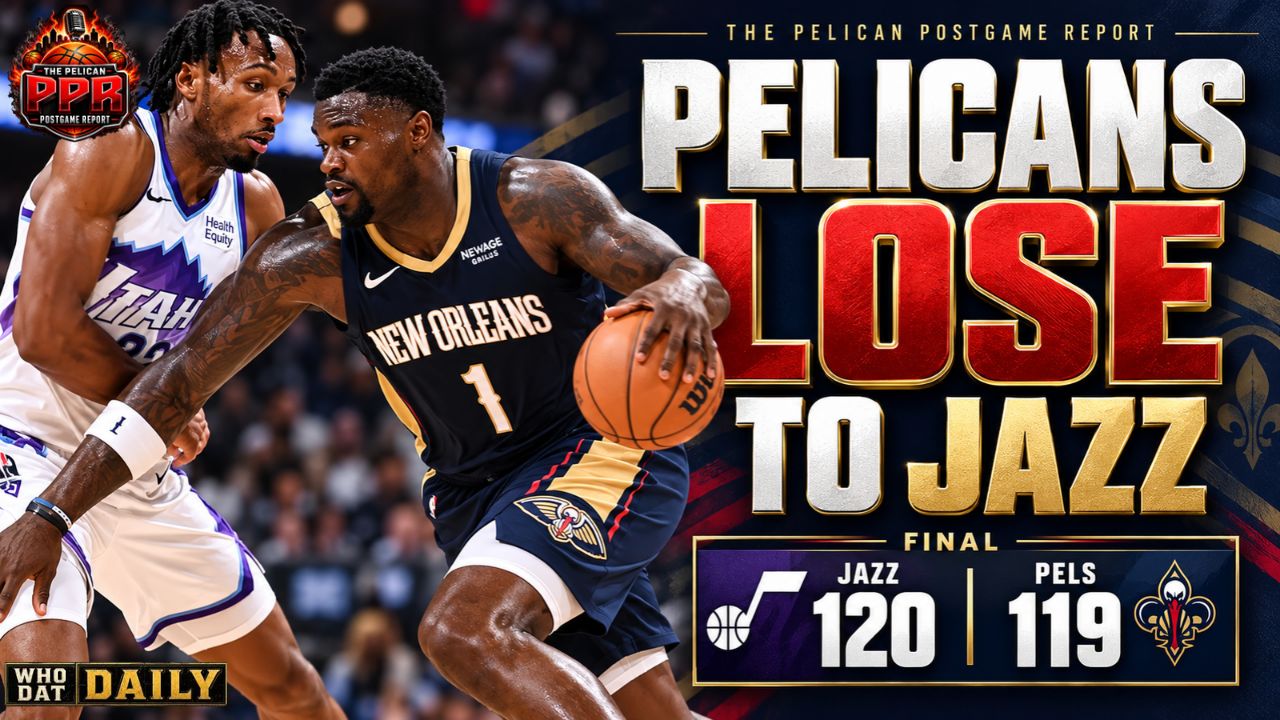

New Orleans fights back from 15 down, loses its fourth-quarter advantage and awaits answers on Yves Missi’s knee.
New Orleans found the fight required to rescue a difficult night in Utah. Finishing the job remains a problem.
The Pelicans lost 120–119 to the Jazz at Delta Center on Friday, dropping to 0–2 after another second-half lead disappeared. Their first two defeats have come by a combined four points. That is close enough to expose the value of individual possessions, and costly enough to demand more than reassurance about how early it is.
The night also brought a concern bigger than the standings: starting center Yves Missi left with a left knee injury. His status now hangs over a team trying to establish itself under Jamahl Mosley.
A comeback that deserved a better finish
Field Level Media’s account traces the game’s central swing: New Orleans erased a 15-point deficit, scored on 10 consecutive possessions and moved ahead. The Pelicans eventually built a 99–94 fourth-quarter lead before Utah answered with a 15–3 run.
That sequence captures both the encouragement and the frustration. The Pelicans had enough offensive traction to change the game. They also had another opportunity to protect a lead, settle into useful possessions and force the opponent to chase.
A comeback and a closing performance require different kinds of control. During a rally, urgency can sharpen decisions and create momentum. Once the lead arrives, a team still needs organized offense, defensive communication and the discipline to handle the opponent’s response.
New Orleans demonstrated that it could seize control for a stretch. The next developmental step is making that control survive a change in momentum. An impressive rally is valuable evidence of competitiveness; the standings reward the team that completes it.
Utah’s response changed the fourth quarter
The Jazz regained a 109–102 advantage with 5:35 remaining, according to Field Level Media. Keyonte George’s shooting and creation for Jaxson Hayes helped drive the surge. New Orleans had gone from making Utah solve problems to needing another recovery of its own.
That is the portion of the game Mosley’s staff should examine as closely as the final shot. A comfortable-looking possession can become a difficult one when the defense takes away the first option. A single stop means less if the next coverage gives the opponent an easy advantage.
The coaching review should identify which offensive actions remained productive when Utah responded, how quickly New Orleans adjusted and which groups could create a dependable defensive possession. Those are practical questions that can lead to changes.
Utah also deserves credit for winning the response. Jaren Jackson Jr. and George each supplied a scoring-and-playmaking or rebounding presence, while Hayes gave the Jazz meaningful production from the bench. This was an opponent that made enough plays to take back the game.
The numbers that sharpen the review
Utah made 13 three-pointers to New Orleans’ eight and led 31–18 in assists. That is 15 extra points from threes.
Those categories help frame the coaching review. An assist total does not record every good pass or every sound decision. The staff should examine whether the offense consistently created a useful second option when the first attack was contained.
The objective is repeatable advantage: move the defense, make the next decision promptly and give the ballhandler an outlet before the possession becomes a difficult individual attempt. That work matters when a team needs stable offense after its hottest stretch ends.
The final minute: chances remained, points did not
Darryn Peterson’s two free throws with 50.5 seconds remaining put Utah ahead for good. The Associated Press reported that a charging call against Zion Williamson was upheld and that Dejounte Murray missed a potential winner just before the buzzer.
The final margin naturally pulls attention toward Murray’s attempt. His responsibility for the shot belongs in the review. The earlier lost advantage belongs there, too.
In a one-possession game, a team has to connect several tasks: get a stop, secure the ball, organize the attack and create a worthwhile attempt. Success at one part does not guarantee success at the next. New Orleans remained within reach, but its closing opportunities did not produce the basket required.
The charge should be described as the call that stood. Turning it into proof that officiating decided the game would require evidence beyond frustration with the outcome. There was already enough basketball for the Pelicans to examine in their own fourth-quarter performance.
The most useful response is specific. Review the available options, the timing of the attack and the alternatives created for the ballhandler. A missed shot is the visible ending; improving the process that produces it is the work.
Williamson, Bey and Murray gave New Orleans a chance
Williamson finished with 23 points, Saddiq Bey contributed 20 off the bench and Murray scored 16. Utah countered with 24 points and 10 rebounds from Jackson, 19 points and 10 assists from George, and 17 points from Hayes.
Bey’s contribution matters because a team cannot ask its primary creators to supply every answer. Productive reserve minutes can keep a difficult game manageable and give the offense another way to function when the defense concentrates on its leading threat.
Murray’s night also requires a complete assessment. His work helped the comeback, and his last attempt did not fall. Both belong in the account. Reducing his performance to the final miss overlooks why New Orleans still had a game to win.
For Williamson, the finishing sequence raises a familiar offensive design question: how can the team preserve his attacking value while making the next option available quickly? Clear spacing and early decisions can give the ballhandler a better chance to react when the defense commits. That is a coaching priority rather than an explanation that can be assigned to every possession from a scoring line alone.

Missi’s injury creates immediate uncertainty
AP’s separate injury report says Williamson fell into Missi’s leg after a blocked drive in the second quarter. Missi needed assistance leaving the court, was ruled out for the remainder of the game with a left knee injury and was scheduled for reevaluation Saturday, October 24.
The reports available for this article did not establish a diagnosis or recovery timetable. His availability will depend on the medical update.
From a basketball standpoint, the uncertainty affects more than a replacement’s minutes. A change at center can alter screening combinations, defensive coverage, rebounding assignments and the types of lineups a coach can trust together.
If Missi misses time, New Orleans will need a deliberate frontcourt plan. Derik Queen, Karlo Matković and the team’s other options offer different combinations of size, offense and experience. The staff must decide which combinations support the rest of the lineup rather than treating the position as interchangeable.
The comeback showed that the Pelicans could remain competitive after the injury. It does not establish that Missi’s absence would be easy to absorb over a longer stretch.
What Mosley must turn into a repeatable standard
The small sample matters. Two close defeats do not determine what this team will become. They do give the staff an immediate problem to solve: the Pelicans have held second-half leads without converting either into a victory.
Accountability should produce identifiable responsibilities. Who organizes the offense after an opponent’s run? Which action gives the team a reliable first advantage? Who communicates the coverage when the opponent changes its attack? Which lineup offers the best balance of creation, size and defensive execution?
The players must carry out those assignments, and the staff must make them clear enough to execute under pressure. A promise to compete has meaning when it shows up in the next possession.
For Mosley, the opportunity is to build on the comeback while tightening the response to adversity. The useful standard is a team that recognizes an adjustment, makes its own and continues to generate sound basketball after the game becomes uncomfortable.
Denver arrives before the frustration has much time to fade
The Pelicans are scheduled to visit Denver on Saturday, October 24, the second game of this road back-to-back. That creates a quick test of their response and an immediate reason to clarify the frontcourt plan.
The priorities are concrete: obtain the medical update on Missi, prepare the available lineups and give the closing group a clear offensive plan. Emotional recovery matters, but preparation must turn that response into decisions the players can use.
New Orleans should take the competitiveness from the Utah comeback into Denver. It should also take a firm understanding that creating another winning opportunity will only complete part of the assignment.
The Pelicans have shown they can make a game difficult for the opponent. Their next task is making the final result reflect that work.
Reporting sources
- Associated Press game report: final score, closing sequence and player performances
- Field Level Media: scoring runs and game flow
- Associated Press: Missi’s left knee injury and reevaluation plan
- Covers: final score and updated records
- CBS Sports: game tracker and play-by-play
- Reuters/Field Level Media: Indiana opener for season context
- Ticketmaster: Pelicans road schedule
Discover more from The Who Dat Daily
Subscribe to get the latest posts sent to your email.






NEW ORLEANS PELICANS
Pelicans Rally, Then Let Another One Slip in 120–119 Loss to Jazz


NEW ORLEANS PELICANS
Bounce Back in Utah? Pelicans Face Their First Response Test

New Orleans Saints
Saints’ Paris Push Faces a Protection Test as Ruiz Sits Again


New Orleans Saints
Saints vs. Vikings Preview: New Orleans Needs a Response on Drew Brees Day

Tulane College Sports
Six Takeaways, One Big Response: Tulane Stuns Memphis 31–17