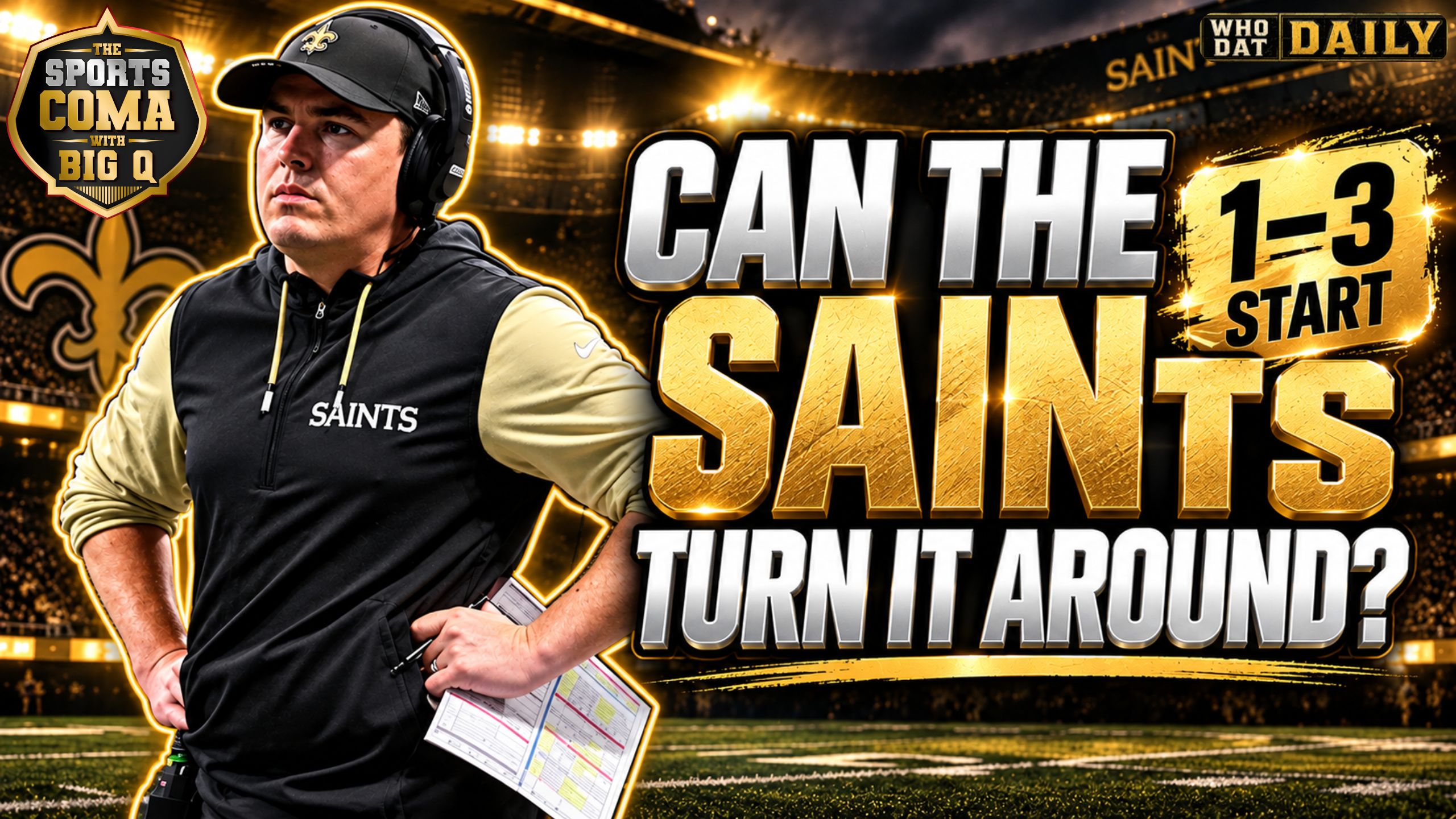

NEW ORLEANS — A rough start doesn’t have to mean a lost season.
The New Orleans Saints find themselves in familiar but uncomfortable territory. At 1–3 through their first four games of the 2026 NFL season, head coach Kellen Moore and his football team face mounting questions about consistency, execution, injuries, and whether this roster has what it takes to turn things around.
For a passionate Who Dat Nation still searching for reasons to believe, the early results have been frustrating. New Orleans has demonstrated flashes of offensive firepower, particularly behind young quarterback Tyler Shough, but costly mistakes, defensive breakdowns, and an inability to finish games have overshadowed those promising moments.
However, Saints history offers an important reminder: A 1–3 start does not automatically eliminate New Orleans from playoff contention.
Twice in franchise history, the Saints have overcome that exact record to reach the postseason. The 1990 team fought through quarterback uncertainty and relied on its defense to survive. A decade later, the 2000 Saints transformed a disappointing September into one of the most memorable seasons in franchise history.
Those two teams provide different blueprints for what Moore’s Saints must accomplish if they hope to make the 2026 season meaningful.
1990: Jim Mora’s Saints Refused to Let Their Season Die
The 1990 New Orleans Saints entered the season facing major uncertainty at the quarterback position.
Veteran starter Bobby Hebert was involved in a contract holdout, leaving head coach Jim Mora searching for stability under center. The Saints struggled to generate consistent offensive production, and early losses pushed the team to a disappointing 1–3 record.
With the season threatening to slip away, New Orleans acquired quarterback Steve Walsh from the Dallas Cowboys.
Walsh did not transform the Saints into an offensive powerhouse, but his arrival helped provide a measure of stability while the defense continued to carry the team.
That defense was anchored by the legendary Dome Patrol, one of the most feared linebacker groups in NFL history. Rickey Jackson, Pat Swilling, Sam Mills, and Vaughan Johnson formed the foundation of a unit capable of keeping New Orleans competitive even when its offense struggled.
Mora’s team continued battling through an uneven season, eventually winning its final two regular-season games against San Francisco and the Los Angeles Rams.
The Saints finished 8–8, good enough to secure the NFC’s final Wild Card position.
Although New Orleans lost to the Chicago Bears in the opening round, the season demonstrated how defensive toughness, timely victories, and perseverance could rescue a struggling football team.
The lesson for 2026: The Saints do not necessarily need a perfect offense to turn their season around. They need a defense capable of getting stops, limiting explosive plays, and protecting leads when the offense puts points on the scoreboard.
2000: A 1–3 Start Became a Division Championship
If the 1990 Saints demonstrated survival, the 2000 team showed what can happen when a struggling football team discovers its identity.
New head coach Jim Haslett inherited a franchise desperately searching for a fresh start. Unfortunately, his first month on the sidelines offered little indication of the success that would follow.
New Orleans opened 1–3, suffering losses to Detroit, Philadelphia, and Seattle. Special teams mistakes and inconsistent execution contributed to the team’s early struggles.
Then everything changed.
The Saints responded with six consecutive victories, completely reversing the direction of their season.
Quarterback Jeff Blake helped spark the turnaround before a season-ending injury forced backup Aaron Brooks into the starting lineup. Rather than allowing the injury to derail the team’s progress, Brooks provided mobility, confidence, and big-play ability that kept the offense moving.
Running back Ricky Williams delivered a 1,000-yard rushing campaign, while wide receiver Joe Horn emerged as one of the NFL’s most dangerous offensive weapons.
Defensively, New Orleans benefited from a relentless pass rush and a physical approach that helped the team win difficult games.
The Saints finished 10–6 and captured the NFC West championship, an accomplishment that seemed unlikely after their first four games.
But the most important moment was still ahead.
In the Wild Card round, New Orleans defeated the defending Super Bowl champion St. Louis Rams 31–28, earning the franchise’s first postseason victory.
For a fan base accustomed to disappointment, that victory represented much more than a playoff win. It proved that the Saints could overcome adversity, challenge established contenders, and create their own history.
The lesson for 2026: Momentum can change quickly in the NFL. The Saints must develop an identity, establish consistency, and put together consecutive victories rather than allowing one disappointing performance to undo the progress of another.
Saints History: Two Different Roads From 1–3 to the Playoffs
| Category | 1990 Saints | 2000 Saints |
|---|---|---|
| Head coach | Jim Mora | Jim Haslett |
| First four games | 1–3 | 1–3 |
| Final record | 8–8 | 10–6 |
| Key quarterback | Steve Walsh | Jeff Blake / Aaron Brooks |
| Main strength | Dome Patrol defense | Balanced offense and pass rush |
| Playoff qualification | NFC Wild Card | NFC West champions |
| Playoff result | Lost to Chicago | Beat St. Louis, then lost to Minnesota |
These teams were built differently, but both shared important characteristics: they responded to adversity, adjusted to personnel challenges, and refused to allow a disappointing opening month to define their entire season.
For the current Saints, that history offers encouragement without guaranteeing anything.
The 2026 Saints: A Season Already at a Crossroads
The current Saints have plenty of reasons to be concerned.
Their 45–24 Monday Night Football defeat against the Atlanta Falcons was more than another loss in the standings. It exposed problems that cannot continue if New Orleans expects to compete for a playoff position.
Atlanta rushed for 205 yards and five touchdowns, repeatedly exploiting the Saints’ defensive front. Meanwhile, New Orleans managed only 50 rushing yards, placing an enormous burden on Tyler Shough and the passing game.

2026 NFL Week 4
+1
The defeat was particularly painful because it occurred during the 20th-anniversary celebration of the Saints’ emotional return to the Superdome following Hurricane Katrina.
Instead of giving the home crowd a memorable victory, New Orleans suffered one of its most discouraging performances of the young season.
Yet there are reasons to believe the Saints possess more offensive potential than their record suggests.
Shough has thrown for 1,203 yards and nine touchdowns through four games. His production has demonstrated that New Orleans can move the football through the air, even as injuries and inconsistent protection have created challenges.
The question is whether the rest of the team can become dependable enough to support its young quarterback.
What Must Change for New Orleans to Repeat History?
The defense must become more physical. The Saints cannot expect to win consistently while surrendering explosive rushing plays and allowing opponents to control the line of scrimmage. Defensive coordinator Brandon Staley must find solutions that improve gap discipline, tackling, and communication.
The running game must become a legitimate threat. Alvin Kamara and the remaining backfield need more consistent blocking and opportunities to establish manageable down-and-distance situations. The offense cannot depend on Shough throwing nearly 50 passes every week.
Kellen Moore must establish an identity. The 1990 Saints leaned on their defense. The 2000 Saints found balance and explosive playmaking. The 2026 team needs to determine what it does best and build a winning formula around those strengths.
New Orleans must learn how to finish. The Saints have already experienced close losses against Detroit and Las Vegas. Finding ways to protect leads, avoid costly turnovers, and execute in critical moments could make the difference between another disappointing season and a legitimate turnaround.
The team must respond immediately. History offers encouragement, but it does not provide additional victories. The Saints must earn those on the field.
The Upcoming Schedule Offers an Opportunity — and a Warning
New Orleans enters an important stretch before its Week 8 bye.
| Week | Opponent | Location |
|---|---|---|
| Week 5 | Minnesota Vikings | Home |
| Week 6 | New York Giants | Away |
| Week 7 | Pittsburgh Steelers | Home |
| Week 8 | Bye | — |
| Week 9 | Cleveland Browns | Home |
The immediate challenge is an undefeated Minnesota Vikings team that has opened the season 4–0.
A victory against Minnesota would give the Saints an opportunity to begin rebuilding confidence. Another loss would leave New Orleans at 1–4, increasing the pressure on Moore and his coaching staff.
NFL.com
+1
With 13 regular-season games remaining, the Saints would need to finish 8–5 to reach nine wins or 9–4 to reach ten.
Neither outcome guarantees a playoff berth, but both illustrate the level of improvement required.
Can the Saints Make History Again?
There is one important difference between the historical turnarounds and today’s NFL.
The 1990 Saints reached the postseason at 8–8 under a different playoff structure. The 2000 Saints earned a division championship at 10–6.
Today’s NFL features a 17-game regular season and seven playoff teams per conference. That provides more games to recover from an early slump, but it also creates a different competitive landscape.
The 2026 Saints cannot rely on history alone.
They need improved coaching adjustments, better defensive execution, a more dependable running game, and the kind of leadership that keeps a locker room together when expectations are not being met.
The 1990 Saints proved that a team could survive a difficult beginning. The 2000 Saints proved that a disappointing start could lead to something extraordinary.
Now Moore, Shough, Kamara, and the rest of this roster have an opportunity to determine whether the 2026 Saints will be remembered as another team that fell short or one that refused to surrender its season.
For Who Dat Nation, the message is simple.
The Saints have been 1–3 before. They have recovered before. But if they want to do it again, the turnaround must begin now.
The Who Dat Daily — Independent coverage of New Orleans Saints football, NFL news, analysis, and Louisiana sports.
Discover more from The Who Dat Daily
Subscribe to get the latest posts sent to your email.






New Orleans Saints
Saints at 1–3: History Proves New Orleans Can Still Turn Its Season Around

NEW ORLEANS PELICANS
Pelicans Fall to Heat 128–118 as Turnovers Spoil Strong Shooting


NEW ORLEANS PELICANS
Pelicans vs. Heat Preview: New Orleans Needs a Stronger Start After Thunder Comeback

NEW ORLEANS PELICANS
Pelicans Open Training Camp With a New Voice, New Depth and No Time to Waste


LSU Football News
LSU Drops to No. 10 in Week 4 AP Poll After Ole Miss Loss