
Gee Bino | The Who Dat Daily
The New Orleans Pelicans are not waiting for training camp to sort itself out. They are actively reshaping the bottom of the roster around new head coach Jamahl Mosley.
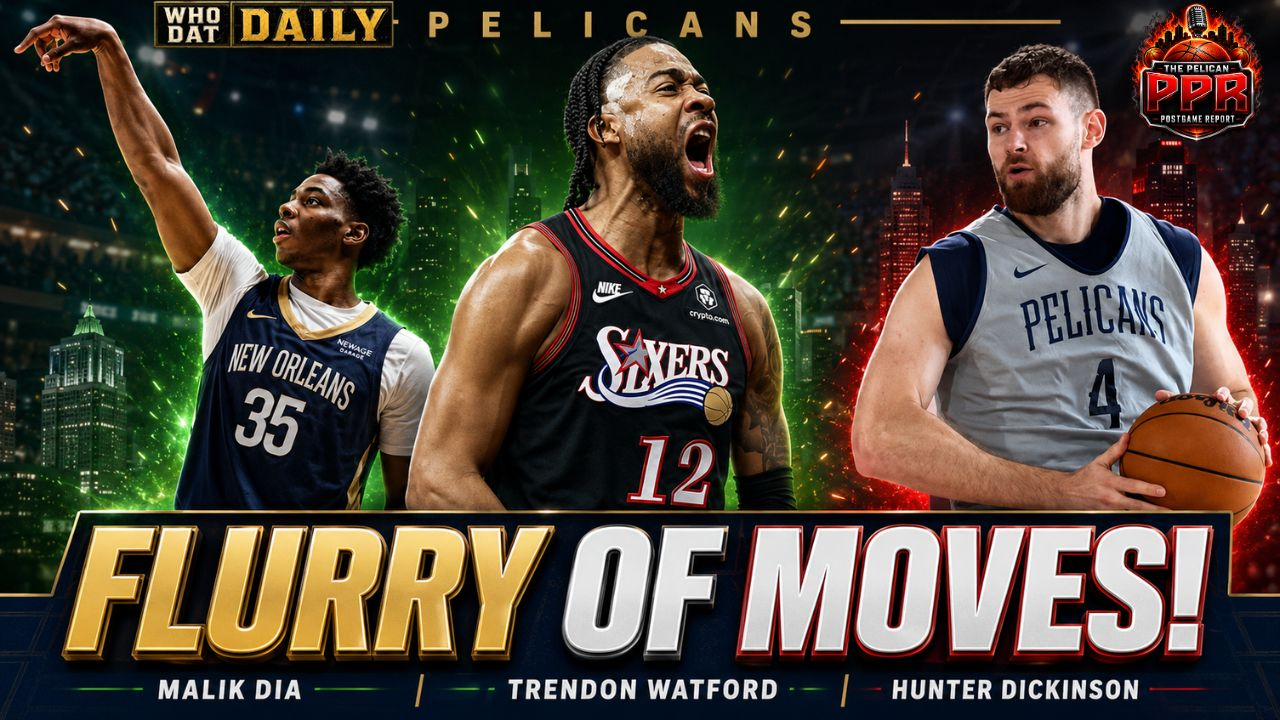
The latest sequence brings a familiar LSU product home, rewards a productive Summer League forward and moves on from a popular college big man:
- Trendon Watford agreed to a one-year, $2.9 million contract.
- Undrafted Ole Miss forward Malik Dia agreed to a two-way contract.
- The Pelicans waived center Hunter Dickinson, according to HoopsHype’s Michael Scotto.
Individually, none of the moves changes the Western Conference. Together, they show how president of basketball operations Joe Dumars and Mosley want to finish the roster: more switchable size, more multi-position skill and more competition around the young core.
Trendon Watford is a sensible late-summer addition
Watford, a former LSU standout, returns to Louisiana after stops with Portland, Brooklyn and Philadelphia. He averaged 6.5 points, 3.3 rebounds and 2.5 assists in 16.3 minutes over 53 games for the 76ers last season. ESPN’s Shams Charania reported the one-year, $2.9 million agreement on August 17.
The appeal is not star power. It is lineup flexibility.
At 6-foot-8 and roughly 245 pounds, Watford can function as a power forward, small-ball center or secondary playmaker. He can grab a defensive rebound and initiate the offense without waiting for a guard. On a team with Zion Williamson, Trey Murphy III, Herb Jones and Saddiq Bey, that gives Mosley another big wing who can keep the ball moving.
Watford is not a high-volume shooter or a defensive stopper. His role will depend on making quick decisions, defending with discipline and avoiding possessions that stall. At the veteran minimum, however, he is an intelligent bet on skill and versatility.
Malik Dia earned the two-way opportunity
Dia went undrafted in June, but he gave New Orleans a strong Summer League audition. In the Pelicans’ win over Phoenix, he produced 18 points, eight rebounds, two steals and two blocks in 23 minutes, according to NBA.com’s game report.
That performance captured his developmental appeal. Dia has legitimate forward size at 6-foot-9 and 250 pounds, but he is mobile enough to play in space. A two-way contract lets the Pelicans develop his shooting, defensive reads and conditioning with the Laketown Squadron while making him available for NBA opportunities.
He does not have to crack Mosley’s rotation immediately. He needs to become a dependable modern frontcourt defender who can finish plays, rebound outside his area and punish defenses that ignore him.
Why Hunter Dickinson was waived
Dickinson’s exit is more about roster arithmetic and defensive fit than his college résumé.
The former Michigan and Kansas star went undrafted in 2025 and appeared in five games as a Pelicans rookie. He then re-signed on a two-way deal in July and showed his offensive touch in Summer League, including a 21-point performance against Charlotte. But New Orleans already has multiple traditional centers, and Dickinson’s pathway to minutes remained narrow.
Dia gives the organization more switchability. Jaron Pierre Jr. occupies another two-way spot. Waiving Dickinson creates room for the Pelicans to continue evaluating a third developmental player before opening night.
This is not a declaration that Dickinson cannot play professionally. It is a decision that New Orleans needs a different developmental profile.
The complete Pelicans offseason roster
The 20 names associated with the team should not be described as 20 regular NBA contracts. The working roster consists of 15 standard contracts, two two-way players and three players competing on camp deals.
| Player | Pos. | Contract bucket | Projected use |
|---|---|---|---|
| Dejounte Murray | G | Standard | Lead guard and primary organizer |
| Jeremiah Fears | G | Standard | Young creator; major second-unit role |
| Jordan Poole | G | Standard | Bench scoring and secondary creation |
| Jordan Hawkins | G | Standard | Movement shooting competition |
| Bryce McGowens | G/F | Standard | Reserve wing and spot scorer |
| Trey Murphy III | G/F | Standard | Core starter and top perimeter scorer |
| Herb Jones | F | Standard | Defensive anchor and connector |
| Saddiq Bey | F | Standard | Starting-caliber scorer and floor spacer |
| Micah Peavy | F | Standard | Defensive rotation wing |
| Zion Williamson | F | Standard | Offensive centerpiece |
| Trendon Watford | F | Standard | Versatile reserve forward/small-ball five |
| Derik Queen | C/F | Standard | Young starting-caliber hub |
| Yves Missi | C | Standard | Rim-running and shot-blocking center |
| Karlo Matkovic | F/C | Standard | Stretch and energy frontcourt depth |
| DeAndre Jordan | C | Standard | Veteran rebounding, screening and leadership |
| Jaron Pierre Jr. | G/F | Two-way | Rookie scoring development |
| Malik Dia | F | Two-way | Switchable forward development |
| Kobe Bufkin | G | Camp deal | Competing for a guard opening/call-up path |
| Caleb Houstan | F | Camp deal | Competing as a shooting wing |
| Christian Koloko | C | Camp deal | Competing as a mobile defensive center |
Hunter Dickinson is no longer on the active working roster following his reported waiver.
A cleaner position-by-position depth chart
Offseason depth charts are fluid, but this is the most logical functional grouping entering camp:
| Role | First group | Second group | Competition/development |
| Lead guard | Dejounte Murray | Jeremiah Fears | Kobe Bufkin |
| Scoring guard | Trey Murphy III | Jordan Poole | Jordan Hawkins, Bryce McGowens |
| Wing stopper | Herb Jones | Micah Peavy | Jaron Pierre Jr. |
| Big forward | Zion Williamson | Saddiq Bey | Trendon Watford, Malik Dia, Caleb Houstan |
| Center | Derik Queen / Yves Missi | Karlo Matkovic | DeAndre Jordan, Christian Koloko |
That table is intentionally based on function, not rigid positions. Mosley’s best lineups should feature several players who can initiate, switch and defend more than one assignment.
How Mosley and his staff should build this team
Jamahl Mosley comes to New Orleans after five seasons with the Orlando Magic, where he helped transform a young rebuilding team into a three-time playoff participant. During his introductory press conference, Mosley and basketball operations chief Joe Dumars outlined a vision built around elite defense, physicality, relentless effort and accountability—not simply player development. (NBA.com)
Mosley’s current staff should also be identified correctly. According to the Pelicans’ official staff directory, Bret Brielmaier, Will Bynum, Randy Gregory, Michael Hopkins, Dale Osbourne and God Shammgod are assistant coaches, while New Orleans native Greg Monroe serves as a player-development assistant. Brielmaier, Osbourne and Shammgod followed Mosley from Orlando, giving the Pelicans several coaches who already understand his system, expectations and communication style. Mosley said he values those assistants because they are willing to challenge him and tell him the truth.
That combination of familiarity and continuity could be important for a roster containing both established veterans and young building blocks. Shammgod’s extensive background in ball-handling and perimeter development should benefit Jeremiah Fears, Dejounte Murray, Jordan Poole and the team’s other guards. Brielmaier and Osbourne can help install Mosley’s defensive principles, while Monroe’s experience as an NBA big man makes him a valuable developmental resource for Derik Queen and Yves Missi.
The Pelicans must now give every member of the staff a clearly defined responsibility. Defense and accountability should become organizational standards rather than occasional talking points. Zion Williamson must be challenged to defend, communicate and remain engaged away from the ball. Fears and Queen need structured development plans, while players such as Trey Murphy III and Herb Jones should be empowered as two-way leaders.
Offensively, Mosley should use Williamson as a devastating downhill creator without forcing him to initiate every possession. Murray and Fears can organize the offense, Murphy can supply spacing and secondary creation, and Poole can provide controlled scoring when the team needs an offensive spark. Queen and Missi should be developed as complementary frontcourt pieces rather than being placed in direct competition for identical roles.
Mosley does not need every player to have the same skill set. He needs them to follow the same standards. If playing time is earned through defensive effort, communication, preparation and unselfish basketball, the Pelicans can finally begin replacing inconsistency with a sustainable team identity.
1. Make defense the price of admission
Herb Jones is the standard. Murphy, Peavy, Bey and Murray give Mosley the length to pressure the ball and switch across the perimeter. Missi and Koloko offer vertical defense behind them. Zion, Poole and the young centers must be held to the same possession-by-possession accountability.
The Pelicans do not need every player to become an All-Defensive candidate. They do need five connected defenders on the floor.
2. Put the ball in Zion’s hands—but not every decision on his shoulders
Zion remains the player who bends a defense. The best version of this roster uses him as a downhill creator surrounded by shooting, cutters and a center who can occupy the rim.
Murray should organize late-clock possessions. Fears needs developmental reps as a second-unit initiator. Queen can become a frontcourt passing hub. Sharing creation duties can make Zion more dangerous and less predictable.

3. Establish a real guard hierarchy
Murray and Fears should receive the cleanest point-guard minutes. Murphy is too valuable as a scorer and defender to be treated as a full-time ballhandler. Poole’s best path is a controlled sixth-man role in which his shot creation lifts bench units without dictating the identity of the starters.
Hawkins, McGowens and the camp guards must earn minutes with shooting, defense and low-turnover decisions.
4. Let Queen and Missi complement each other
Queen supplies touch, passing and interior scoring. Missi supplies speed, rim protection and vertical pressure. Mosley does not have to choose one permanently in October. He can use matchups and development priorities to split the minutes, then close with the player who best fits the opponent.
Watford and Matkovic give the staff smaller or more skilled alternatives when a traditional center compresses the floor.
5. Use Laketown as a true development program
Dia and Pierre should receive heavy G League minutes instead of collecting NBA bench DNPs. Their two-way deals are most valuable if the organization gives them defined assignments: defend multiple positions, improve shot selection and learn the same terminology used by Mosley’s NBA rotation.
Big Q’s bottom line
The Pelicans’ flurry of moves makes sense because each transaction addresses a different layer of the roster.
Watford helps now. Dia is a development bet. Waiving Dickinson opens flexibility. The three camp contracts create competition without disturbing the 15 standard deals.
The roster is not perfectly balanced—there are still too many guards who need touches and too many centers who need evaluation—but Mosley has length, youth and lineup variety. His first job is not drawing a brilliant offense on a whiteboard. It is establishing a rotation in which defense, decision-making and availability determine who plays.
If that standard is real, the Pelicans finally have enough internal competition to make it matter.
Sources
Discover more from The Who Dat Daily
Subscribe to get the latest posts sent to your email.






New Orleans Saints
Saints at 1–3: History Proves New Orleans Can Still Turn Its Season Around

NEW ORLEANS PELICANS
Pelicans Fall to Heat 128–118 as Turnovers Spoil Strong Shooting


NEW ORLEANS PELICANS
Pelicans vs. Heat Preview: New Orleans Needs a Stronger Start After Thunder Comeback

NEW ORLEANS PELICANS
Pelicans Open Training Camp With a New Voice, New Depth and No Time to Waste


New Orleans Saints
Saints Place Travis Etienne on IR, Add Ojabo and Bentley Before Falcons