
By Gee Bino | The Who Dat Daily
The New Orleans Pelicans ended their 2026 NBA Summer League run with their most lopsided defeat of the tournament.
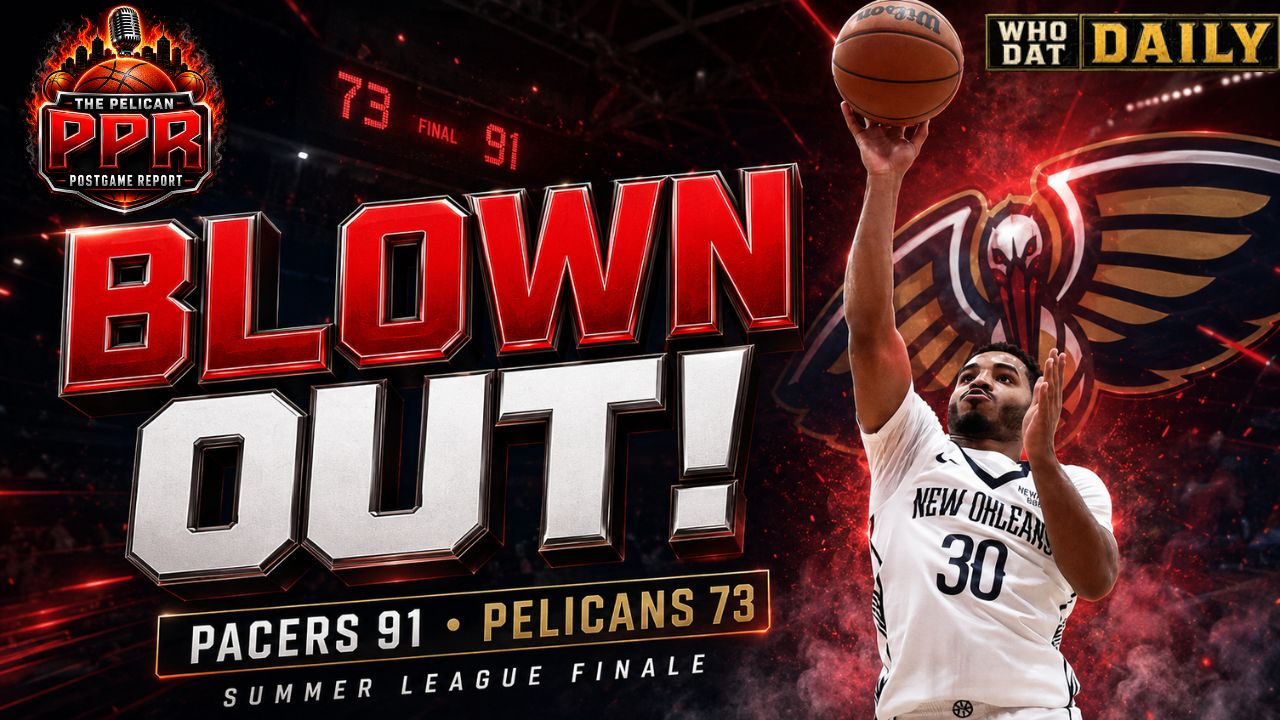
Indiana defeated New Orleans 91-73 after leading by as many as 24 points. The Pacers controlled the game through superior ball movement, better shooting and relentless pressure against a Pelicans offense that never established a sustainable rhythm.
New Orleans finished its five-game Las Vegas schedule with a 2-3 record.
Dominique Daniels Jr. scored a team-high 25 points, while Markquis Nowell added 14 points and six assists. However, the Pelicans shot only 36 percent, committed 21 turnovers and recorded half as many assists as Indiana.
The final score was disappointing. More importantly, the performance provided one final evaluation of the players competing for training-camp invitations, two-way positions and opportunities with the Laketown Squadron.
Pacers Controlled the Summer League Finale
Indiana led for 84 percent of the game. New Orleans held an advantage for only eight percent and never led by more than four points.
The Pacers shot 45 percent from the field compared to the Pelicans’ 36 percent. Indiana also finished with a decisive 28-14 advantage in assists.
That difference defined the game.
Indiana consistently created shots through penetration, passing and off-ball movement. New Orleans relied too heavily on individual creation, often attempting difficult shots after its initial action failed.
The Pacers recorded assists on most of their made field goals. The Pelicans assisted on only 14 of their 25 baskets.
Summer League offenses are rarely polished, but New Orleans’ lack of organization became impossible to overlook.
Pelicans Offense Never Found a Rhythm
New Orleans finished 25-of-69 from the field and made nine of its 27 three-point attempts.
The Pelicans’ 33 percent perimeter shooting was respectable enough to remain competitive. Their inability to finish other opportunities created the larger problem.
New Orleans generated 12 offensive rebounds and 15 steals. Those effort plays should have created enough extra possessions to challenge Indiana.
Instead, the Pelicans repeatedly gave the ball back.
New Orleans committed 21 turnovers, including 13 from its five starters. Solomon Washington and Markquis Nowell combined for 11 giveaways.
The Pelicans also shot just 54 percent from the free-throw line, converting seven of 13 attempts. Nate Mensah missed all five of his free throws.
Poor shooting, turnovers and missed free throws eliminated the value of New Orleans’ defensive activity.
Dominique Daniels Jr. Delivered His Best Performance
Daniels entered the finale needing a significant performance to strengthen his case for another opportunity.
He responded with 25 points in 31 minutes.
Daniels shot 8-of-19 from the field, made four of his eight three-point attempts and converted all three of his free throws. He also recorded three assists, two steals and only two turnovers.
His aggression gave the Pelicans their most reliable source of offense.
Daniels did not receive consistent minutes behind New Orleans’ primary guards during the preliminary schedule. With Kobe Bufkin, Jaron Pierre Jr. and Micah Peavy unavailable for the finale, he finally received an extended opportunity.
He took advantage of it.
One productive game does not guarantee a contract, but Daniels demonstrated enough scoring and shot-making ability to earn consideration from Birmingham or another G League organization.
His next challenge will be proving that he can organize an offense rather than functioning primarily as a scorer.

Markquis Nowell’s Night Captured His Summer League Story
Nowell finished with 14 points, six assists and two steals. He made three three-pointers and attempted to keep the Pelicans organized against Indiana’s pressure.
However, he also committed six turnovers and finished with a team-worst minus-18 rating.
That combination summarized his Summer League performance.
Nowell can create offense. His handle, vision and confidence allow him to generate opportunities that many developmental guards cannot see. He also plays with enough energy to create steals despite standing only 5-foot-7.
The physical limitations remain unavoidable.
Indiana pressured Nowell, disrupted his passing angles and forced him into difficult decisions. NBA teams will repeatedly target him through switches and larger defenders.
Still, Nowell demonstrated that he belongs in a professional development system.
The Pelicans should consider prioritizing him as a lead guard for Birmingham. A G League role would allow him to run an offense, improve his turnover management and continue proving that his skill can overcome his size.
Film Room: Why Indiana’s Passing Broke New Orleans Down
The Pacers did not dominate because of one unstoppable scorer. They created advantages collectively.
Indiana moved the ball after forcing the first defensive rotation. When New Orleans helped against penetration, the Pacers found the next open player instead of immediately forcing a shot.
That approach produced 28 assists.
The Pelicans frequently generated the opposite result. Guards attacked the first defender, encountered help and then attempted difficult finishes or late passes.
New Orleans’ offense became especially stagnant when Indiana took away the initial action.
The Pacers also punished the Pelicans in transition. New Orleans’ turnovers allowed Indiana to attack before the defense could establish its matchups.
That difference matters when evaluating prospects.
Summer League players naturally want to showcase their individual abilities. However, NBA coaches need players who recognize the next pass, maintain spacing and make decisions before the defense recovers.
Indiana consistently played that way. New Orleans did not.
Solomon Washington Filled the Stat Sheet
Washington scored only six points, but he made an impact in several other categories.
He collected 11 rebounds, including five on the offensive glass, and recorded four steals. His activity gave the Pelicans additional possessions while helping them remain competitive on the boards.
Washington’s five turnovers undermined some of that work.
He must become more secure with the ball and avoid attempting plays outside his offensive role. His clearest pathway involves defense, rebounding and effort—not high-volume creation.
Washington has the physical tools to become a useful developmental forward. He needs a clearly defined role that emphasizes what he already does well.
Malik Dia and Christian Shumate Provided Support
Dia recorded 11 points, nine rebounds, two steals and one block. Although he shot only 4-of-12, his size and activity created several positive moments.
Shumate also scored 11 points while adding five rebounds and two steals. He committed only one turnover and finished with the best plus-minus among the starters at minus-nine.
Neither player changed the result, but both demonstrated useful qualities.
Dia’s rebounding and interior presence merit continued evaluation. Shumate’s defensive activity and relatively disciplined performance could earn him an opportunity with a G League team.
The Pelicans must determine whether either player possesses one NBA-level skill strong enough to justify a developmental investment.
Nate Mensah’s Defense Was Undermined at the Line
Mensah scored two points and missed all five of his free-throw attempts.
His inability to convert at the line was costly, but his defensive contributions should not be ignored.
Mensah collected nine rebounds, blocked two shots and recorded two steals. He also added two assists while committing only one turnover.
That production illustrates the difficulty of evaluating developmental centers.
Mensah affected the game defensively, but opponents can exploit a center who cannot convert free throws or finish offensive opportunities. His next development program must place significant emphasis on shooting mechanics and touch.
Defensive activity can earn Mensah another opportunity. Offensive limitations will determine how far that opportunity extends.
Big Q’s Take
The 91-73 loss was not simply the result of missing several prominent players.
The Pelicans failed to execute basic offensive principles.
New Orleans generated 15 steals and grabbed 12 offensive rebounds. Those numbers demonstrate effort. The problem was what happened after the Pelicans created those opportunities.
Twenty-one turnovers and 14 assists reveal an offense that did not value possession or consistently create shots for teammates.
Daniels helped himself with a 25-point performance. Nowell again showed enough playmaking to deserve a longer developmental look. Washington, Dia and Mensah contributed through rebounding and defense.
However, the finale demonstrated why most Summer League players remain far from permanent NBA roles.
Talent creates opportunities. Decision-making determines whether those opportunities last.
Who Earned Another Opportunity?
The Pelicans’ full Summer League evaluation should include all five games rather than allowing one loss to determine every decision.
Several players remain clear priorities.
Jaron Pierre Jr. is New Orleans’ only 2026 draft selection and must receive a structured development plan.
Micah Peavy remains valuable because of his defensive versatility and existing place within the organization.
Hunter Dickinson is already under two-way control and possesses enough offensive skill to justify continued development.
Kobe Bufkin produced the strongest overall scoring run of the tournament and should compete for a backup role during training camp.
Markquis Nowell deserves consideration for Birmingham or an available two-way position.
Dominique Daniels Jr. strengthened his case with a 25-point finale and should receive additional G League evaluation.
The Pelicans do not need to keep every player. They must preserve the prospects whose strongest skills can translate into Mosley’s system.
Why It Matters
Summer League is the beginning of player development—not the end of roster construction.
The Pelicans need inexpensive contributors who can eventually support their established core. Two-way players and G League prospects provide flexibility when injuries or salary-cap restrictions affect the main roster.
Mosley also needs the same basketball principles operating at every organizational level.
Players in Laketown should learn New Orleans’ defensive terminology, offensive spacing and decision-making expectations. That continuity allows developmental prospects to contribute more quickly when called up.
The 91-73 loss exposed how much work remains.
New Orleans played hard enough to produce 15 steals. It did not play intelligently enough to convert that activity into winning basketball.
Final Summer League Verdict
The Pelicans completed Las Vegas with a 2-3 record.
They discovered several prospects worth developing, but they did not identify enough dependable shooting, ball security or half-court organization.
Bufkin was the most consistent scorer. Pierre delivered an encouraging breakout against Phoenix. Peavy supplied defensive versatility. Nowell created offense, while Daniels made a strong final statement.
The next step belongs to the front office and development staff.
Summer League identified the possibilities. Training camp and Kenner will determine which players can turn those possibilities into legitimate NBA roles.
Gee Bino is a senior writer and columnist for The Who Dat Daily, covering the New Orleans Saints, Pelicans, LSU athletics, and the Gulf South sports landscape. He specializes in roster construction, player development, salary cap strategy, and breaking news coverage. Follow The Who Dat Daily for daily news, analysis, and exclusive team coverage.
Discover more from The Who Dat Daily
Subscribe to get the latest posts sent to your email.






New Orleans Saints
Saints Beat Giants 34–27: Turning Point or More Questions?

NEW ORLEANS PELICANS
New Voice, Real Stakes: The Pelicans’ 2026–27 Season Outlook


New Orleans Saints
Saints Place Travis Etienne on IR, Add Ojabo and Bentley Before Falcons


New Orleans Saints News
Saints vs. Falcons Preview: Shough, Run Defense and a Chance to Reset