
By Gee Bino | The Who Dat Daily
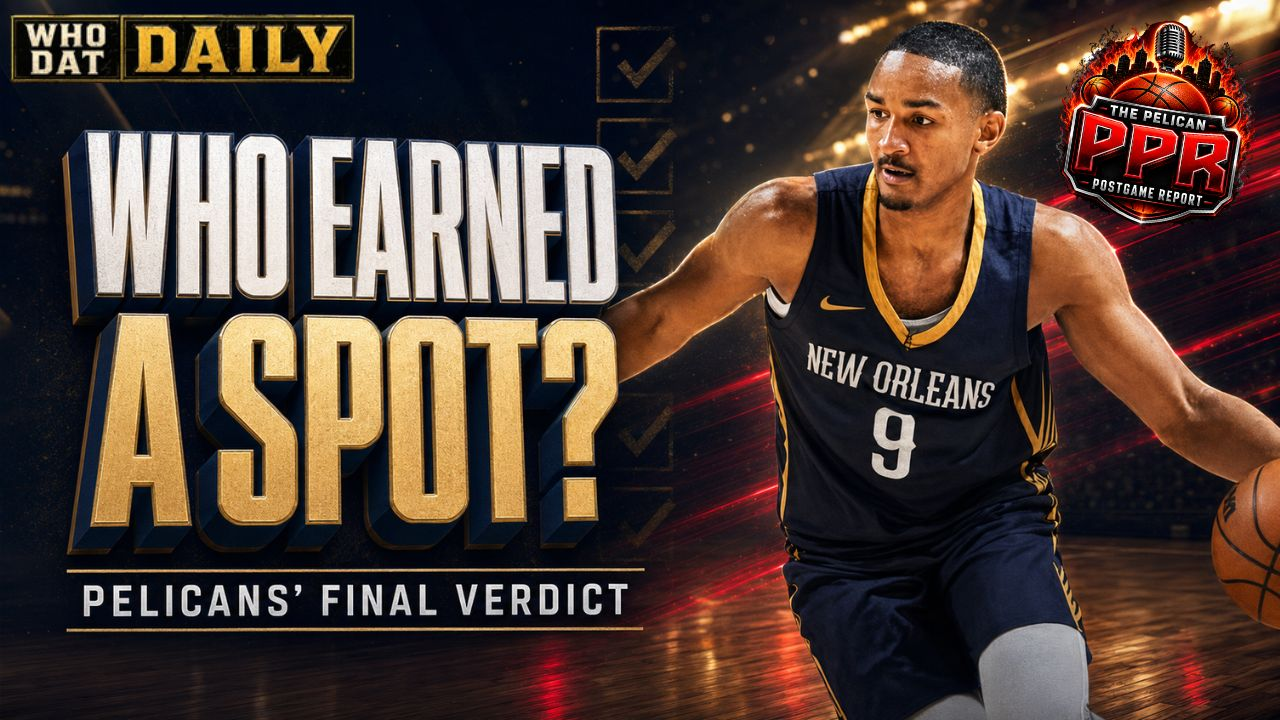
The New Orleans Pelicans completed their four-game preliminary Summer League schedule with a 2–2 record, but their final matchup against the Indiana Pacers carries greater significance than the standings suggest.
New Orleans entered Las Vegas looking for more than victories. The organization needed to evaluate which young players could fit head coach Jamahl Mosley’s defensive system, compete for open two-way positions or strengthen the Lakeview Squadron.
Kobe Bufkin and Markquis Nowell supplied explosive backcourt performances. Jaron Pierre Jr. provided an encouraging glimpse of his scoring potential. Chris Bell demonstrated legitimate floor-spacing ability, while Micah Peavy continued doing the less glamorous defensive work that could eventually earn him NBA minutes.
The final game against Indiana gives those players one more opportunity to influence the organization’s decisions.
Some prospects are already under team control. Others are fighting for an invitation, a developmental contract or simply enough strong film to attract another franchise.
Pelicans Finished the Preliminary Schedule at 2–2
New Orleans split its first four games in Las Vegas.
The Pelicans lost their opener to Minnesota, 105–92, before responding with consecutive victories over Charlotte and Phoenix. Cleveland then defeated New Orleans, 82–77.
The 81–75 win over Phoenix represented the team’s most complete performance. New Orleans controlled the game from the beginning, received balanced backcourt production and showed the defensive activity Mosley wants to establish throughout the organization.
Jaron Pierre Jr. led the Pelicans with 16 points and three rebounds. Bufkin added 15 points, four rebounds, two assists and two steals. He also made all four of his free-throw attempts.
Nowell contributed eight points, three assists and four steals against only one turnover.
New Orleans did not reproduce that offensive balance against Cleveland. The Pelicans shot 36 percent from the field and made only six of their 30 three-point attempts. However, 11 steals and 16 forced turnovers kept the game competitive.
That contrast summarized much of their Summer League experience. The defensive activity was encouraging, but the half-court offense and shooting remained inconsistent.
Kobe Bufkin Produced the Strongest Overall Scoring Run
Bufkin entered Summer League with more NBA pedigree than most of the roster, and he frequently played like it.
The former first-round selection erupted for a game-high 30 points and six rebounds against Minnesota. His scoring helped New Orleans remain competitive despite losing the rebounding battle and allowing 105 points.
Markquis Nowell added 20 points in that opener. The official Pelicans recap identified the starting backcourt as the leading bright spot in the defeat. New Orleans Pelicans
Bufkin followed that performance with 14 points against Charlotte and 15 against Phoenix. He handled heavy minutes, defended actively and showed that he could contribute in several areas without being completely dependent on his shot.
His estimated scoring average through the preliminary schedule was approximately 16.5 points per game.
The next question is whether Bufkin can translate those performances into a defined NBA role.
New Orleans does not need another high-usage guard who dominates possessions. It needs a reserve capable of defending the ball, organizing the offense and making quick decisions beside the team’s established scorers.
Bufkin’s Summer League performance should earn him a serious training-camp opportunity to compete for that role.
Markquis Nowell Provided an Immediate Spark
Nowell remains one of the most fascinating players on the roster.
At 5-foot-7, he faces an obvious physical disadvantage. Opposing offenses will attempt to target him in switches, post-ups and screening actions.
However, Nowell’s skill, speed and confidence consistently changed the Pelicans’ offensive tempo.
He scored 20 points against Minnesota and delivered eight points, three assists and four steals in the victory over Phoenix. His ability to pressure the ball and generate turnovers helped compensate for his lack of size.
Nowell also showed that he could create offense when the Pelicans’ initial action broke down. That quality matters on a Summer League roster where spacing and chemistry are often inconsistent.
His pathway to a standard NBA role remains difficult. Smaller guards must be exceptional decision-makers because opponents will continually test their defensive limitations.
Nevertheless, Nowell proved that he belongs in an NBA developmental system.
If the Pelicans do not use an available two-way position on him, they should prioritize him as a lead guard for Birmingham. His playmaking could help organize the Squadron’s offense while creating developmental opportunities for Pierre, Bell and other prospects.

Jaron Pierre Jr. Showed Why New Orleans Drafted Him
Pierre entered Las Vegas carrying more long-term importance than any other player on the roster.
The Pelicans selected the Louisiana native with the No. 58 pick in the 2026 NBA Draft after he completed his college career at SMU. He rewarded that investment with his best performance against Phoenix.
Pierre scored 16 points and helped New Orleans secure a wire-to-wire victory. He demonstrated the ability to create his own shot, attack space and score over defenders.
His Summer League experience was not completely smooth. Pierre scored six points against Minnesota and nine against Charlotte while shooting 4-of-15 from the field in the latter game. Cleveland also made his perimeter opportunities difficult.
That inconsistency should not surprise anyone.
Late second-round selections rarely arrive as polished NBA rotation players. Pierre’s scoring ability gives the Pelicans a foundation, but his long-term development must involve more than difficult shot-making.
He needs to improve his reads, off-ball movement and defensive consistency. He also must learn how to remain effective when he is not receiving a large number of attempts.
Pierre is a keeper, but his next contract should be paired with a detailed development plan.
Film Room: What Pierre Must Improve
Pierre’s NBA opportunity will depend on how quickly he processes the game.
In college and Summer League, he could create offense by using his size and scoring confidence. At the NBA level, defenders will close space more quickly and force him toward predetermined help.
Pierre must learn to identify the second defender before beginning his attack.
When the low defender steps toward the lane, Pierre needs to locate the corner shooter. If a big switches onto him, he must attack immediately rather than allowing the defense to reset. When he gives up the ball, he should relocate instead of watching the possession.
These details separate an intriguing scorer from a functional NBA guard.
Defensively, Pierre has enough size to become useful. Effort alone will not be sufficient. Mosley’s scheme demands communication, early rotations and discipline away from the ball.
Pierre has a pathway, but it will require patient development.
Micah Peavy’s Defense Remains His Calling Card
Peavy did not dominate the scoring column, averaging approximately 6.5 points across his preliminary appearances.
His value came from defense.
Peavy recorded 16 points, five assists and two steals against Minnesota, but he shifted into a more specialized role during the following games. He helped anchor the defense against Phoenix and finished with a team-best plus-12 rating despite scoring only four points.
That performance illustrates why coaches evaluate more than raw totals.
Peavy can guard across multiple perimeter positions, pressure the ball and contribute without demanding touches. Those qualities fit Mosley’s preference for length, activity and interchangeable defenders.
The concern is his jumper.
Peavy must become a reliable enough shooter to prevent defenses from ignoring him. If he can consistently convert open corner threes, his defense could carry him toward a rotational role.
He is already under organizational control, making him one of the more secure developmental pieces from this roster.
Chris Bell Supplied Needed Shooting
Bell made one of his strongest arguments against Cleveland.
The undrafted California forward led the starters with 12 points on 4-of-7 shooting. His efficiency stood out during a game in which the Pelicans struggled badly from the field.
Bell shot 40 percent from three-point range during his final college season while averaging 14.2 points. That shooting represents a transferable NBA skill.
The Pelicans need floor spacers around Zion Williamson, Dejounte Murray and Trey Murphy III. A forward who can remain ready off the ball and punish aggressive help defense will always deserve consideration.
Bell’s challenge is proving that he can contribute when his jumper is not falling.
He must rebound his position, defend with sufficient physicality and make fast decisions after receiving the ball. If he develops those supporting skills, New Orleans should prioritize keeping him with Birmingham.
Hunter Dickinson Remains Part of the Developmental Plan
Dickinson offers something few Summer League players possess: a developed interior scoring game.
His size, footwork and touch can create offense when perimeter possessions stall. He also has enough range to pull opposing centers away from the basket.
The question has always been defense.
NBA guards will place Dickinson in repeated pick-and-roll actions. He must improve his positioning, reaction time and ability to defend without retreating too far from the ball.
Because Dickinson is already under team control through a two-way arrangement, the Pelicans have time to evaluate him. Birmingham can provide the minutes needed to improve his defensive recognition without requiring immediate production at the NBA level.
His skill is worth developing, but his defense will determine his ceiling.
Who Has Earned the Right to Stay?
The players fall into three broad categories entering the Indiana finale.
Organizational Priorities
Jaron Pierre Jr. must remain central to the development plan. He is New Orleans’ only 2026 draft selection and owns the most meaningful long-term investment.
Micah Peavy fits Mosley’s defensive identity and is already under team control.
Hunter Dickinson remains a two-way developmental big whose offensive ability merits continued evaluation.
Earned Further Consideration
Kobe Bufkin played well enough to receive a serious opportunity during training camp. His scoring and two-way activity could make him a candidate for a backup role.
Markquis Nowell should receive two-way consideration or become a featured guard for Birmingham.
Chris Bell should remain within the organization if possible because his size and shooting address an obvious need.
Players Needing a Breakthrough
Dominique Daniels Jr. and Jordan Riley struggled to establish consistent roles behind the primary guards. Unless either produces a major final performance against Indiana, the Pelicans may decide to prioritize other players for their remaining developmental opportunities.
That does not mean their professional careers are over. It means New Orleans has limited roster and G League resources and must invest them carefully.
Big Q’s Take
The Pelicans should resist the temptation to judge this group by record alone.
The purpose of Summer League is to identify NBA-translatable skills. Bufkin showed scoring and defensive activity. Nowell provided playmaking. Pierre displayed shot creation. Peavy defended. Bell stretched the floor. Dickinson offered interior offense.
New Orleans must now determine which weaknesses it can realistically develop.
That distinction matters. Every Summer League prospect has limitations. The organization cannot keep players simply because their best moments were impressive. It must decide whether their shortcomings can be hidden, corrected or offset within Mosley’s system.
Pierre, Peavy and Dickinson are already part of the plan. Bufkin, Nowell and Bell made the strongest cases to join them.
Why It Matters
The Pelicans cannot build sustainable depth exclusively through trades and veteran contracts.
Two-way players, second-round selections and G League prospects provide inexpensive roster flexibility. Finding even one dependable rotation player from this Summer League group would give New Orleans meaningful value.
Mosley and assistant coach God Shammgod now must create continuity between the NBA team and Birmingham.
The same defensive terminology, offensive principles and accountability standards should exist at every level. A prospect called up from the Squadron should already understand where to stand, how to rotate and what decisions the coaching staff expects.
That is how Summer League becomes part of an actual development system instead of an isolated tournament.
Preliminary Prediction Before the Indiana Finale
Pierre, Peavy and Dickinson will remain in the organization’s immediate plans.
Bufkin has earned a training-camp opportunity. Nowell should receive two-way consideration or a major role with Birmingham. Bell should also be prioritized for the Squadron because of his shooting upside.
Confidence level: 81 percent
The Indiana game can still influence the final order, but the first four contests have already revealed which players deserve a longer evaluation.
Gee Bino is a senior writer and columnist for The Who Dat Daily, covering the New Orleans Saints, Pelicans, LSU athletics, and the Gulf South sports landscape. He specializes in roster construction, player development, salary cap strategy, and breaking news coverage. Follow The Who Dat Daily for daily news, analysis, and exclusive team coverage.
Discover more from The Who Dat Daily
Subscribe to get the latest posts sent to your email.






New Orleans Saints
Saints Beat Giants 34–27: Turning Point or More Questions?

NEW ORLEANS PELICANS
New Voice, Real Stakes: The Pelicans’ 2026–27 Season Outlook


New Orleans Saints
Saints Place Travis Etienne on IR, Add Ojabo and Bentley Before Falcons


New Orleans Saints News
Saints vs. Falcons Preview: Shough, Run Defense and a Chance to Reset