
By Gee Bino | The Who Dat Daily
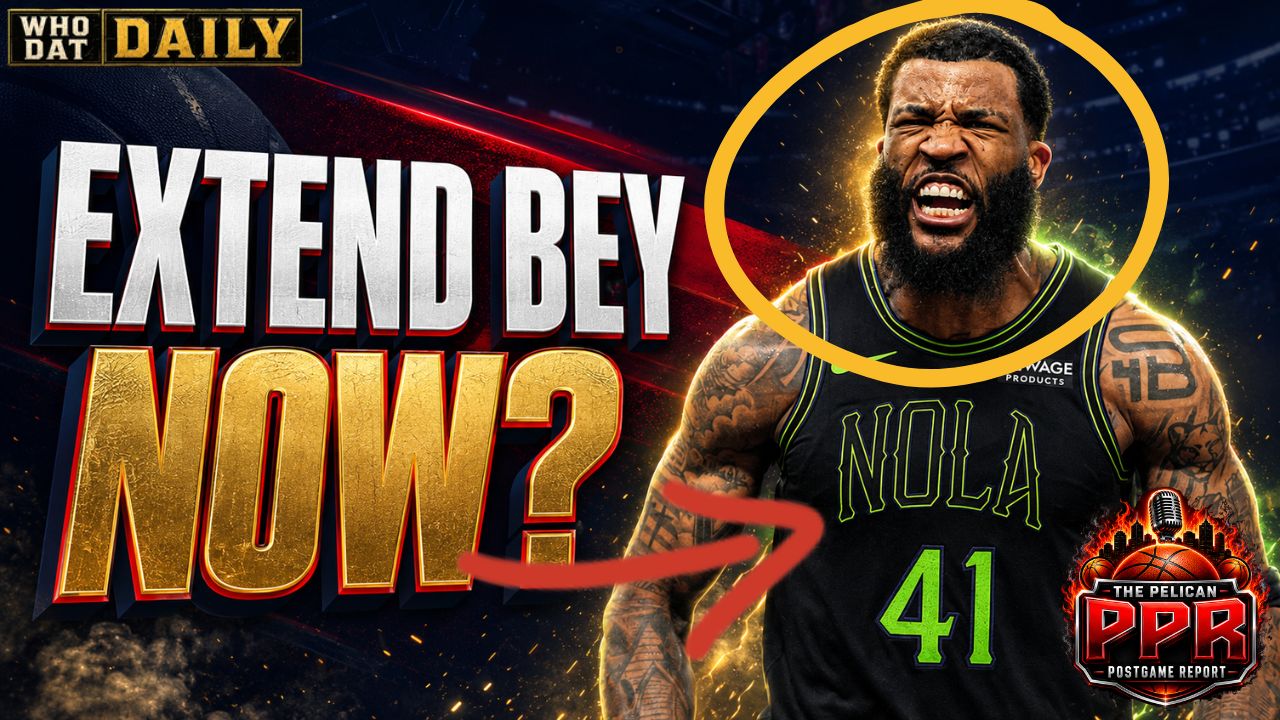
The New Orleans Pelicans do not face an absolute October deadline to extend Saddiq Bey, but that should not give the organization an excuse to wait indefinitely.
Bey became eligible for a veteran extension in July 2026 after completing the required time on his current three-year contract. He will earn a base salary of approximately $6.44 million during the 2026–27 season, with a listed cap hit of about $6.56 million, before becoming an unrestricted free agent in 2027.
That gives New Orleans a valuable negotiating window—and an important decision.
The Pelicans should pursue a Saddiq Bey extension now because he has already rebuilt his market value, fits the team’s emerging identity and could become considerably more expensive if he reaches unrestricted free agency.
Correcting the October 23 Deadline
Some reports have identified October 23, 2026, as the final day for New Orleans to sign Bey to an extension. However, that date should not be treated as a firm expiration point in his case.
NBA veteran-extension rules distinguish between players with multiple guaranteed seasons remaining and those entering the final season of their contracts.
Players with more than one guaranteed year remaining generally face a preseason signing window. A player with only one season left, such as Bey, can ordinarily sign a veteran extension during the regular season. The league’s extension rules therefore give the Pelicans more time than the commonly reported October cutoff. CBA extension guide
The corrected timeline does not eliminate the urgency.
Allowing negotiations to stretch deep into the season would increase uncertainty, invite outside speculation and potentially strengthen Bey’s bargaining position. If he produces another career season, New Orleans could find itself competing against teams with meaningful cap space in July 2027.
The Pelicans have time—but they should not waste it.
Bey Earned a Significant Raise
Bey entered the 2025–26 season needing to prove that he could regain his form following the ACL injury that ended his tenure with the Atlanta Hawks.
He answered that question emphatically.
In 72 appearances for New Orleans, Bey averaged:
- 17.7 points
- 5.6 rebounds
- 2.5 assists
- 45.1 percent shooting
- 36.7 percent from three
- 84.1 percent from the free-throw line
Those numbers represented a career-high scoring average and one of the league’s strongest bounce-back campaigns. His production is confirmed by both the NBA’s official player profile and ESPN’s season statistics.
Bey also demonstrated his offensive ceiling when he erupted for 42 points against the Utah Jazz in February. That performance showed that he is more than a stationary catch-and-shoot forward. He can attack mismatches, draw fouls and generate points when the primary options need help.
At approximately $6.56 million against the cap, Bey is one of the best values on the current roster. That bargain will not last beyond this season.

What Should a Saddiq Bey Extension Cost?
A reasonable negotiating range begins around $17 million annually and could climb beyond $20 million per season.
Bey’s representatives can point to contracts previously signed by starting wings such as Dillon Brooks and De’Andre Hunter. Brooks received a four-year, $86 million agreement from Houston in 2023, while Hunter signed a four-year, $90 million rookie extension with Atlanta in 2021.
Those contracts are not perfect comparisons. Brooks commands a premium for his defensive reputation, while Hunter has produced stronger efficiency in certain seasons. However, Bey’s scoring, rebounding and positional size place him within the broader market for productive starting forwards.
The Pelicans also have a valuable internal comparison in Herb Jones, who signed a four-year, $53.8 million contract in 2023. That deal quickly became one of the NBA’s best bargains and should not be treated as the present market rate for every starting wing.
A realistic compromise could resemble one of the following structures:
| Contract range | Average salary | Pelicans’ perspective |
|---|---|---|
| Three years, $51–57 million | $17–19 million | Shorter protection against injury regression |
| Four years, $72–80 million | $18–20 million | Best balance of security and long-term value |
| Four years, approximately $90–93 million | $22.5–23.25 million | Near the upper extension range |
The most sensible outcome would be approximately four years and $76 million, with partial protection or performance incentives in the final season.
That figure would reward Bey without immediately pricing him as an elite two-way forward.
Why the Extension Will Not Hurt This Year’s Cap
Any new extension would begin with the 2027–28 season. It would not replace Bey’s existing 2026–27 salary or increase his current cap hit.
That distinction matters because New Orleans is already navigating an expensive roster.
Current estimates place the Pelicans at approximately $192.2 million in tax allocations, around $8.2 million below the league’s $200.4 million luxury-tax threshold. The NBA officially set the 2026–27 first apron at $209.015 million and the second apron at $221.686 million. NBA salary-cap announcement
The extension would give the front office a full season to prepare for Bey’s raise. New Orleans could adjust the roster through trades, expiring contracts or other personnel decisions before the higher salary begins.
The agreement could also include descending annual salaries if both sides favor a front-loaded structure. That would place the largest cap charge in the first extension season before reducing Bey’s number later in the contract.
Most importantly, signing an extension preserves an asset. Losing a productive 27-year-old wing for nothing would be far more damaging than committing a reasonable percentage of the future salary cap to him.
How Bey Fits the New Pelicans
The Pelicans hired Jamahl Mosley to establish a more physical, connected and defensively accountable team. Bey has the size and offensive versatility to function within that vision.
At 6-foot-7 and roughly 215 pounds, he can play either forward position. He gives New Orleans another floor-spacing option alongside Trey Murphy III, while his rebounding helps smaller lineups survive on the glass.
Bey is not the same caliber of defender as Jones. He does not need to be.
His value comes from providing secondary scoring, positional strength and lineup flexibility. Mosley can use Jones on the opponent’s most dangerous perimeter creator while placing Bey in more favorable defensive matchups.
On offense, Bey can space the floor around Zion Williamson, punish smaller defenders in the post and provide scoring when Murphy or Zion leaves the game. That combination makes him more valuable to New Orleans than his raw statistics alone suggest.
Big Q’s Take: Extend Him or Prepare to Trade Him
The Pelicans cannot allow Bey’s situation to drift toward unrestricted free agency without a clear plan.
If New Orleans believes he is part of Mosley’s long-term rotation, the organization should move aggressively toward an extension in the four-year, $72–80 million range. That contract could become team-friendly as the salary cap continues to rise.
If Bey’s representatives insist on the maximum available extension and the Pelicans are unwilling to reach that level, the front office must determine his trade value well before the February deadline.
Doing nothing would create the worst possible outcome: carrying Bey through another productive season, missing the playoffs and then watching him sign elsewhere without compensation.
There is no absolute October 23 deadline forcing the Pelicans into an immediate agreement. Nevertheless, there is a strategic deadline approaching.
New Orleans must decide whether Bey is part of its future before the rest of the NBA gets an opportunity to make that decision for them.
Gee Bino is a senior writer and columnist for The Who Dat Daily, covering the New Orleans Saints, Pelicans, LSU athletics, and the Gulf South sports landscape. He specializes in roster construction, player development, salary-cap strategy, and breaking news coverage.
Discover more from The Who Dat Daily
Subscribe to get the latest posts sent to your email.






New Orleans Saints
Saints Reveal Plan to Stop Lamar Jackson + Thursday Injury Report

NEW ORLEANS PELICANS
Pelicans Lock In Saddiq Bey With Three-Year, $55.5 Million Contract Extension

NEW ORLEANS PELICANS
Pelicans Add 7-Foot Center Aziz Bandaogo to G League Pipeline

Tulane College Sports
Tulane vs. Kansas State Week 3 Preview: Can the Green Wave Shock Manhattan Again?

LSU (Football)
#7 LSU vs #8 Ole Miss Preview: Sam Leavitt Doubtful

New Orleans Saints News
Saints Looking for WR Help: Four Receivers Work Out Before Lions Opener

New Orleans Saints News
Saints Add 12 Players to Practice Squad as New Orleans Continues Roster Moves

New Orleans Saints News
Saints Add 3 Players as Kendre Miller Exits Practice

New Orleans Saints News
Saints vs. Lions Preview: Five Keys to a Week 1 Win in Detroit