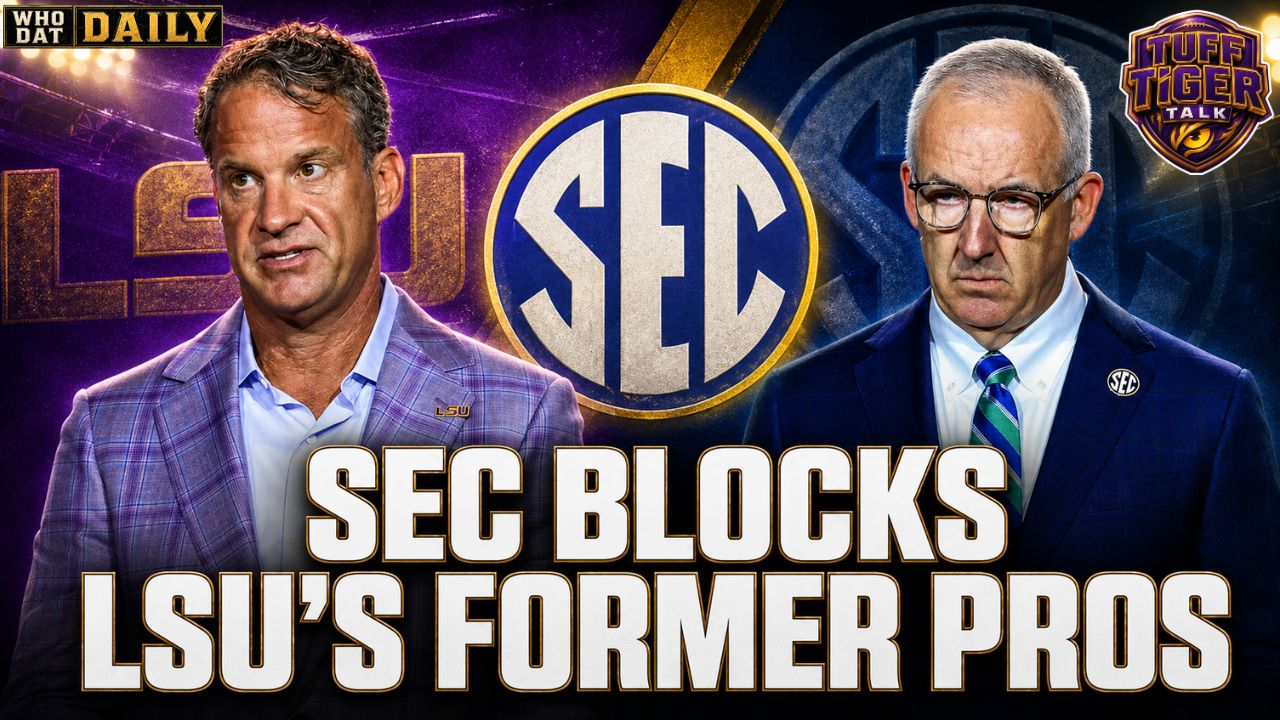

LSU’s attempt to add players who had already signed professional contracts has triggered a direct response from the Southeastern Conference—and created one of the most important eligibility fights in modern college sports.
On August 25, SEC presidents, chancellors and athletics directors approved a new policy preventing member schools from carrying athletes who crossed specific professional thresholds. The vote was reportedly 16–0, and commissioner Greg Sankey was authorized to enforce the rule with penalties against conference members.
The immediate impact falls on LSU football commitments Dae’Quan Wright and Zxavian Harris and LSU basketball addition RJ Luis Jr. All three received favorable court relief in Louisiana against NCAA eligibility restrictions, but all three also fit at least one category prohibited by the SEC’s new policy.
That means they are presently blocked from representing LSU in SEC competition unless the legal situation changes, the conference grants relief or a court orders the SEC not to enforce its rule.
The important distinction is this: A judge’s ruling against the NCAA does not automatically eliminate a separate SEC roster policy.
Here is what the new rule says, how it affects each LSU player and what comes next.
What the SEC’s New Rule Actually Says
An SEC institution may not have an athlete on its roster if that athlete has:
- Declared for the NFL, NBA or WNBA draft and failed to withdraw appropriately;
- Signed a contract with an NFL or other professional football league, NBA/G League, WNBA or affiliate team; or
- Been listed on a roster in one of those professional leagues or affiliates.
The policy is broader than a ban on players who appeared in a regular-season professional game. Signing a contract or appearing on a roster is enough.
That is why arguments that Wright did not play an NFL regular-season snap, Harris spent time on a non-football injury list or Luis never appeared in an NBA or G League regular-season game do not remove them from the policy.
The SEC also preserved a key distinction for athletes who test professional interest correctly. A player who declares for a draft and withdraws before the applicable deadline is not automatically barred by the first category. The rule targets players who remained in the draft, signed professional deals or were placed on professional rosters.
Why the SEC Acted So Quickly
The NCAA adopted a new age-based eligibility model that generally allows many athletes to compete for five years within a five-year window. The transition did not automatically give an extra season to players from the high school class of 2022 who had already used four college seasons during 2022–25.
Multiple athletes challenged that treatment in court. A Louisiana judge granted temporary relief to a group that included former Ole Miss football players, opening a path for some athletes to terminate professional contracts, return earnings and pursue a fifth college season.
LSU coach Lane Kiffin moved immediately. His staff pursued Wright and Harris, two players he coached at Ole Miss. LSU basketball also received a preliminary injunction allowing Luis to practice and potentially play after his NBA and G League contract history.
The SEC first issued a statement arguing that former professional players should not return to college competition. One day later, the league adopted a direct roster policy.
The conference’s argument centers on competitive balance, roster stability and opportunities for current college and high school players. The athletes’ legal argument centers on unequal treatment, changing eligibility rules and their right to pursue a remaining season.
Those positions are now headed toward another legal collision.
Court Eligibility and SEC Eligibility Are Not the Same Thing
This is the central point for LSU fans.
The Louisiana court orders provided protection against NCAA enforcement. They did not necessarily bind the SEC, which is a separate organization with its own membership rules.
The SEC responded by creating a conference-level restriction. LSU can argue that the new policy is anticompetitive, unlawfully coordinated or unfairly targeted, but the policy remains operative unless it is withdrawn or enjoined.
As of August 26:
- The NCAA court relief has not disappeared.
- The SEC policy creates an independent barrier.
- LSU risks conference penalties if it places a covered athlete on its roster.
- The announced penalty schedule has not been made public.
- Reports say Sankey received broad enforcement authority that could include declaring athletes ineligible, suspending coaches or administrators and, in an extreme case, suspending a school from competition.
- A preliminary injunction hearing for the football plaintiffs is scheduled for August 31 at 1:30 p.m. Central in East Baton Rouge Parish.
Calling the cases “finished” would be premature. Calling the players available to LSU today would be equally inaccurate.
Player-by-Player Impact on LSU
| Player | LSU sport/role | Professional step | Effect of SEC policy |
|---|---|---|---|
| Dae’Quan Wright | Football tight end | Signed with Philadelphia and Cleveland; appeared on NFL rosters | Barred under contract and roster provisions |
| Zxavian Harris | Football defensive tackle | Signed with New Orleans Saints; placed on NFL roster/NFI list | Barred under contract and roster provisions |
| RJ Luis Jr. | Men’s basketball guard/wing | Stayed in 2025 NBA Draft; signed Utah and Boston-related deals | Barred under draft, contract and roster provisions |
| Junior Tuihalamaka | Football edge defender | Did not enter a pro draft or sign a pro contract | Not covered by the SEC’s professional-athlete ban |
Dae’Quan Wright: A Major Offensive Addition Now on Hold
Wright played four college seasons at Virginia Tech and Ole Miss before going undrafted in 2026. He signed with the Philadelphia Eagles, was later claimed by the Cleveland Browns and was waived as he pursued the opportunity to join LSU.
The 6-foot-4 tight end earned second-team All-SEC honors in 2025 after catching 39 passes for 635 yards and five touchdowns. His familiarity with Kiffin’s offense and ability to create mismatches made him an immediate candidate for a major role at LSU.
The SEC rule blocks him on two grounds: he signed professional contracts and appeared on NFL rosters. Whether he played in a regular-season game is irrelevant under the text of the policy.
Current outlook: Wright cannot safely join LSU’s active roster while the SEC rule is enforceable. His path depends on new court relief against the conference, a policy change or a move outside a league with a similar restriction.
Zxavian Harris: Interior Size LSU Expected to Use
Harris also played for Kiffin at Ole Miss. The 6-foot-7 defensive lineman signed with the New Orleans Saints as an undrafted free agent after the 2026 NFL Draft, spent the summer on the non-football injury list while recovering from foot surgery and was waived on August 8.
LSU viewed Harris as experienced interior depth with unusual size and SEC familiarity. He could have strengthened a defensive front expected to handle physical conference opponents.
Like Wright, Harris signed an NFL contract and appeared on an NFL roster. Both facts independently place him inside the SEC ban.
Current outlook: Harris is blocked from LSU’s roster under the new policy despite the temporary NCAA relief. His August 31 hearing may determine whether the athletes can obtain a stronger injunction, but the complaint may need to address the SEC directly.

RJ Luis Jr.: A Court Win That Is No Longer Enough by Itself
Luis was the 2024–25 Big East Player of the Year at St. John’s and a second-team All-American. He went undrafted in the 2025 NBA Draft, signed a two-way contract with the Utah Jazz, was traded to Boston, was waived and later signed an Exhibit 10 arrangement connected to the Maine Celtics.
He appeared in preseason action but did not play in an NBA or G League regular-season game. A Louisiana judge granted Luis a preliminary injunction against the NCAA, accepting the argument that he did not meaningfully compete as a professional.
The SEC policy uses a different test. Luis remained in the NBA Draft, signed professional contracts and appeared on professional rosters. He therefore fits all three prohibited categories.
For LSU basketball, the loss would be substantial. Luis is a proven high-level college scorer and rebounder who was expected to become a starting-caliber centerpiece.
Current outlook: The preliminary injunction protects Luis against the NCAA, but the SEC policy presently prevents LSU from rostering him. His attorneys would likely need additional relief directed at the conference.
Junior Tuihalamaka: Why He Is Different
Tuihalamaka played four seasons at Notre Dame and received court-backed eligibility for a fifth college season. He then committed to LSU as an edge defender.
Unlike Wright, Harris and Luis, Tuihalamaka did not sign a professional contract, remain in a professional draft or appear on a professional roster.
He therefore falls outside the SEC’s newly announced professional-athlete categories.
Current outlook: Tuihalamaka remains eligible under the current court order and is not excluded by the SEC pro-athlete policy, barring a new legal or eligibility development.
Can LSU Play Wright, Harris or Luis Anyway?
Technically, LSU could challenge the policy and attempt to obtain emergency relief. Practically, placing a covered athlete on the roster before receiving that relief would expose the university to serious conference action.
The SEC did not publish a fixed chart of penalties when it announced the policy. It instead authorized Sankey to enforce the rule against member institutions. League bylaws already give the commissioner broad authority, and reports indicate the presidents expanded that discretion for this issue.
LSU must therefore treat the players as unavailable unless one of four things happens:
- A court enjoins the SEC from enforcing the policy;
- The SEC changes or narrows the rule;
- The conference grants an exception; or
- A final legal ruling establishes that the league cannot impose the restriction.
None of those outcomes is guaranteed.
What the August 31 Hearing Could Change
The football players’ temporary restraining order is an early form of relief, not a final victory. The August 31 preliminary injunction hearing will examine whether stronger protection should remain in place while the case proceeds.
Three questions now matter:
- Will the athletes amend their legal challenge to include the SEC?
- Will a judge view the conference policy as an independent membership rule or as an unlawful attempt to accomplish what the NCAA could not?
- Will LSU hold roster positions open while the litigation continues?
The timeline is especially difficult for football. The regular season is arriving, installation time is limited and roster decisions cannot remain open indefinitely.
Basketball has more calendar room, but Luis faces the same fundamental SEC barrier.
What the Rule Means for Other Players
The policy does not ban ordinary transfers. Players can still move between college programs through the transfer portal if they otherwise meet eligibility and roster rules.
It creates a one-way professional threshold for SEC athletes:
| Player action | SEC roster effect |
| Enters draft and withdraws properly | Not automatically barred by this policy |
| Enters draft and does not withdraw | Barred |
| Goes undrafted but signs a pro contract | Barred |
| Appears on a pro roster without playing a regular-season game | Barred |
| Participates in the G League or an affiliate system | Barred |
| Receives a fifth college year without entering pro ranks | Not barred by this policy |
An affected player might explore a non-SEC school, but that is not an automatic solution. The athlete would still need NCAA eligibility, an available roster spot, a valid transfer path and compliance with the rules of the destination conference. The Big Ten has already adopted a similar football restriction, and other leagues are considering their own policies.
Gee Bino’s Verdict: LSU’s Aggressiveness Exposed a National Rules Problem
LSU did not create the eligibility confusion. The NCAA changed its framework, courts issued competing orders and no national standard was ready for athletes from the 2022 class.
Kiffin and LSU responded to the rules that existed at that moment. If experienced players were legally available and could appear for another opponent, recruiting them was a predictable competitive decision.
The SEC’s concern is also understandable. Allowing players to move from an NFL camp back to a college roster weeks before the season creates roster, development and competitive-balance problems that the sport was not designed to handle.
However, writing a conference rule after LSU had already acted guarantees another round of litigation. The policy may restore a bright line, but it does not end the legal dispute.
For the immediate future, the answer is clear:
Wright, Harris and Luis are blocked from LSU by the SEC policy. Tuihalamaka is not. The three former pros will need new legal relief before LSU can use them without risking major conference penalties.
The August 31 hearing is the next major checkpoint—not the final word.
Author Bio
Gee Bino is a senior sports writer and columnist for The Who Dat Daily, covering the New Orleans Saints, Pelicans, LSU athletics, Tulane football, boxing and the Gulf South sports landscape. He specializes in breaking news, roster analysis, player development and straightforward commentary.
Sources
- SEC policy text reported by WAFF: professional draft, contract and roster restrictions
- ESPN: SEC adopts rule stopping NFL, NBA and WNBA players from returning
- ESPN: SEC statement on former professional athletes
- Associated Press: SEC and Big Ten ban former pros from returning
- Reuters: SEC and Big Ten rules affect LSU’s former NFL additions
- Tiger Rag: SEC presidents approve policy and authorize enforcement
- Associated Press via ABC News: Dae’Quan Wright’s LSU path and August 31 hearing
- ESPN: RJ Luis Jr. granted an injunction after signing NBA contracts
- Tiger Rag: Junior Tuihalamaka commits to LSU with fifth-year eligibility
- NCAA: Division I and II age-based eligibility rules
Discover more from The Who Dat Daily
Subscribe to get the latest posts sent to your email.






New Orleans Saints
Saints at 1–3: History Proves New Orleans Can Still Turn Its Season Around

NEW ORLEANS PELICANS
Pelicans Fall to Heat 128–118 as Turnovers Spoil Strong Shooting


NEW ORLEANS PELICANS
Pelicans vs. Heat Preview: New Orleans Needs a Stronger Start After Thunder Comeback

NEW ORLEANS PELICANS
Pelicans Open Training Camp With a New Voice, New Depth and No Time to Waste


New Orleans Saints
Saints Place Travis Etienne on IR, Add Ojabo and Bentley Before Falcons