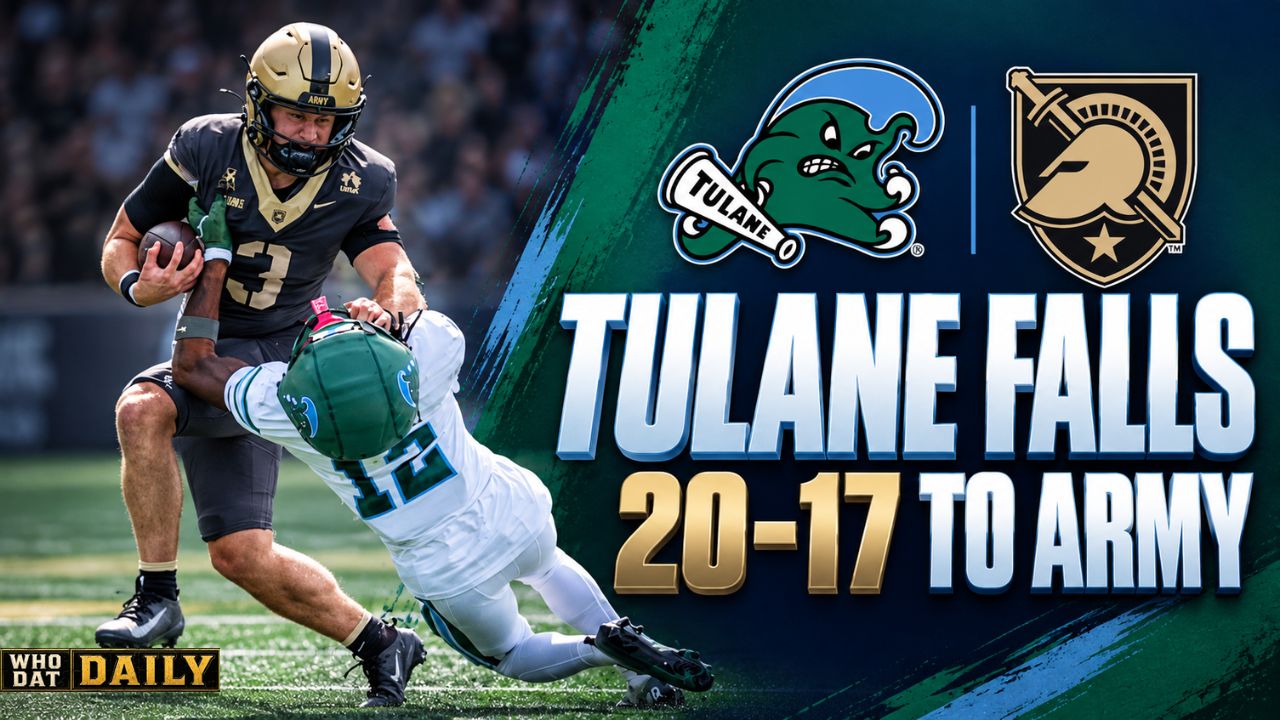
The Tulane Green Wave came painfully close to securing an important American Conference road victory Saturday afternoon. Instead, Army delivered another late-game heartbreak, defeating Tulane 20–17 on a field goal as time expired at Michie Stadium.
The loss dropped Tulane to 2–3 overall and 0–1 in conference play, raising questions about the Green Wave’s ability to finish close games and contain physical rushing attacks.
For a program accustomed to competing near the top of the American Conference, the defeat represents a significant early-season obstacle.
Army established the early advantage when quarterback Cale Hellums scored on a one-yard touchdown run in the first quarter.
Tulane answered with a second-quarter field goal before finding greater offensive success after halftime.
The Green Wave eventually built a 17–10 fourth-quarter advantage, putting themselves in position to escape West Point with a valuable road victory.
However, Army refused to go away.
Hellums broke loose for a 58-yard touchdown run, tying the contest and setting up a dramatic finish.
Following a failed fourth-down conversion by Tulane, the Black Knights marched downfield and positioned kicker Dawson Jones for the decisive attempt.
Jones converted from 25 yards as time expired, completing Army’s comeback.
Army’s Rushing Attack Overwhelms Tulane
The biggest problem for the Green Wave was their inability to consistently contain Hellums.
Army’s quarterback delivered a career-best performance with 223 rushing yards, accounting for the majority of the Black Knights’ ground production.
Army finished with 329 rushing yards and controlled possession for more than 35 minutes.
Tulane managed only 122 rushing yards of its own.
The contrast highlighted the physical advantage Army established through its option-based offensive attack.
When a team controls the clock and consistently moves the chains, opposing offenses face additional pressure to make every possession count.
Kadin Semonza and the Offense Show Flashes
Tulane quarterback Kadin Semonza finished with 158 passing yards, helping the Green Wave generate opportunities despite Army’s possession advantage.
Running back Johnnie Daniels led Tulane with 67 rushing yards, while receiver Destyn Hill contributed 54 receiving yards.
The Green Wave finished with 280 total yards.
Although Tulane showed enough offensive ability to take a late lead, its inability to extend drives in critical situations ultimately proved costly.
A failed fourth-and-eight attempt late in the game gave Army the opportunity it needed to deliver the winning score.
Conference Championship Hopes Face Early Test
Tulane has developed a reputation as one of the American Conference’s most competitive football programs.
That reputation now faces a difficult test.
At 0–1 in league play, the Green Wave must improve their defensive discipline, rushing efficiency, and late-game execution to remain in the championship conversation.
Army’s offense presented a unique challenge, but the larger concern is Tulane’s inability to protect a seven-point fourth-quarter lead.
Those are the situations successful teams must learn to finish.
What Tulane Must Correct
The Green Wave need better control of the line of scrimmage, particularly against opponents capable of dominating possession.
Offensively, Tulane must become more dependable on short-yardage and late-game possessions.
Defensively, improved tackling and assignment discipline will be essential against future opponents.
The season is far from over, but Tulane can no longer afford to let winnable games slip away.
The Who Dat Daily Final Take
Tulane demonstrated enough toughness to take a fourth-quarter lead on the road. Unfortunately, the Green Wave could not deliver the final defensive stop or offensive possession needed to finish the job.
The 20–17 defeat is a reminder that competing for conference championships requires more than playing well for three quarters. It requires finishing when the pressure is greatest.