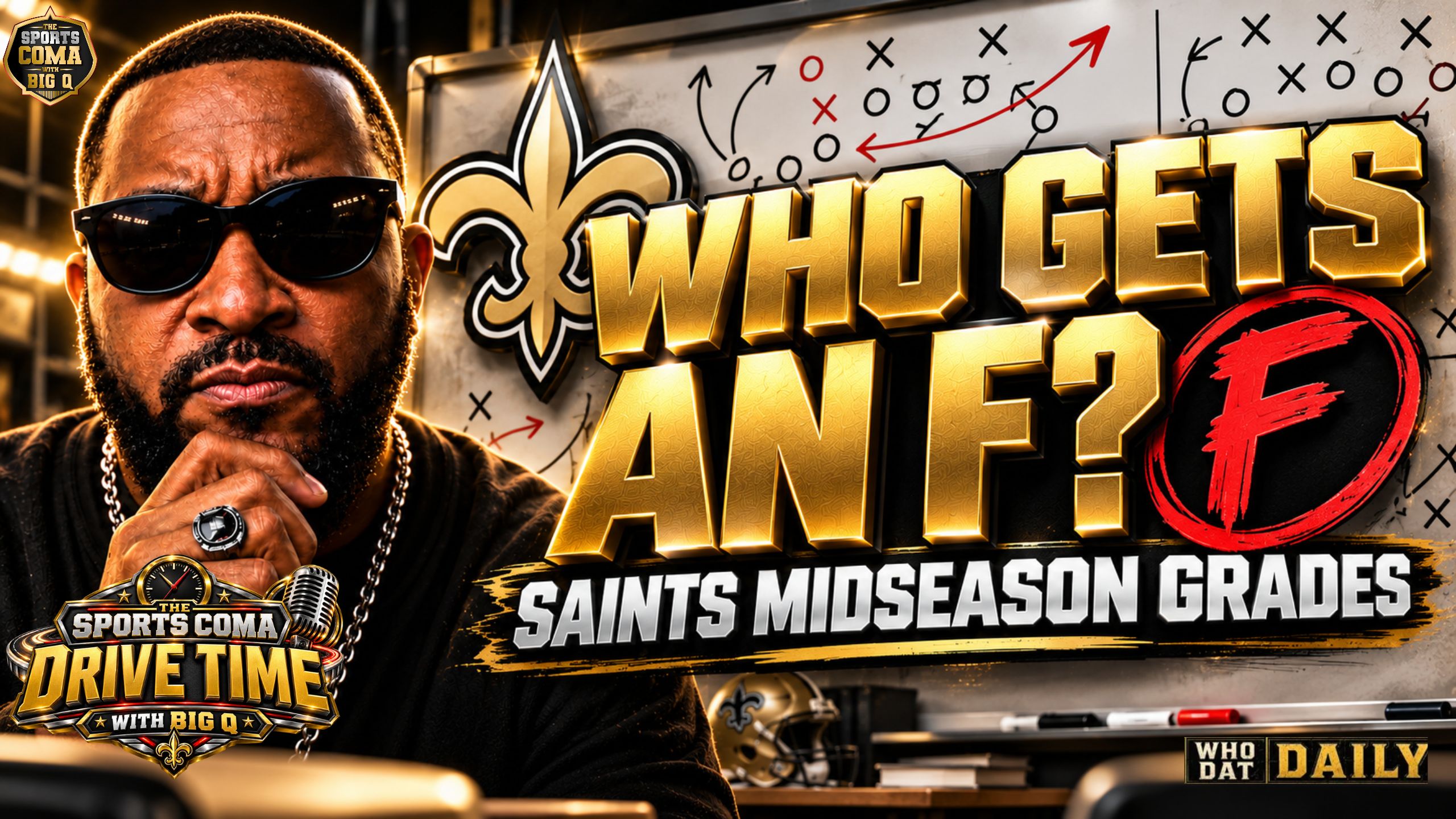


Saints Midseason Report Card at the Bye: Big Q grades New Orleans’ struggling roster, examines trade-deadline inactivity, and questions whether the organization has a real plan to turn around its disappointing 2026 season.
A 2–5 Record That Demands Answers
NEW ORLEANS — Seven games into the 2026 NFL season, the New Orleans Saints have reached their Week 8 bye with more questions than answers.
The Saints are 2–5 following a frustrating 16–10 defeat to the Pittsburgh Steelers in Paris. What was supposed to be an opportunity to build momentum instead became another painful reminder of the team’s offensive limitations, inconsistent defense, and inability to finish critical situations.
On a special edition of The Sports Coma with Big Q, Big Q delivers his Saints midseason report card, examining the players, coaches, front office, and organizational leadership.
The grades aren’t pretty.
But with the NFC South still within reach, the bigger question is whether the Saints can make the adjustments necessary to salvage the season.
Saints Midseason Report Card: The Grades
Quarterback — B+
Tyler Shough has emerged as one of the few encouraging developments in an otherwise disappointing season.
Through seven games, Shough has produced 1,721 passing yards, 13 touchdowns, and six interceptions while dealing with injuries, inconsistent protection, and a struggling rushing attack.
He hasn’t been perfect. Turnovers, decision-making, and late-game execution remain areas for improvement.
But considering the circumstances, Shough has demonstrated enough resilience and passing ability to offer hope for the future.
Big Q’s question: Is Shough developing into the Saints’ long-term answer, or is the organization asking him to overcome too many roster deficiencies?
Running Game — F
There is no way to sugarcoat this grade.
The Saints managed just 18 rushing yards on 17 attempts against Pittsburgh, averaging approximately 1.1 yards per carry.
A running game that cannot consistently produce positive yardage creates enormous pressure on the quarterback and makes the offense predictable.
The struggles extend beyond individual running backs. Blocking assignments, offensive-line execution, personnel usage, and play design all deserve scrutiny.
Head coach Kellen Moore must find a workable rushing identity before the Browns arrive in New Orleans.
Offensive Line — D-
Injuries have complicated the Saints’ offensive-line situation, but the results remain unacceptable.
Shough has repeatedly been forced to operate under pressure, while the running backs have struggled to find open lanes.
Protection breakdowns have disrupted offensive rhythm and made it difficult to sustain drives.
The Saints need more than improved health. They need better communication, smarter protection adjustments, and a commitment to winning at the line of scrimmage.
Wide Receivers and Tight Ends — B-
New Orleans has shown flashes of productivity through the passing game, with Chris Olave providing a legitimate receiving threat and Devaughn Vele contributing valuable catches.
However, consistency across the receiving group remains an issue.
Injuries, limited separation in certain situations, and an inconsistent offensive structure have prevented the passing attack from reaching its potential.
The possible return of rookie Jordyn Tyson could provide another weapon, but the coaching staff must find ways to maximize the talent already available.
Defensive Line and Run Defense — D
The Saints have struggled to control the trenches defensively.
Despite contributions from Chase Young and Carl Granderson as pass rushers, the defense has been vulnerable against physical rushing attacks.
Poor gap discipline, inconsistent tackling, and an inability to dictate the line of scrimmage have repeatedly placed the defense in difficult situations.
Against stronger opponents, those weaknesses have become impossible to ignore.
Linebackers and Secondary — C-
The defense has produced occasional momentum-changing plays, but consistency has been missing.
Third-down failures have been particularly damaging.
Against Pittsburgh, the inability to secure a late defensive stop allowed the Steelers to control the final minutes and eliminate New Orleans’ opportunity for a comeback.
Defensive coordinator Brandon Staley must simplify responsibilities where necessary, improve communication, and help his players execute with greater confidence.
Special Teams — D
Close games magnify every missed opportunity.
Daniel Carlson’s inconsistent field-goal production has raised questions about the Saints’ kicking situation.
With Charlie Smyth available as an alternative, the organization must evaluate whether a competition is necessary.
Field position, coverage discipline, and overall reliability also deserve attention.
Coaching Staff — D
Kellen Moore’s offensive philosophy has not consistently translated into results.
The Saints have struggled to establish the run, finish drives, and respond to defensive adjustments.
On defense, Brandon Staley has yet to establish the consistency required to keep New Orleans competitive every week.
Coaching isn’t simply about drawing up plays. It’s about preparation, adjustments, discipline, and putting players in positions to succeed.
The bye week provides an opportunity to correct recurring problems.
Failure to show improvement afterward will intensify the criticism.
Front Office and Roster Construction — D-
General manager Mickey Loomis faces serious questions about the roster’s depth, offensive-line stability, and overall direction.
Injuries have exposed weaknesses that existed before the season began.
The lack of significant movement in the trade market has also generated frustration among fans seeking immediate help.
However, making trades simply to create headlines is not a sound strategy.
The Saints must determine whether they are legitimate postseason contenders, a developing team building around Shough, or an organization attempting to pursue both goals simultaneously.
That decision should shape every move they make.
Trade Deadline: Why Aren’t the Saints Making Moves?
With the NFL trade deadline approaching, New Orleans faces a difficult balancing act.
At 2–5, surrendering valuable draft capital for a short-term solution could undermine the team’s future.
But standing still while the offensive line and defensive front continue to struggle could also signal an unwillingness to address obvious problems.
Big Q examines the organization’s options:
- Pursue affordable offensive-line depth and defensive help.
- Consider moving veterans if the return strengthens future roster construction.
- Protect premium draft picks instead of chasing a desperate short-term fix.
- Determine which young players should receive expanded opportunities.
The Saints don’t necessarily need the biggest trade.
They need a coherent plan.
Gayle Benson, the Windsor Court Hotel, and the Bigger Ownership Picture
Away from football, Saints and Pelicans owner Gayle Benson has made headlines with the acquisition of New Orleans’ Windsor Court Hotel.
The move adds another significant property to Benson’s business interests and reinforces her economic presence in the city.
But the timing also creates an interesting contrast.
While the ownership group continues to make substantial investments outside football, Saints fans are asking whether the same level of urgency is being applied to improving the team.
The hotel acquisition is a separate business decision and does not, by itself, indicate anything about the Saints’ football spending or commitment.
Nevertheless, it opens a broader conversation about ownership visibility, organizational accountability, and the expectations surrounding one of New Orleans’ most important institutions.


Gayle Benson’s International Message and the State of the Franchise
The Saints’ international appearance also placed the organization under a brighter spotlight.
Benson’s public remarks surrounding the franchise and its international presence deserve examination alongside the team’s on-field performance.
The organization continues to emphasize its connection to New Orleans and its broader ambitions.
But international visibility and business success must be accompanied by a competitive football product.
For supporters, the central question remains straightforward:
What concrete steps will ownership and football leadership take to produce sustained improvement?
What Must Change During the Bye Week?
The Saints cannot afford to return from the break playing the same brand of football.
First, establish a functional running game. Moore must introduce greater variety, use motion more effectively, and create manageable situations for Shough.
Second, protect the quarterback. Better blocking communication, quicker passing concepts, and improved personnel deployment must become priorities.
Third, improve defensive execution. Staley’s group must tackle more consistently, stop the run, and get off the field on third down.
Fourth, evaluate every roster spot. The bye week should be used to assess injuries, potential returns, special-teams competition, and opportunities for younger players.
Finally, demand organizational accountability. The head coach, coordinators, front office, and ownership must be aligned on the team’s direction.
The Cleveland Browns Are Waiting
New Orleans returns from its bye to face the Cleveland Browns on November 8 at the Caesars Superdome.
Cleveland’s defensive front presents a serious challenge for a Saints offensive line already struggling to establish consistency.
The matchup will provide an immediate test of whether the coaching staff used its extra preparation time effectively.
If the Saints emerge with the same offensive limitations and defensive breakdowns, the calls for significant changes will only grow louder.
Big Q’s Final Take: The Bye Week Must Become a Turning Point
A 2–5 record isn’t what Saints fans expected.
But the season isn’t mathematically over, and the NFC South remains an opportunity.
The real issue isn’t simply the number of losses. It’s how those losses have occurred.
The Saints have shown flashes of promise, particularly at quarterback, but too often their progress has been undermined by poor execution, questionable decisions, and deficiencies in the trenches.
Big Q’s message is simple: the organization cannot keep talking about improvement without demonstrating it.
The second half of the season will reveal whether New Orleans has the leadership, discipline, and roster foundation necessary to change its direction.

Watch The Sports Coma with Big Q for the complete Saints midseason report card, trade-deadline discussion, ownership news, and fan reaction.
Visit The Who Dat Daily for continuing Saints coverage.

Discover more from The Who Dat Daily
Subscribe to get the latest posts sent to your email.





New Orleans Saints
Saints Midseason Report Card: Who Deserves the Blame?

New Orleans Saints
Saints Roster Exposed? Moore and Loomis Face Hard Questions

NEW ORLEANS PELICANS
Finally in the Win Column: Fears and Zion Power Pelicans Past Kings

NEW ORLEANS PELICANS
Pelicans Fall to 0-4 as Nuggets Slam Door on Rally

NEW ORLEANS PELICANS
Pelicans vs Nuggets: Mosley Must Fix the Rotation

Tulane College Sports
Six Takeaways, One Big Response: Tulane Stuns Memphis 31–17


Tulane College Sports
Uptown Stand: Tulane Faces Memphis With Its Conference Hopes Under Pressure


NEW ORLEANS PELICANS
Pelicans vs. Wizards: One Last Test for Fears, Mosley and the Rotation