
By Gee Bino | The Who Dat Daily
For years, the New Orleans Pelicans have searched for an offensive identity that could survive injuries, lineup changes and the natural tension created by several players needing the basketball.
The talent has rarely been the primary problem.
The Pelicans have employed explosive scorers, gifted playmakers and versatile forwards. However, their offense has too often depended on individual creation instead of a structure that consistently places those players in advantageous situations.
New head coach Jamahl Mosley wants that to change.
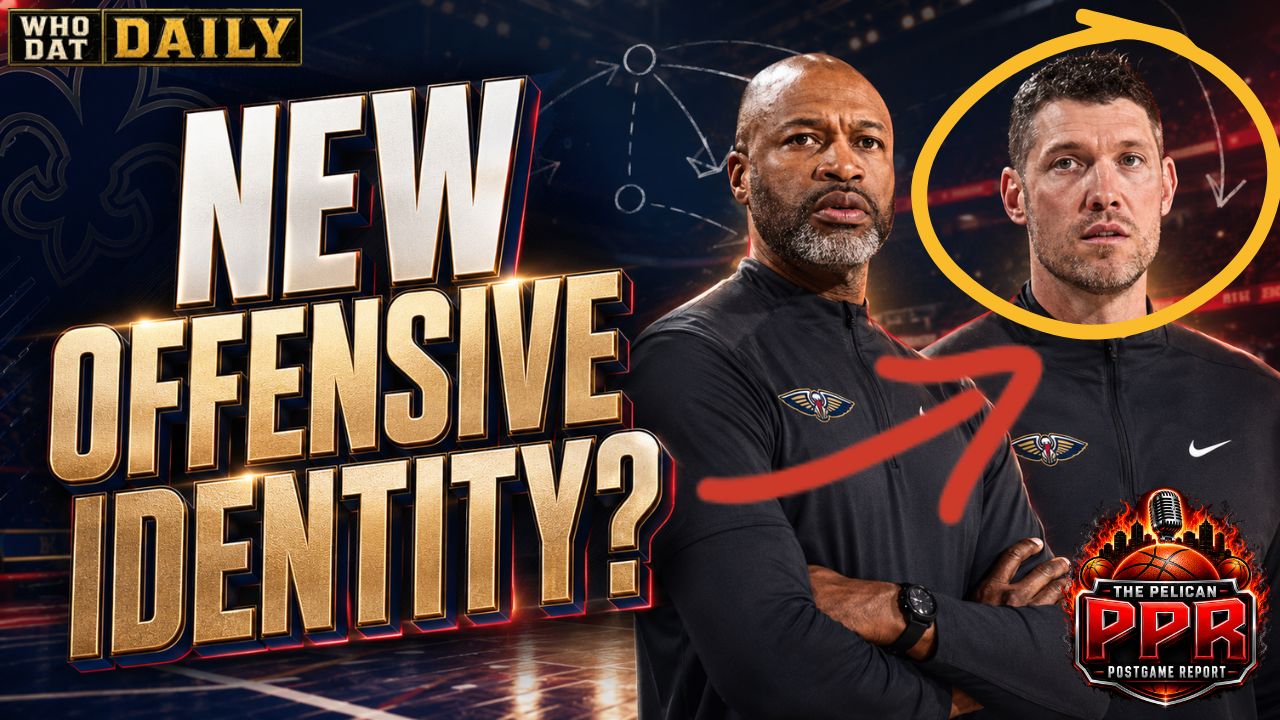
Mosley arrived in New Orleans with a reputation as a demanding culture builder who emphasizes physical defense, accountability and player development. He also brought one of his most trusted assistants from Orlando to oversee the other side of the court.
Bret Brielmaier will serve as the Pelicans’ offensive coordinator, giving him responsibility for designing a system that connects Zion Williamson, Trey Murphy III, Dejounte Murray, Jordan Poole and the franchise’s developing young talent.
Brielmaier’s offense should emphasize quick decisions, organized spacing, early ball-screen actions and purposeful movement away from the basketball. It will attempt to generate paint pressure without allowing New Orleans to become predictable.
It will not be a magical cure for every roster limitation. However, it could provide the Pelicans with something they have lacked for far too long:
A clear offensive blueprint.
Who Is Bret Brielmaier?
Brielmaier has built his career inside several highly respected basketball organizations.
He began his NBA coaching journey with the San Antonio Spurs, first as a player-development assistant under Gregg Popovich in 2009 and later as a video coordinator. He joined the Cleveland Cavaliers in 2013 and remained on the staff through their 2016 NBA championship.
Brielmaier then spent four seasons as an assistant with the Brooklyn Nets before becoming head coach of the G League’s Long Island Nets for the 2020-21 season.
Mosley hired him as an assistant with the Orlando Magic in 2021. Brielmaier remained beside Mosley throughout Orlando’s transformation from a young rebuilding team into a playoff contender.
His résumé also includes international experience as an assistant with Germany’s 2023 FIBA World Cup championship team.
According to the National Basketball Coaches Association, Brielmaier’s professional background includes stops under Popovich, Tyronn Lue, Kenny Atkinson, Jacque Vaughn and Mosley.
That background matters because Brielmaier has experienced several different offensive environments.
He learned San Antonio’s emphasis on rapid processing and collective execution. In Cleveland, he saw how a coaching staff creates space around dominant playmakers such as LeBron James and Kyrie Irving. Brooklyn exposed him to modern spacing and player development, while Orlando required him to help organize an offense built around large, physical creators who were not always surrounded by elite shooting.
Those experiences make him an intriguing fit for New Orleans.
What the Numbers Say—and What They Do Not
Brielmaier is not arriving from an offensive juggernaut.
That must be acknowledged before evaluating his potential impact.
The 2025-26 Magic finished 45-37 and produced a 114.9 offensive rating, ranking 19th in the NBA. Orlando played at a pace of 100 possessions per 48 minutes, which ranked 12th. The Magic also finished 11th defensively, helping them maintain a positive net rating.
The Pelicans finished 26-56 with a 114.4 offensive rating, placing 21st. New Orleans played at a similar pace but ranked 25th defensively. Basketball Reference lists the Pelicans’ final pace at 100.3 possessions per 48 minutes.
| 2025-26 metric | Orlando Magic | New Orleans Pelicans |
|---|---|---|
| Record | 45-37 | 26-56 |
| Offensive rating | 114.9 — 19th | 114.4 — 21st |
| Defensive rating | 114.3 — 11th | 118.9 — 25th |
| Pace | 100.0 — 12th | 100.3 — 11th |
| Net rating | Plus-0.6 | Minus-4.5 |
On the surface, the offensive difference appears small. Orlando scored only half a point more per 100 possessions.
However, the comparison requires context.
The Magic improved from a 109.4 offensive rating in 2024-25 to 114.9 in 2025-26. That represents a substantial year-to-year jump. Orlando also won 45 games despite continuing to operate without the ideal collection of perimeter shooters.
Still, Brielmaier should not receive sole credit for every Orlando improvement. Mosley remained the head coach, other assistants contributed to the scheme, personnel changed and the players developed.
The fair conclusion is that Brielmaier helped build an offense that improved, not that he personally transformed Orlando into an elite unit.
New Orleans is hiring him to take that next step with a roster containing different—and potentially more explosive—offensive weapons.
The Foundation: Structure Without Losing Creativity
Brielmaier’s first objective should be reducing the number of possessions in which Pelicans players stand and watch one creator attack a loaded defense.
That does not mean eliminating isolation basketball.
Every NBA offense needs late-clock creators who can defeat a defender individually. Zion, Murphy, Murray and Poole all possess that ability in different ways.
The goal is to make isolation the final solution instead of the initial plan.
A well-organized Brielmaier offense should incorporate four foundational principles:
- Early offense before the defense becomes organized
- Multiple creators involved in the same possession
- Purposeful movement on the weak side
- A second action when the first attack is contained
Those principles would give New Orleans greater continuity.
If the initial Murray pick-and-roll does not create an advantage, the ball should move immediately into a Murphy handoff, Zion post entry or second-side ball screen. The possession should not stop because the first option failed.
That is the difference between running a play and operating a system.

Film Room: The Actions New Orleans Could Emphasize
Brielmaier has not publicly released a Pelicans playbook, so any detailed projection must be presented as analysis rather than confirmed strategy.
Based on his coaching background, Orlando’s personnel and the strengths of the Pelicans’ roster, several actions make sense.
Early Drag Screens
A drag screen occurs when a big man screens for the ball-handler during transition or early offense before the opposing defense establishes its preferred matchups.
This should be particularly valuable for Dejounte Murray, Jeremiah Fears and Jordan Poole.
Murray can attack the middle, reach his preferred pull-up areas or deliver passes to a rolling center. Fears can use his speed against a backpedaling defense. Poole can create a three-pointer when the defender goes under the screen or turn the corner when the coverage steps too high.
The purpose is not simply to play faster. It is to attack earlier, when the floor is naturally more open.
Delay Actions Through the Center
New Orleans can position a skilled big near the top of the floor and use him as a passer, screener or handoff hub.
This is where Derik Queen could become especially important.
Queen’s handle, touch and passing instincts make him more than a traditional finisher. From the elbow or top of the key, he can initiate dribble handoffs, identify cutters and attack slower centers who step too far from the basket.
A five-out or four-out alignment involving Queen would also create interior space for Zion.
Inverted Pick-and-Rolls
Instead of asking a center to screen for a guard, New Orleans can use a guard or wing to screen for Zion.
This forces defenders into uncomfortable decisions. If the defense switches, Zion may receive a smaller player in the paint. If it traps or shows two defenders, the screener can slip into open space.
Murphy would be particularly dangerous in these actions. Defenses would have to choose between containing Zion’s drive and staying attached to a 6-foot-8 shooter with deep range.
Dribble Handoffs and Pindowns
Jordan Hawkins and Murphy should not be used exclusively as stationary floor-spacers.
Both can benefit from pindown screens, handoffs and wide actions that allow them to catch the basketball while already moving. That movement can create immediate shot attempts, defensive overreactions or driving opportunities.
Even when they do not receive the pass, their movement can pull defenders away from Zion and the team’s rolling bigs.
Second-Side Creation
The first side of a possession often attracts the strongest defensive attention. The second side is where the cleaner opportunity appears.
If Murray uses a high screen and draws help, the Pelicans must reverse the ball quickly. Murphy can attack the closeout, Zion can receive a deeper catch, or a center can screen again against a defense that is already rotating.
This is where Brielmaier’s emphasis on quick decisions could produce the greatest improvement.
How the System Can Unlock Zion Williamson
Zion remains the most powerful variable in any Pelicans offensive equation.
When healthy and engaged, he is one of the NBA’s most destructive paint scorers. The problem arises when the offense becomes so dependent on Point Zion that every opponent knows where the attack will begin.
Brielmaier should diversify Zion’s entry points.
Zion can still initiate from the top, but he should also receive the ball after setting a screen, cutting from the weak side, sealing a mismatch or catching closer to the basket.
Using Zion as a screener would be especially valuable.
If two defenders follow the guard, Zion can roll into space. If the defense switches, he can punish a smaller player. If defenders collapse, Murphy, Hawkins, Poole and Saddiq Bey become kick-out options.
The Pelicans should also use Zion as an off-ball threat when Murray or Fears initiates the action. That would preserve his energy and prevent opponents from building their entire shell defense before he attacks.
Brielmaier’s challenge is not to remove the ball from Zion’s hands. It is to help him receive it with an advantage already created.
Trey Murphy III Could Become the Offensive Connector
Murphy’s importance extends far beyond his ability to make three-pointers.
His range creates spacing, but his growth as a driver and passer makes him capable of connecting different parts of the offense.
Brielmaier can feature Murphy in several roles:
- Movement shooter coming off screens
- Screener in inverted pick-and-rolls
- Secondary ball-handler attacking closeouts
- Transition finisher
- Weak-side cutter
- Late-clock creator
Murphy’s shooting gravity should make the system function. Defenders cannot leave him to crowd Zion, tag a rolling center or overload Murray’s side of the floor.
The next step is increasing the number of possessions in which Murphy influences the defense before he receives the basketball.
Moving him through screens and handoffs can force opponents to communicate constantly. That creates confusion, and confusion creates openings.
Finding Balance Between Dejounte Murray and Jordan Poole
Murray and Poole offer different offensive strengths.
Murray provides size, pick-and-roll playmaking and comfort in the middle of the floor. Poole brings deeper shooting range, improvisation and the ability to generate quick scoring bursts.
The Pelicans should not ask them to perform the same job.
Murray is best positioned as a primary organizer who can control the pace, manipulate ball-screen coverage and find teammates. Poole can operate as a scoring guard who moves between on-ball and off-ball roles.
Brielmaier must also stagger their minutes.
Lineups featuring Murray without Poole can emphasize structure and size. Groups led by Poole can increase movement, spacing and shooting. When they play together, Poole’s willingness to work away from the basketball will become critical.
The partnership succeeds if each guard complements the other. It becomes inefficient if both take turns dominating possessions.
The Importance of the Center Rotation
Brielmaier’s offense will ask New Orleans’ centers to perform clearly defined jobs.
Yves Missi offers vertical spacing. His screening, rim running and lob-catching can place immediate pressure on the basket.
Queen supplies skill spacing through his handle and passing. He can become a short-roll playmaker who receives the ball in the middle and makes the next decision.
Karlo Matković can stretch the floor, slip screens and operate as a mobile offensive big.
Hunter Dickinson brings size, touch and passing potential from the post or elbow.
The exact rotation remains uncertain, but the offensive goal should be consistent: each center must create an advantage through screening, rolling, passing or shooting.
Standing near the basket without affecting the defense will only make Zion’s job harder.
Why Brielmaier and Jamahl Mosley Could Work
The Mosley-Brielmaier partnership offers clear role definition.
Mosley is expected to establish the team’s identity through defense, toughness, communication and accountability. Brielmaier can concentrate on giving the offense enough structure to complement those priorities.
The two sides should not operate independently.
Mosley wants a defense that forces difficult shots and creates turnovers. Those stops can feed directly into Brielmaier’s early offense, allowing the Pelicans to attack before opponents establish their half-court coverage.
That connection is critical.
A strong defense can generate better offensive possessions. An organized offense can reduce live-ball turnovers and protect the defense from constant transition attacks.
Mosley and Brielmaier spent five seasons together in Orlando. That familiarity should reduce the philosophical conflict that sometimes occurs when a defensive-minded head coach hires a coordinator with a completely different vision.
The NBA’s report on Mosley’s introductory press conference confirmed that Brielmaier, Dale Osbourne and God Shammgod followed Mosley from Orlando to New Orleans.
They already understand how responsibilities will be divided.
Big Q’s Take: Better Organization Is the First Victory
Pelicans fans should be encouraged by Brielmaier’s experience, but they should not expect New Orleans to become an elite offense overnight.
Orlando was not an offensive powerhouse. The Magic finished 19th in offensive rating last season, only two positions ahead of New Orleans.
The value of this hire is not that Brielmaier arrives with a magic playbook. It is that he brings experience organizing young players, developing large playmaking forwards and constructing functional offense without perfect spacing.
His first victory will be clarity.
Players must understand where to stand, when to cut and what read comes next. Zion should not have to defeat three defenders from a standstill. Murphy should not spend entire possessions waiting in the corner. Murray and Poole cannot simply alternate isolations.
Brielmaier must connect the roster.
If he accomplishes that, the Pelicans’ offensive ceiling becomes considerably higher than Orlando’s was.
Why It Matters
New Orleans does not need to choose between playing through Zion, empowering Murphy or developing its young guards.
A strong system can accomplish all three.
Brielmaier inherits multiple creators, movement shooters, athletic centers and a rare interior force. His responsibility is to arrange those pieces so that one player’s strength does not interfere with another’s.
The Pelicans must improve their decision-making, spacing and half-court continuity. However, their largest team-wide leap could come from Mosley’s defense.
If New Orleans rises from 25th defensively toward league average, it will create more transition opportunities and reduce the number of possessions in which Brielmaier’s offense must score against a completely organized defense.
That is the real Mosley-Brielmaier vision:
Defend with force. Run with purpose. Execute with structure.
Prediction and Confidence Level
The Pelicans possess enough offensive talent to improve, but health, shooting consistency and lineup balance will determine how far they rise.
Prediction: New Orleans will finish between 12th and 17th in offensive rating during Brielmaier’s first season, representing a meaningful improvement from 21st.
The Pelicans should generate more assisted baskets, more productive early offense and cleaner opportunities for Murphy and Zion. Becoming a top-10 offense immediately may be unrealistic, but climbing toward the league’s upper-middle tier is achievable.
Confidence level: 74 percent.
The system will give the Pelicans a chance. The players’ availability, decision-making and willingness to embrace defined roles will determine whether that chance becomes a genuine breakthrough.
Final Word
Bret Brielmaier is not coming to New Orleans to install one unstoppable play.
He is coming to establish an offensive language.
Quick decisions. Better spacing. Multiple actions. Defined roles. Relentless pressure on the paint.
The Pelicans have enough individual ability to score. What they have lacked is a structure capable of turning that talent into consistent team offense.
Brielmaier’s job is to build that structure.
If he succeeds, Mosley’s physical defense and Brielmaier’s organized offense could finally give New Orleans an identity strong enough to survive adversity—and dangerous enough to compete in the Western Conference.
Gee Bino is a senior writer and columnist for The Who Dat Daily, covering the New Orleans Saints, Pelicans, LSU athletics, and the Gulf South sports landscape. He specializes in roster construction, player development, salary cap strategy, and breaking news coverage. Follow The Who Dat Daily for year-round coverage and analysis.
Standing Pat by Design? Why Joe Dumars Believes the Pelicans Already Have Enough – The Who Dat Daily
Discover more from The Who Dat Daily
Subscribe to get the latest posts sent to your email.





New Orleans Saints
Saints Reveal Plan to Stop Lamar Jackson + Thursday Injury Report

NEW ORLEANS PELICANS
Pelicans Lock In Saddiq Bey With Three-Year, $55.5 Million Contract Extension

NEW ORLEANS PELICANS
Pelicans Add 7-Foot Center Aziz Bandaogo to G League Pipeline

Tulane College Sports
Tulane vs. Kansas State Week 3 Preview: Can the Green Wave Shock Manhattan Again?

LSU (Football)
#7 LSU vs #8 Ole Miss Preview: Sam Leavitt Doubtful

New Orleans Saints News
Saints Looking for WR Help: Four Receivers Work Out Before Lions Opener

New Orleans Saints News
Saints Add 12 Players to Practice Squad as New Orleans Continues Roster Moves

New Orleans Saints News
Saints Add 3 Players as Kendre Miller Exits Practice

New Orleans Saints News
Saints vs. Lions Preview: Five Keys to a Week 1 Win in Detroit